When most of us hear the word “tractor”, we picture the machine with big rear wheels that we see both on the road and in the field. Yet in places such as between vineyard rows, in nurseries, around greenhouses, on muddy stream banks or in sloping orchards, a different design comes to the fore: the tracked tractor.
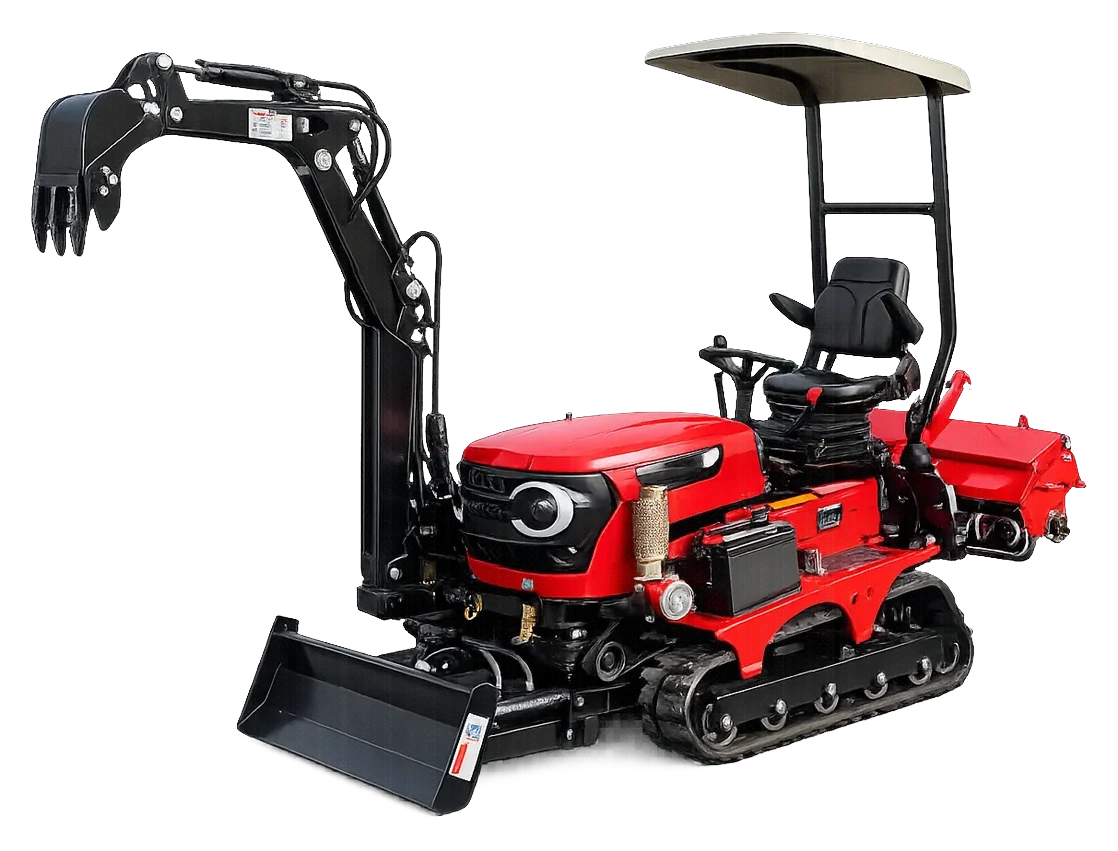
A tracked tractor moves on a continuous track belt instead of wheels. Compact models designed for vineyard and orchard work are also called tracked orchard tractors, or simply orchard tractors. This simple difference sets the two machines apart in many ways, from traction to soil compaction and from stability on slopes to road use. Which one is right for you depends on your land and your work.
In this guide we explain how a tracked tractor works, how it differs from a wheeled one, its advantages and, honestly, its disadvantages; at the end we give you a list of questions to make your decision easier.
How does a tracked tractor work?
On a tracked tractor, the engine’s power is transmitted to the track through the drive sprocket. The track turns like a closed belt running over the rollers, and the machine moves forward on this belt. Track tension is adjusted with a tensioning mechanism.
As an example, the QD35’s track system has 1 drive sprocket, 5 rollers, 1 top roller and 1 tensioner. The drive sprocket turns the track; the rollers underneath distribute the machine’s weight over the track; the top roller stops the track from sagging; and the tensioner keeps the track at the correct tension.
Steering also works differently from a wheeled tractor: on tracked machines, turning is usually achieved by changing the speed of the two tracks relative to each other. The QD35 manages this with a steering-wheel layout, so the operator works with controls close to the tractor logic they are used to.
Why does track tension matter so much?
A tracked machine’s undercarriage lasts a long time as long as it runs at the correct tension. A slack track can come off, especially on side slopes and in sharp turns, while an over-tightened track puts unnecessary load on the rollers, drive sprocket and tensioning mechanism and wears them out early. The correct tension value and the way to measure it are given in the operator’s manual. Soil packed into the track after working in mud also increases the tension, so the adjustment should be checked after the undercarriage has been cleaned.
Tracked vs wheeled tractors: the differences
The strengths and weaknesses of the two designs are almost mirror images of each other:
| Feature | Tracked tractor | Wheeled tractor |
|---|---|---|
| Traction in mud and loose soil | ✅ Strong; the load is spread over a large area | Wheels can slip |
| Ground pressure, soil compaction | ✅ Lower | Higher in the wheel ruts |
| Stability on slopes | ✅ Low body, large contact area | Varies by model |
| Narrow rows, under low branches | ✅ Narrow, low-bodied models available | Usually wider and taller |
| Road speed and long distances | Low; asphalt wears the tracks | ✅ Fast and comfortable |
| Turning on hard ground | Can scuff the surface and leave marks | ✅ Gentler on the surface |
| Undercarriage maintenance | Tracks, rollers, sprocket and tensioner to monitor | Tyres, rims and front axle to monitor |
| Ride comfort | Vibration is more noticeable | ✅ Usually more comfortable |
The table shows general trends; even within the same class, models differ. When deciding, look at which row matters most on your own land.
One more point: engine power alone doesn’t determine how much work gets done. On soft soil, part of a wheeled tractor’s power is lost to wheel slip, whereas tracks transfer the same power to the ground more efficiently. On hard, dry ground this difference shrinks and the wheeled tractor’s speed comes to the fore. So before comparing horsepower, ask what kind of ground the machine will mostly be working on.
Ground pressure and soil compaction
The least talked-about but, for farming, most important advantage of tracks is that they spread the machine’s weight over a larger area. A machine of the same weight puts less pressure on the soil when it sits on a wide track than on a narrow wheel footprint.
Why does this matter? In compacted soil, water and air move less easily, roots struggle to grow deep and rainwater ponds on the surface. Wheel ruts driven over again and again, especially on wet soil, can leave compacted bands whose effects last a long time.
Let’s be honest — tracks don’t eliminate soil compaction altogether. Whatever machine you take onto very wet soil, the soil structure will suffer. The advantage of tracks is that they do the same job with less damage; waiting until the soil is in a workable condition is still the best course.
There’s a practical way to tell whether the soil is workable: take a handful of soil from the depth you will be working and squeeze it. If it sticks to your fingers, smears and can be stretched into a long ribbon, it is still too wet. If it forms a ball that crumbles at a light touch, it is ready to work. This simple test protects both your soil and your machine from unnecessary strain.
Advantages of a tracked tractor: traction, mud and slopes
When a wheeled tractor loses traction in loose or muddy soil, it slips: the wheel spins but the machine doesn’t move forward, and it digs into the soil and leaves a hole. Tracks, by contrast, grip the ground over a much larger area, so they keep moving in these conditions. Being able to keep work on schedule in a wet season is, for most farmers, the most tangible benefit of tracks.
This advantage is felt on sloping ground too: the large contact area and low body make the machine more stable. But no machine is immune to rolling over. Which direction to work in on a slope, and when not to start work at all, is a separate topic; we cover it in detail in our guide to muddy and sloping ground.
Tight spaces: vineyards, orchards, greenhouses and nurseries
Many tracked tractors are designed for places that large tractors can’t get into. The QD35’s machine dimensions are 3,100 × 980 × 1,150 mm: a width just under one metre makes it easier to get into narrow rows, and its low body makes it easier to work under the branches of fruit trees.
The point to watch here is to judge the row spacing not just against the machine’s body but against the attachment width and the safety margin to be left on both sides. Also, the machine height doesn’t tell you how high the operator sits; measure your branch height against the operator’s head and the protective frame, if fitted.
Before you decide on a machine, take these measurements on your land:
- Narrowest row spacing: Measure the narrowest point, not the average; the machine has to get through there too.
- Lowest branch height: Go by the situation before pruning; branches droop during the season.
- Headland turning space: Is there room at the end of each row for the machine and attachment to turn comfortably? With a tracked machine, a tight turning area means manoeuvring by scuffing the soil.
- Entrances and crossings: The width and load capacity of points such as the orchard gate, bridges and irrigation channel crossings.
We explain season by season which jobs are done with the QD35 in vineyards and orchards, and when, in our guide to vineyard and orchard work with the QD35.
The honest disadvantages
- Road speed and distance: A tracked tractor isn’t designed for long road journeys. The QD35’s speed is 15 km/h, which costs time over long distances between fields. Confirm with the relevant authorities, under current regulations, the conditions in which the machine may be used on public roads; over long distances, moving it on a trailer is usually more practical.
- Asphalt and concrete: Travelling on hard surfaces for long periods wears the tracks, and turns can leave marks on the surface.
- Scuffing the soil when turning: Tracked machines can scrape off the top layer of soil in sharp turns. On grass, delicate vegetation or newly sown ground, make wide, gentle turns.
- Vibration and comfort: On long working days it can be more tiring than a wheeled tractor; plan your breaks accordingly.
- Undercarriage maintenance: The tracks, rollers, drive sprocket and tensioner need regular checks. We list these checks as daily, weekly and seasonal tasks in our tracked tractor maintenance checklist.
A concrete example: the QD35
To put these differences into concrete terms, let’s look at the key figures for the QD35 we sell at EKSFORK:
- Engine: 35 HP, Quanchai–Changzhou, single-cylinder, water-cooled diesel; 2,200 rpm
- Transmission: Fully geared mechanical, dual-clutch special gearbox; 3 forward + 1 reverse, 8 speeds in total with the high/low range
- Weight and frame: 750 kg; reinforced T3 steel frame
- Fuel: 16-litre tank; consumption of 1–2 litres per decare
- Work rate: About 2 decares per hour; belt-driven
Example (work it out for your own land): If you are going to work a 10-decare orchard with a rotavator, at about 2 decares per hour the job takes roughly 5 hours, and at 1–2 litres per decare it uses 10–20 litres of fuel. On light soil the 16-litre tank may be enough for the whole job; on heavy soil, consumption will approach the upper limit, so plan to refuel once in the middle of the day.
The QD35 starts at 249.000 ₺ + VAT, and the version with the rear excavator arm at 349.000 ₺ + VAT. You can find all the technical specifications on the QD35 product page.
Here’s an honest assessment: a compact tracked tractor like the QD35 is strong in vineyards, orchards, nurseries, around greenhouses and in small fields — in other words, in work where tight spaces and soft ground are the deciding factors. On the other hand, for long days of ploughing in large, flat cereal fields, or for a farm that needs long road journeys every day, a larger wheeled tractor is usually the better choice.
Tracked or wheeled? Questions to help you decide
- How often is your land wet or muddy? If the soil is soft for much of the season, tracks come out ahead.
- Do you have sloping sections? The steeper the slope, the greater the advantage of a low body with a wide contact area; even so, apply the rules for working on slopes rigorously.
- What are your row spacing and branch height? In narrow, low spaces a compact tracked machine works much more comfortably.
- How far apart are your fields? If you will be driving many kilometres every day, a wheeled tractor may be more practical.
- Which attachments will you use? Check whether compatible attachments are available for jobs such as rotavating, ploughing, trenching and trailer work.
- Do you have digging work too? If jobs such as irrigation channels, planting holes for saplings or drainage come up, consider the version with the excavator arm.
- Who will operate the machine? A tracked tractor behaves differently from a wheeled one when turning and on slopes, and getting used to it takes a little time. At EKSFORK, basic operator training is given on delivery; we recommend that the person who will operate the machine attends this training in person.
If you’re torn between digging and farming, our guide Excavator or Tractor? looks at this decision in detail. And we go through the attachments suitable for a tracked tractor one by one in our tracked tractor attachments guide.
Summary
- A tracked tractor spreads its weight over a large area: strong traction in mud, low pressure on the soil
- On slopes and in tight spaces, a low, compact body is an advantage
- Its weak points are road speed, wear on asphalt and scuffing the ground when turning
- Tracks, rollers, sprocket and tensioner need regular checks
- Base the decision on how wet your land is, its slope, the row spacing and the road distances
You can browse the models in the tracked tractor category, or describe your land and ask us on WhatsApp which model would suit it.