Shopping centres, supermarkets and hospitals may seem like three different worlds, but when it comes to floor cleaning they share the same three problems: the floor is never empty, there is zero tolerance for slip accidents, and cleaning happens in full view of everyone. A cleaning plan that works in a warehouse or factory often can’t be applied as it is in these places.
Machine cleaning is a powerful tool for these places: the floor behind the machine dries quickly, there are no cables on the floor and no exhaust because the machine runs on batteries, and the result is the same quality every day. But you need to use the right machine at the right time, with the right rules.
In this guide we first cover the rules common to all three places, and then the points specific to each. At the end you will find a table showing which type of machine suits which area, and a checklist for operators.
Rules common to all three places
Whatever building you work in, machine cleaning in an area where people are present has four basic rules:
- A wet floor is always signposted. Even though the floor behind the machine dries quickly, the area under the brush, the turning points and the tank filling spot are wet. Warning signs go in front of and behind the strip the machine is working on.
- The machine gives way to people. In crowds the machine slows down or stops; at blind corners, shop entrances and in front of lifts the operator looks first, then moves on.
- No cables, no exhaust. Battery-powered machines remove these two risks from the outset. Charging is done in a technical area the public doesn’t pass through.
- Noise is planned around the time of day. For example, the K1’s catalogue noise level is 72 dB. That may not be a problem for short spot cleaning during the day, but for a patient-room corridor or a quiet shop the choice of time matters.
Know when to remove the sign too: look at the floor from the side, against the light. If you see shiny wet patches or thin water lines, the floor isn’t dry yet. If drying regularly takes a long time, the problem is usually too much water or a worn squeegee blade; the fix is to remove the cause, not to take the sign away early.
Shopping centre floor cleaning: wide concourses, busy entrances
In a shopping centre the floor is a collection of zones with different needs. Trying to deal with them all with a single machine at a single time usually means either not getting the wide concourses done or leaving the entrances dirty.
Main concourses
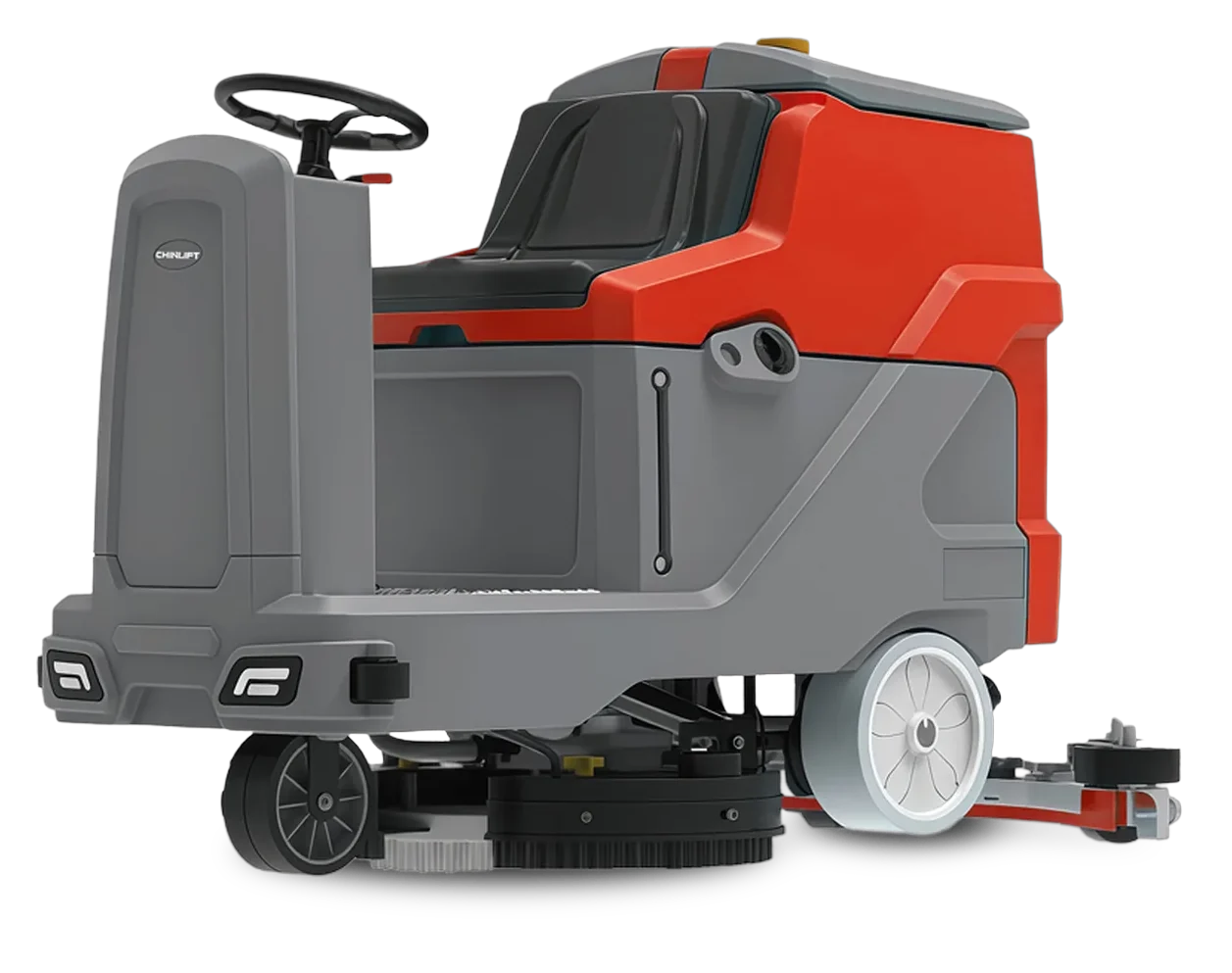
Wide, open concourses are ride-on territory. A full clean is done after closing, when the shops have emptied. The HY660, with twin brushes and a 660 mm cleaning width, and the KL860, with an 860 mm brush and a 1,200 mm squeegee, are suited to this kind of area.
Don’t forget to coordinate with shop tenants for night cleaning. A stand, table or box of products put out in front of a shop after closing cuts across the machine’s path and stops the operator every time. Telling tenants in advance at what time shopfronts must be clear is the cheapest way to shorten night cleaning.
Entrances and the food court
On rainy days entrances bring in mud and water within minutes; in the food court, grease, sauce and drink stains form all day long. These zones can’t wait for the night clean. During the day, short spot passes are made with a compact walk-behind machine, and entrance mats are changed regularly. For greasy dirt in the food court, choose a low-foam product suitable for machines.
Car parks and moving between floors
In an indoor car park the first step is usually sweeping, followed by scrubbing if needed; we explain the details in our car park and outdoor areas guide. When moving the machine between floors, use the goods lift and check its capacity: the K1 and K2 weigh 145 kg, the KL860 390 kg. Machines are never carried on escalators.
Supermarkets: rack aisles, spilt products and chilled aisles
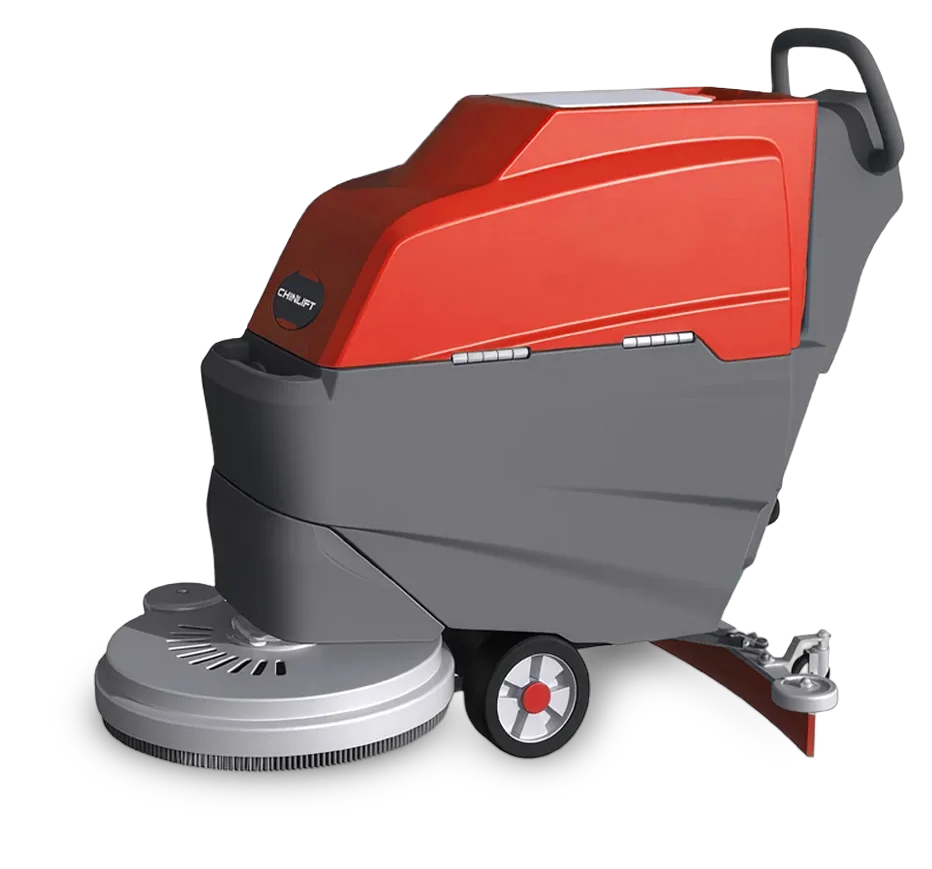
In a supermarket the floor is divided into narrow rack aisles, and the biggest obstacle is usually not the width but the promotional stands and pallets in the aisles. Measure the narrowest point before choosing a machine. The catalogue dimensions are 995 × 550 × 1,165 mm for the K1 and 1,300 × 620 × 1,060 mm for the K2; the K2’s twin swivel wheels make manoeuvring easier in tight spots.
- Timing: A full clean is done before opening or after closing. During the day only spills and entrances are cleaned.
- Broken products: Solid pieces and any broken glass are picked up first by hand or with a broom. Glass cuts the squeegee blade and can block the suction hose; only then is the machine used.
- In front of chilled cabinets: Condensation can collect in front of cabinet doors. These zones are checked at short intervals during the day; a wet spot is the most slippery place in the supermarket.
- Checkouts and entrance: These are the first places mud reaches in wet weather. The better the entrance mat works, the easier the cleaning inside becomes.
- Back-of-store warehouse: Pallet truck and forklift wheel marks build up here; this area is cleaned with a different brush or pad from the sales floor, so warehouse dirt isn’t carried into the aisles.
Hospitals: hygiene protocol first, then the machine
In a hospital, cleaning is governed not by the machine but by the protocol. The hospital’s infection control team decides which area is cleaned how often, with which product and in which order. The machine follows this protocol; the protocol isn’t changed to suit the machine.
- Work from clean to dirty: The general principle is to start in clean areas and move towards higher-risk areas. This order stops the machine carrying dirt from one zone to another.
- Zone-specific brushes and pads: Many hospitals use a colour-coded system. The same pad is not used in areas with different risk levels.
- Critical areas: Whether and how a machine is used in operating theatres, intensive care and isolation areas depends entirely on the protocol; dedicated equipment is often used for these areas.
- Disinfectant compatibility: Confirm with the supplier that the disinfectant you will use is compatible with the machine’s tank, seals and hoses. Don’t combine disinfectant and detergent in the same tank.
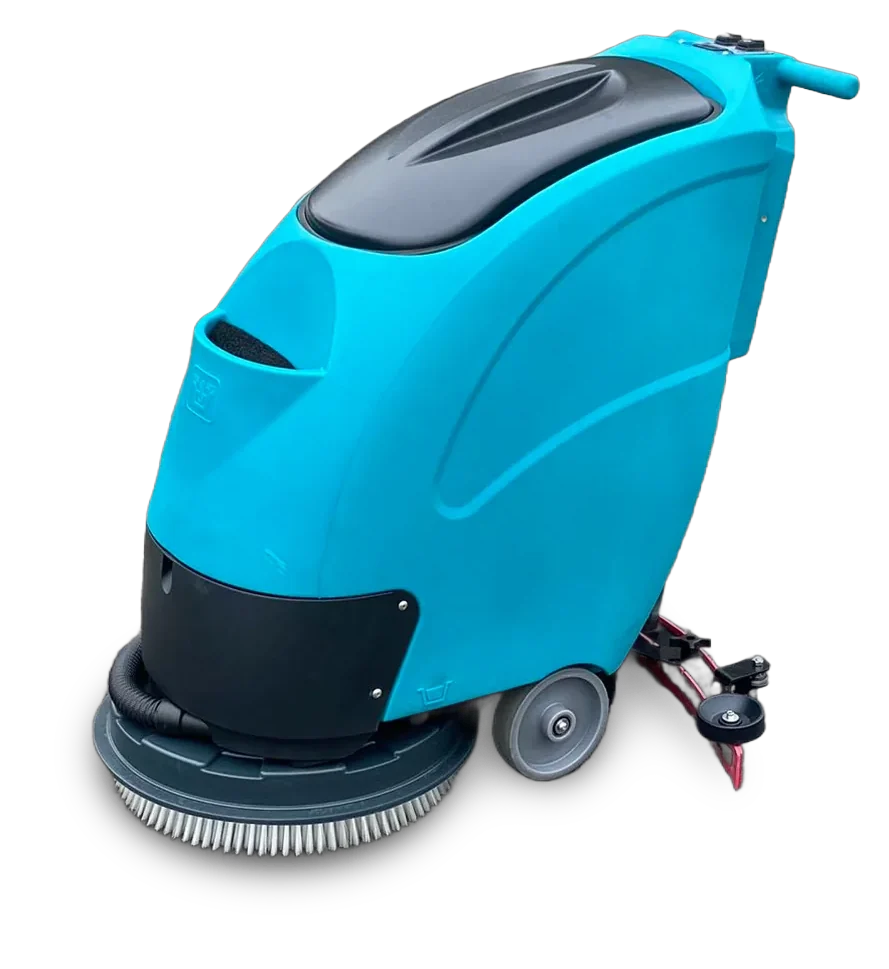
- Quiet: In corridors near patient rooms, set the cleaning time together with the hospital management. A compact and relatively quiet walk-behind machine is better suited to cleaning corridors at night. The K1 walk-behind floor scrubber, with its 72 dB noise level, lithium battery and 3–4 hours of run time, is worth considering for this kind of area.
Split the corridor in two. A hospital corridor is never without people using walking sticks, walking frames or wheelchairs, or without stretchers. Instead of wetting the whole corridor at once, clean one half first and leave the other half dry for people to pass; once the first half is dry, switch sides. This method makes cleaning take a little longer but noticeably reduces the slip risk and disruption to patient traffic.
We explain the difference between detergent and disinfectant, and how to calculate the dose, in our detergent selection guide. The choice of disinfectant, however, always depends on the hospital’s own protocol.
Which machine for which area?
The table below is a starting point; for a definite choice, assess your area’s dimensions and your time window together.
| Area | Suitable machine type | Typical time | Watch out for |
|---|---|---|---|
| Shopping centre main concourse | Ride-on (HY660, KL860) | After closing | Goods lift capacity, charging location |
| Shopping centre entrance, food court | Walk-behind (K1, K2) | Spot cleaning during the day | Warning signs, low-foam product |
| Supermarket rack aisles | Walk-behind (K1, K2) | Before opening, after closing | Narrowest aisle, stands |
| Supermarket back-of-store warehouse | Walk-behind or ride-on | Between deliveries | Separate brush or pad |
| Hospital corridor | Walk-behind, compact | According to protocol | Zone separation, quiet |
| Indoor car park | Sweeper (S1), scrubbing if needed | Quietest traffic hours | Ramp gradient; the S1’s climbing capacity is 25% |
We show the capacity calculation by area size step by step in our m²/h calculation guide.
Day or night? Setting the time window
Cleaning in these places is planned in three layers: immediate response during the day, a full daily clean and a weekly heavy clean. Below is a sample daily routine for a shopping centre; adapt the times to your own opening hours:
- Before opening: Entrances, the food court and the areas in front of toilets get a quick pass with a compact machine.
- Throughout the day: Spills and wet-weather call-outs are handled; the operator can be called by radio or phone.
- After closing: The main concourses are cleaned with a ride-on machine, and shopfronts and narrow passages with a walk-behind.
- Once a week: Heavy cleaning with a double pass is done in high-traffic zones.
- At the end of every shift: The machines are emptied, cleaned and put on charge.
Battery run time sets the limit of this plan: the catalogue gives run times of 2–3 hours for the K2, 3–4 hours for the K1, 3–5 hours for the HY660 and 4–5 hours for the KL860. If night cleaning takes longer than this, divide the work into zones or arrange the charging routine accordingly; we explain the difference between battery types in our lithium and gel battery guide.
Operator checklist
An operator working in a public area has more to watch out for than an operator in a warehouse. Start every shift with this list:
- Are the warning signs with the machine?
- Is the clean water tank filled with solution at the right dose, and is the dirty water tank empty?
- Is the squeegee blade intact, and does the brush or pad belong to this zone?
- Is the battery charge enough for the planned work?
- Are the blind corners, lift lobbies and shop entrances in the work zone known?
- Has the facility designated where the dirty water is to be emptied?
- When parked, is the machine switched off and left somewhere safe from being started by unauthorised people?
The basic operating training we provide on delivery covers the machine itself; the site-specific rules are something you need to embed in your team with this list.
The machine’s own hygiene
In a busy building, a smelly machine draws more attention than the cleaning itself. The smell usually comes from water left standing in the dirty water tank. After every use, empty the dirty water tank, rinse it and leave the lid open to dry. Wipe the squeegee, and wash the brushes and pads and leave them to dry. In hospitals, the disinfection required by the protocol is added to these steps. We describe the full daily and weekly maintenance in our maintenance guide.
Summary
- The rule common to all three places: wet floors are signposted, the machine gives way to people, and noise is planned around the time of day.
- In shopping centres, the main concourse is cleaned at night with a ride-on machine, and entrances and the food court during the day with a walk-behind.
- In supermarkets, measure the narrowest point; glass and solid pieces are picked up before the machine goes through.
- In hospitals the protocol decides; zone-specific pads and disinfectant compatibility are essential.
- The machine mustn’t smell: the dirty water tank is emptied and dried after every use.
For tight spaces, take a look at the K2 walk-behind floor scrubber, which comes with a water level indicator, a wide filling opening and a side-access clean water filter. For the right combination of machines for your premises and current prices, message us on WhatsApp.