When buying a floor cleaning machine, everyone looks at the same figure: m²/h. When the catalogue says 2,400, 3,760 or 6,950 m²/h, the calculation looks easy: divide the area by that number and you have the time. But on site this calculation almost never works out, because the catalogue figure knows nothing about turns, racks, refilling water or charging the battery.
In this guide we give you a simple method for converting catalogue output into real output on site. We explain how to choose the right class on paper by taking your area, your time window and the machine’s battery and tank limits into account together, and we make the method concrete with three worked examples.
If you are curious how the machine works with water, brushes and vacuum, you can first take a look at our guide to how it works; this article focuses directly on the capacity calculation.
Where does the catalogue m²/h figure come from?
Catalogue output is usually a theoretical value: the cleaning width multiplied by the ideal working speed. It assumes the machine moves in a straight line without ever stopping or turning.
Example: A machine that cleans a 0.5-metre width and moves at 4 km (4,000 metres) per hour theoretically cleans 0.5 × 4,000 = 2,000 m²/h. The figures are illustrative, chosen to show the method.
This value is useful for comparing two machines under the same conditions, but on its own it isn’t enough for planning. Also, whether the width is taken from the brush or the squeegee can vary from manufacturer to manufacturer, so be careful when comparing catalogues from different sources directly.
From theoretical to practical output: where are the losses?
The items that reduce output on site are the same in every area; only their weight changes:
- Strip overlap: So that no dirty strip is left in between, each pass overlaps the previous one slightly; the effective width is less than the catalogue width.
- Turns: At the end of every aisle the machine slows down, turns and lines up again. Short aisles mean lots of turns.
- Obstacles: Work is slower around rack legs, columns, furniture, stands and stacks of pallets.
- The water cycle: Going back and forth to the water point to fill the clean tank and empty the dirty tank takes time.
- Soil level: Heavy soiling means slowing down or making a double pass.
- Areas finished by hand: Spots the machine can’t get into, such as corners, wall bases and under racks, take extra time.
The way to express these losses as a single number is the efficiency factor:
Practical output = Catalogue output × Efficiency factor
You measure the factor most accurately in your own area: work with the machine for an hour in a typical zone and calculate the m² actually cleaned. Until you have measured it, you can assume a higher factor for open areas and a lower one for racked and furnished areas, as in the examples below; but remember that this is an estimate.
How to run a one-hour trial
- Choose a zone that represents your area: neither the emptiest hall nor the most cramped corner.
- Note the start time and work at a normal pace with the normal water setting; don’t rush for the trial.
- If you need to fill or empty a tank during this time, include that in the time; it will happen in real life too.
- At the end of the hour, measure the zone cleaned and work out its area in m².
- Divide this value by the machine’s catalogue output: the resulting ratio is your efficiency factor.
If you have areas of different character (such as an open hall and rack aisles), run a separate trial for each; a single average factor can throw the plan off. If you don’t have a machine yet, build the plan with an example factor and confirm it with this trial in the first week after delivery.
Step-by-step capacity calculation
- Measure the net area. Count the floor that will actually be cleaned, not the area under racks and machines. Use the floor plan if you have one; if not, measure the aisles one by one.
- Set the time window. How many hours a day can the machine work? For example, after the shop closes, between shifts or before opening in the morning.
- Find the practical output you need: Area (m²) / Time (hours).
- Convert it to the catalogue equivalent: Required practical output / Efficiency factor.
- Compare with the models and leave some margin; areas grow over time and soil levels change with the seasons.
- Check the battery run time: Does the run time cover your time window?
- Check the tank cycle: How much area does one tank clean, and how many fills does the job need?
- Check the physical limits: Aisle width, doors, lifts, ramps and where the machine will be kept.
Catalogue values of the models
The values to use in your calculation are below. The output column shows catalogue values; multiply them by your own factor to convert them to practical values.
| Model | Type | Catalogue output | Cleaning width | Clean water tank | Run time | Weight |
|---|---|---|---|---|---|---|
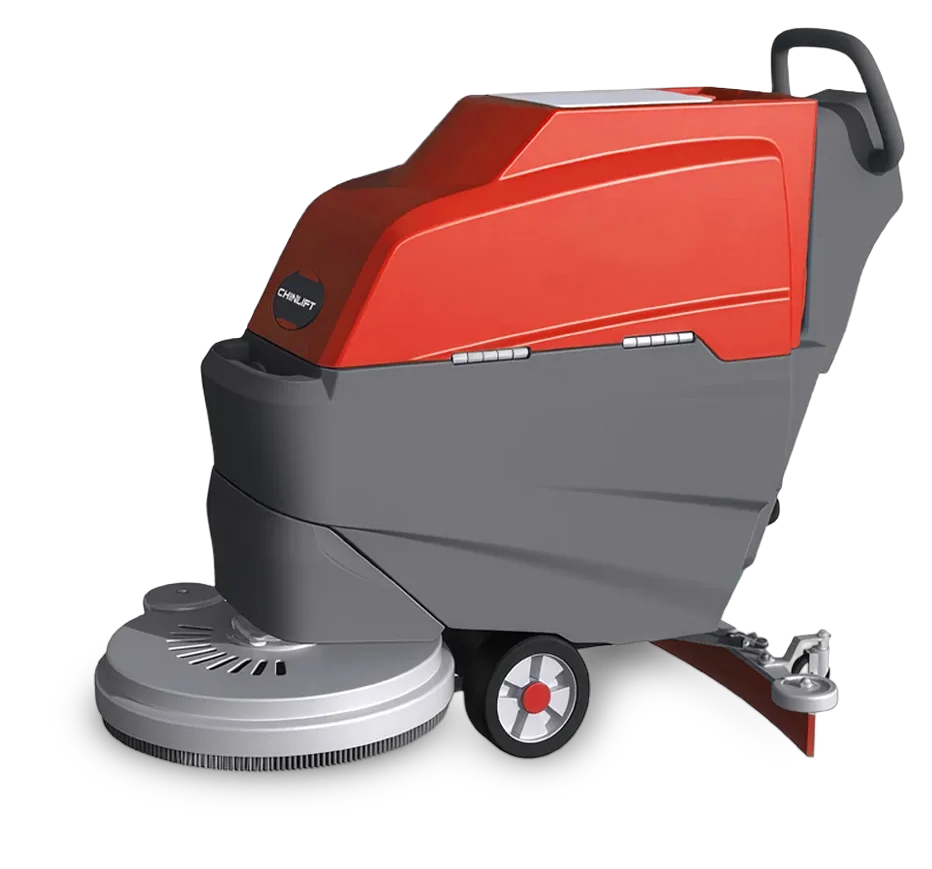
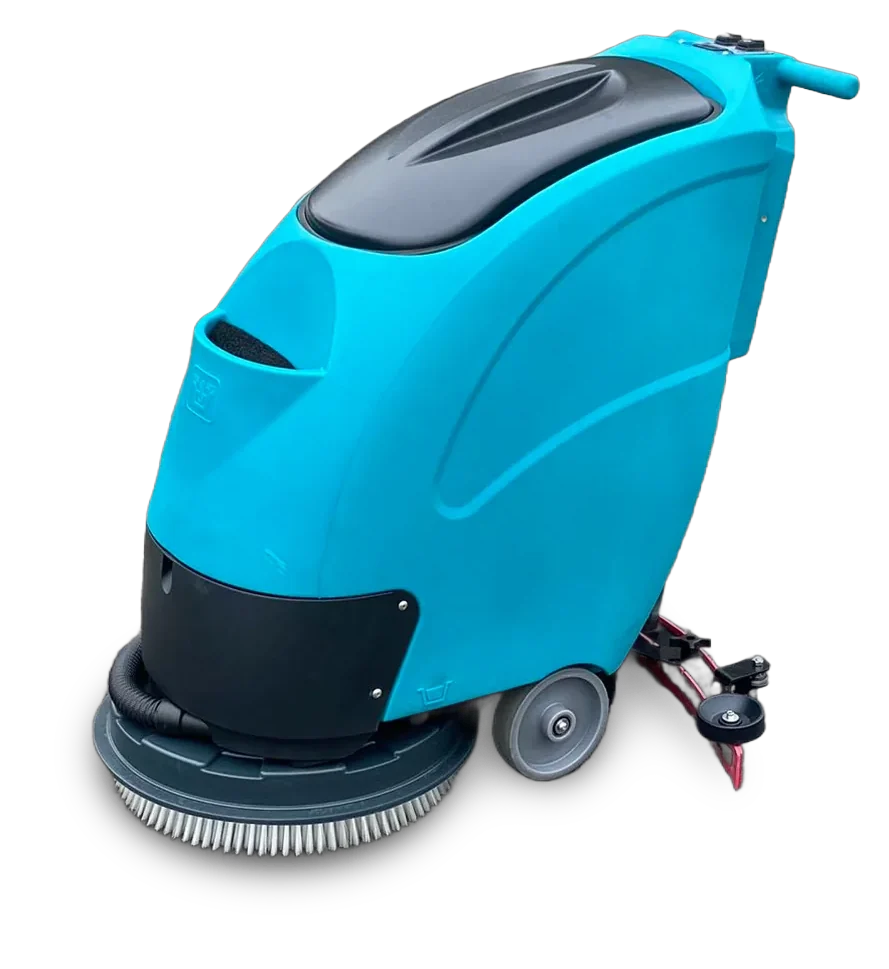
| K2 | Walk-behind | 2,400 m²/h | 510 mm brush | 55 L | 2–3 h | 145 kg |
| K1 | Walk-behind | 3,760 m²/h | 510 mm brush | 40 L | 3–4 h | 145 kg |
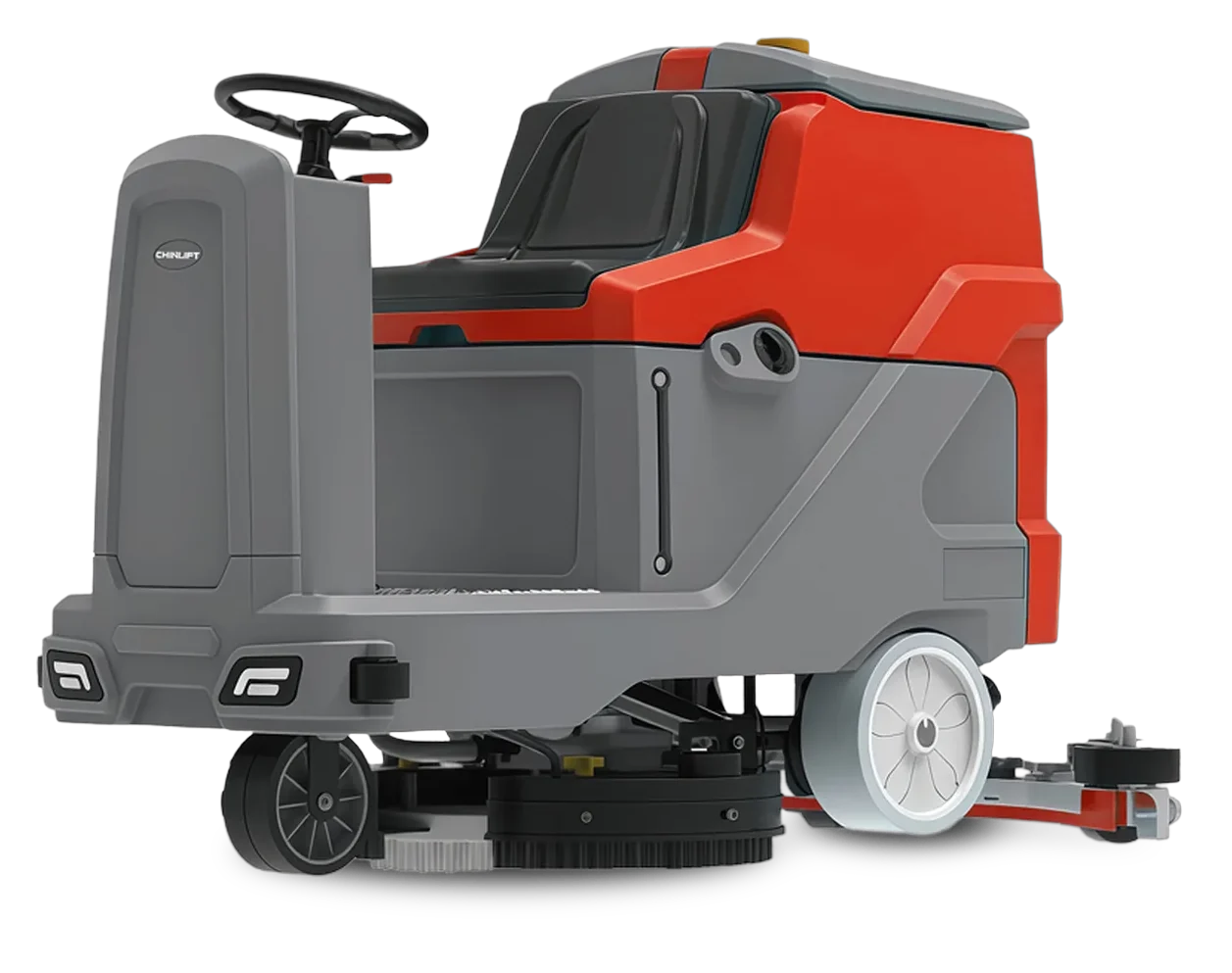
| KL860 | Ride-on | 5,600 m²/h | 860 mm brush | 155 L | 4–5 h | 390 kg |
| HY660 | Ride-on, twin brush | At least 6,950 m²/h | 660 mm | 90 L | 3–5 h | Not in the catalogue |
When looking at the table, bear in mind that catalogue output comes not only from width but also from the machine’s working speed. As with the HY660 and KL860, a machine that cleans a narrower width can show a higher catalogue output. So don’t compare on m²/h alone, but together with width, tank volume and run time; the definitive result still comes from a trial in your own area. For sweeping, the S1’s catalogue output is 6,300 m²/h, but sweeping and scrubbing are different jobs and are not compared in the same calculation.
Three worked examples
In the examples below, the areas, time windows and efficiency factors are purely illustrative; they were chosen so that you can see the method. Calculate with your own values.
Example 1: 1,500 m² supermarket, 1.5 hours after closing
Since it is a racked area, let’s take an example factor of 0.5. Required practical output: 1,500 / 1.5 = 1,000 m²/h. Catalogue equivalent: 1,000 / 0.5 = 2,000 m²/h. The K2 (2,400) meets this need with a small margin, the K1 (3,760) with a comfortable one. Both models also run for longer than 1.5 hours. Because the rack aisles are narrow, a walk-behind machine is more practical here than a ride-on.
When choosing between the K1 and K2, don’t look at output alone: the K2’s clean water tank holds 55 L, the K1’s 40 L. If your trial shows that one tank isn’t enough for 1,500 m², you will have to refill in the middle of the job, and that can eat up part of the output margin. The right answer comes from calculating both values together.
Example 2: 8,000 m² warehouse, 3 hours a day
Since the aisles are wide and straight, let’s take an example factor of 0.6. Required practical output: 8,000 / 3 = approximately 2,670 m²/h. Catalogue equivalent: 2,670 / 0.6 = approximately 4,450 m²/h. The K1’s 3,760 m²/h isn’t enough; the KL860 (5,600) or the HY660 ride-on floor scrubber is the class for this area. The KL860’s 155 L clean water tank means fewer trips to the water point, and the run times also cover the 3-hour window.
Example 3: 20,000 m² factory, 4 hours between shifts
Let the example factor again be 0.6. Required practical output: 20,000 / 4 = 5,000 m²/h. Catalogue equivalent: 5,000 / 0.6 = approximately 8,330 m²/h. That is a figure no machine in the table can meet on its own. To be honest — the right answer here isn’t to look for a bigger machine but to change the plan: either you split the zones between two machines, or you clean each zone on rotation according to how dirty it gets rather than every day — for example, high-traffic aisles every day and little-used zones a few times a week.
Battery and tank: two hidden factors that limit output
A machine with a high catalogue output can’t finish the job if its battery run time is shorter than your time window. The catalogue run times are 2–3 hours for the K2, 3–4 hours for the K1, 3–5 hours for the HY660 and 4–5 hours for the KL860. If your time window is longer than this, you will either need to split the job over two days or arrange the charging routine accordingly. We explain how battery type changes charging habits in our lithium and gel battery guide.
On the tank side, the calculation is:
Area cleaned per tank = Clean water tank (L) / Water consumption per m² (L/m²)
Water consumption per m² varies with the water flow setting and the floor, so you won’t find a single value in the catalogue. It is easy to measure: fill the tank, clean a measured area at your normal setting, read off the remaining water and divide the water used by the area. Divide the total area by this value and you know how many fills the job needs. If the water point and drain are far from the area being cleaned, each fill costs more; a machine with a large tank becomes even more valuable in that case.
The shape of the area matters as much as the square metres
Two areas with the same square metres can need completely different machines. An open warehouse hall suits a ride-on machine, while a shop of the same size divided by narrow rack aisles can be cleaned faster with a walk-behind. Dimensions and weight are part of this decision:
- K1: 995 × 550 × 1,165 mm, 145 kg. Compact for narrow aisles and doors.
- K2: 1,300 × 620 × 1,060 mm, 145 kg. Bigger tanks, a slightly longer body.
- KL860: 1,665 × 1,150 × 1,350 mm, 390 kg; maximum climbing angle 18°. In areas with ramps, compare the slope with this value and the operating conditions in the manual.
If you will move the machine between floors, check the lift’s load capacity and car dimensions, and make sure the place where the machine will be kept has a socket for charging and a dry area. We cover how to plan the time window in areas where people are present, such as shopping centres, supermarkets and hospitals, in a separate guide.
A bigger machine isn’t always better
When the calculation points to a class, it is tempting to say “let’s go one size up, just in case”. But a big machine has its price too: it can’t get into tight spaces, needs more storage space and is harder to move between floors and sites. Often the better solution is a mixed fleet: a ride-on for wide halls and a walk-behind for rack aisles and small rooms. If you want to calculate the payback on a machine investment, see our payback calculation guide.
Quick checklist
Prepare the following information before asking for a quote; we will identify the right model much faster:
- Net area to be cleaned (m²) and a floor plan if you have one
- The time window set aside for daily cleaning
- Dimensions of the narrowest aisle, door and lift
- Floor type and typical kind of dirt (dust, oil, mud, tyre marks)
- Water point and drain location
- Whether there are ramps or sloping areas
- Where the machine will be kept and charged
With this information you can compare the floor cleaning machines using your own factor. To do the calculation together and find out current prices, send us your area measurements on WhatsApp.