For a cleaning company, a floor cleaning machine isn’t an expense but an investment that has to pay for itself. In cleaning services, labour usually makes up most of the cost; a machine makes it possible to clean the same area with fewer labour hours, or to take on more area with the same team. But whether that gain really materialises depends on the calculation done before buying.
Two flawed attitudes are often heard in the sector: the optimism of “if we buy a machine, everything speeds up” and the pessimism of “we can’t afford that much money”. Both are conclusions reached without doing the sums. In this guide we give you a step-by-step method for calculating the payback period by plugging in your own figures.
Wherever possible we build the calculation on labour hours rather than money, because wages, prices and contract values vary by region and over time, whereas labour hours can be measured from every business’s own records.
Machine investment for cleaning companies: the payback comes from three sources
The value a machine brings you comes from three separate sources, and they should be kept separate in the calculation:
- Labour hour savings: Cleaning the area in your existing contracts with fewer labour hours. This is the easiest gain to measure and the most reliable.
- Increased capacity: Taking on new contracts with the same team. Valuable, but it depends on you finding the new work, so it should be calculated cautiously.
- Quality and consistency: The floor drying quickly, the same result every day and fewer complaints. This helps you keep the contract, but it is hard to measure in money.
To be honest — a sound investment decision should make sense on the first item alone. Increased capacity and quality should be seen as added value on top of the calculation; basing the investment solely on the assumption that “new work will come” is risky.
Step 1: Measure the current situation
A calculation without measurement is no more than a guess. For the contracts where you are thinking of using a machine, record the following for two weeks:
- The net area cleaned at each site (m²) and the cleaning frequency
- The total labour hours spent on each clean (how many people, how many hours)
- The time spent on parts the machine can’t get into, such as edges, corners and stairs
- Time spent filling water, carrying equipment and preparing
If possible, take the measurements during a representative period. In rainy, muddy months cleaning the same area takes longer; measurements taken only in a dry period can paint a different picture from the year as a whole.
Calculate your current productivity from these records:
Current productivity (m²/labour hour) = Area cleaned / Labour hours spent
We look in detail at the productivity difference between mop and machine, and where it comes from, in our staff productivity guide.
Step 2: Calculate how long the same job takes by machine
For the machine time, don’t use the m²/h figure in the catalogue directly; because of turns, obstacles and the water cycle, output on site is lower. Multiply the catalogue value by your own efficiency factor; we explain this method with examples in our m²/h calculation guide.
Machine time = (Area / Practical output) + Preparation + End-of-day maintenance + Transport + Areas finished by hand
The extra items in the formula are often forgotten. A machine needs a few minutes of maintenance every day, such as emptying the tanks and cleaning the squeegee and filter; if it is moved between sites, loading and set-up time is added too. Edges and corners are still finished by hand. A calculation that leaves these items out makes the saving look bigger than it is.
Step 3: List the cost items
The cost of a machine isn’t just its purchase price. Fill in the table below with your own figures:
| Item | Type | How is it calculated? |
|---|---|---|
| Machine price | One-off | The quote you received |
| Financing cost | Monthly | Instalment surcharge or loan cost according to the payment plan you choose |
| Brushes, pads, squeegee blades | Monthly | Your replacement frequency record × part price |
| Cleaning chemicals | Monthly | Chemical cost per m² × m² per month |
| Electricity | Monthly | Charger power (kW) × charging time (hours) × charges per month × unit price of electricity |
| Maintenance and service | Yearly | Periodic maintenance quotes and spare parts |
| Battery replacement provision | Monthly reserve | Battery price / expected battery life (months) |
| Transport | Monthly | Vehicle, ramp, securing equipment and travel time |
| Operator training | One-off | Unproductive labour hours during training |
We explain how to calculate chemical costs per m² in our detergent selection guide, and the differences in life and cost between battery types in our lithium and gel battery guide. Setting aside the battery replacement provision as a separate item stops a large expense a few years down the line from shaking your cash flow.
Step 4: Calculate the payback period
Combine the data you have in two formulas:
Monthly net contribution = (Labour hours saved × Your cost per labour hour) + Gross profit from extra contracts − Monthly running costs
Payback period (months) = (Machine price + One-off costs) / Monthly net contribution
When calculating your cost per labour hour, include not just net wages but all the costs borne by the employer, plus extras such as travel and meals; ask your accountant for this figure.
Worked example
The figures below are purely illustrative; they were chosen to show the method, so plug in your own measurements.
- Contract: 6,000 m² of warehouse floor, cleaned 26 days a month.
- Current method: 3 people working 3 hours each a day; 9 labour hours a day.
- Machine method: one operator cleans the main area with a ride-on machine in 2 hours, and one person cleans the edges and corners in 2 hours; including end-of-day maintenance, around 4.5 labour hours a day.
- Daily saving: 9 − 4.5 = 4.5 labour hours. Monthly saving: 4.5 × 26 = 117 labour hours.
Multiply these 117 labour hours by your own cost per labour hour to find the gross monthly saving. Subtract the monthly running costs from the table; what remains is the monthly net contribution. Divide the machine price and one-off costs by this amount and you have the payback period in months.
For the 117 labour hours saved in the example to turn into a real gain, those hours need to be put to use elsewhere: a new contract, less overtime, or time the team can spend on detail cleaning. If the hours saved sit idle, the calculation stays on paper.
Cash flow: compare the instalment with the monthly contribution
There is another question as important as the payback period: does the machine cover its own instalments while it is being paid off? If you buy on instalments, compare the monthly instalment with the monthly net contribution you calculated above; in this case don’t deduct the financing cost from the net contribution separately, because it is already included in the instalment. If the monthly net contribution is bigger than the instalment, the machine is paying for itself from the first month; if it is smaller, you will need to cover the difference from other income. For small companies with tight cash flow, this comparison can be even more decisive than the payback period.
Utilisation: an idle machine earns nothing
The most sensitive variable in the payback calculation is how many hours a month the machine actually works. The difference between the same machine working one hour a day and six hours a day changes the payback period several times over.
- One machine, several contracts: Using the same machine at one site during the day and at another in the evening increases utilisation, but it also changes the transport time, the risk and the battery plan. If the battery run time doesn’t cover both jobs, an opportunity-charging or spare-battery plan is needed.
- Ease of transport: The K1 and K2 weigh 145 kg and can be loaded onto a light commercial vehicle with a suitable ramp. The KL860 weighs 390 kg; loading it needs a sturdy ramp or a vehicle with a tail lift, and good tie-downs.
- Site infrastructure: Every site should have a water point, a drain and a suitable socket for charging. If any of these is missing, the machine’s output on site drops.
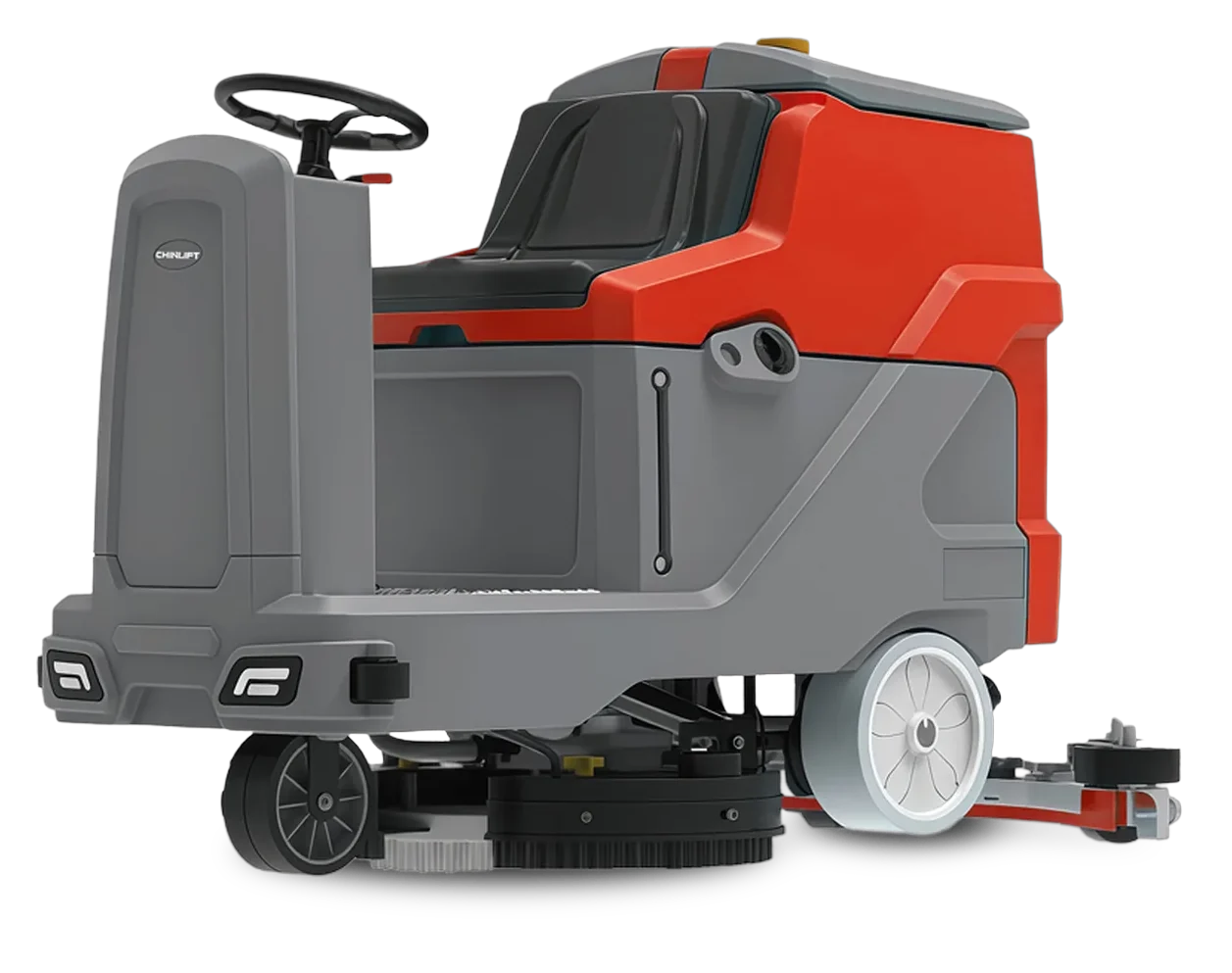
For the first machine, the best choice is often the one that fits your largest and most frequently cleaned contract, because that is where utilisation will be highest. If contracts with large areas dominate, starting with a ride-on machine usually makes more sense; if contracts with scattered, narrow areas dominate, a walk-behind.
Pricing the machine into new quotes
Once you have bought the machine, you need to reflect its cost in your price per m² when quoting for new contracts. A simple method:
Machine cost per m² = (Monthly depreciation + Monthly running costs) / Total m² the machine cleans per month
You can find the monthly depreciation by dividing the machine price by the number of months you plan to use the machine. Add this value to your labour cost per m² and you can see the floor price for your quote. The more area the machine cleans each month, the lower the cost per m²; here too, the importance of utilisation shows.
Risks and honest limits
A good investment calculation also includes the downside scenario:
- Losing the contract: If the contract the machine was bought for ends, the machine may sit idle. Choosing a model that can be used at different sites reduces this risk.
- Optimistic output assumptions: Setting the efficiency factor high makes the payback look shorter than it is. Do the calculation with a cautious factor.
- Operator turnover: When a trained operator leaves, the new person’s learning curve and the risk of misuse follow. Train at least two people on the machine.
- Neglected maintenance: A machine that doesn’t get its daily maintenance loses performance, and the savings calculation falls apart.
- Small, scattered areas: On sites made up of many small rooms, transport and hand-finishing time can eat up the gain; on these sites a machine doesn’t always deliver the calculated saving.
Pre-investment checklist
- Have you measured each site’s area, frequency and current labour hours for at least two weeks?
- Have you calculated the practical output with a cautious factor?
- Have you allowed for preparation, maintenance, transport and hand-finishing times?
- Have you decided where you will put the labour hours saved to use?
- Does every site have a water point, a drain and a charging point?
- Are the vehicle and ramp that will move the machine suitable?
- Have you set aside a monthly budget for brushes, pads, squeegee blades and chemicals?
- Have you allowed for the battery replacement provision?
- Is training planned for at least two operators?
- Do you have the warranty, service and spare parts terms in writing?
We explain how the daily maintenance routine affects machine life in our maintenance guide; treat maintenance as part of the calculation.
Summary
- Calculate the payback first on labour hour savings; increased capacity and quality are added value.
- Don’t do the calculation without measuring current labour hours; a two-week record is a good enough start.
- Add preparation, maintenance, transport and hand-finished areas to the machine time.
- Payback period = investment / monthly net contribution; the most sensitive variable is utilisation.
- Hours saved don’t turn into a gain unless they are put to use elsewhere.
For large contract areas, take a look at the HY660 twin-brush ride-on floor scrubber. At EKSFORK we offer flexible payment options; we explain them in our payment options guide. For the right machine for your sites, current prices and a payment plan, message us on WhatsApp.