Anyone who has tried to clean a large warehouse, factory yard or square with a broom knows the scene: dust rises, hangs in the air for a while and settles back where you have just swept. What’s more, sweeping a few thousand square metres by hand takes hours, and by the time the job is done the team is exhausted.
A floor sweeper does this job with a different logic: it collects the dirt with brushes without raising it into the air, throws it into a hopper and keeps the dust inside. In this guide we explain how a sweeper works, what it collects and what it doesn’t, how to calculate its capacity, the right techniques for using it, and its maintenance points.
How does a floor sweeper work?
Although the details vary from model to model, most sweepers work with the same basic layout:
- The side brush spins dirt from along walls, around columns and at kerb edges into the front of the machine, into the path of the main brush.
- The main brush is a cylindrical brush that rotates on a horizontal axis under the machine; it lifts dirt off the floor and throws it into the dust hopper.
- The dust hopper holds the collected dirt; it is emptied when full.
- On many models, a suction fan and filter draw air from inside the hopper to stop fine dust escaping.
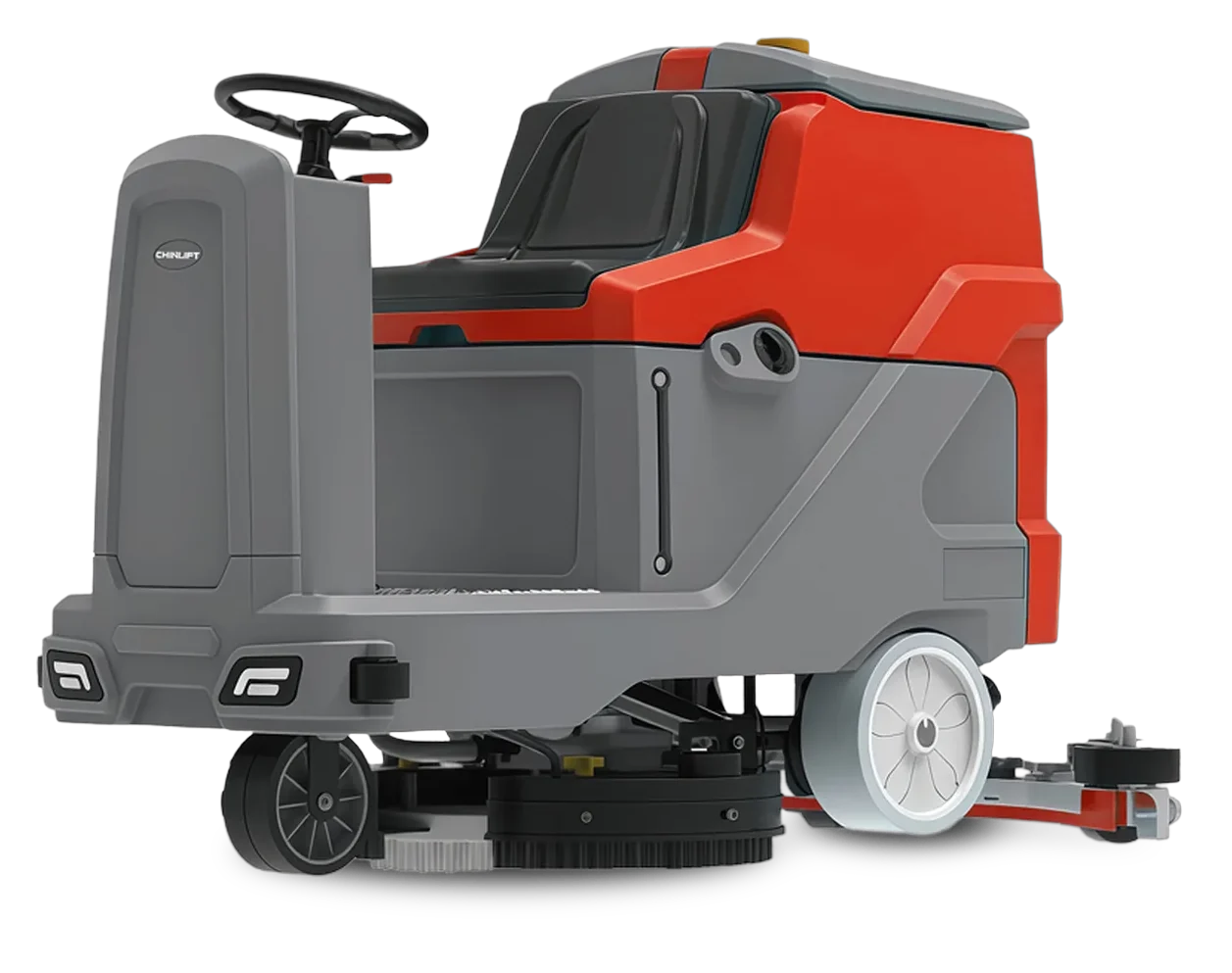
Some machines also have a water tank. On sweepers, the water tank is usually used to spray a fine mist in front of the brushes to keep the dust down. For example, the S1 ride-on sweeper has an 80 L water tank alongside its 80 L dust hopper; confirm how the water is used from the user manual or with us.
The S1’s technical data make this layout concrete: a 1,250 mm sweeping width, a 500 mm main brush, a 400 mm diameter side brush, a 48 V battery and a run time of 4–5 hours. Its catalogue output is 6,300 m²/h and its top speed 12 km/h.
Why does dust-free sweeping matter?
When cleaning with a broom, much of the dirt isn’t actually collected, only moved around. The fine dust that rises settles on shelves, on products and packaging, inside machines and, a few hours later, back on the floor. It looks as if cleaning has been done, but the next day the same dust is swept again.
This has three concrete consequences:
- Staff health: Breathing in fine dust such as concrete and stone dust is undesirable. Collecting dust without raising it is the first step in protecting the person sweeping and the people working nearby; if dust levels are high, also use the protective equipment recommended by your health and safety adviser.
- Products and equipment: In sectors such as food, packaging, paint and electronics, airborne dust has a direct effect on product quality.
- Repeated work: The less dust is raised, the less often you have to clean the same area.
Whether a sweeper works dust-free depends on its filter, rubber skirts and the hopper’s seal. When maintenance of these parts is neglected, the machine starts raising dust too; that is why we go into detail in the maintenance section.
What does it collect, and what doesn’t it?
The first condition for getting results from a sweeper is not to expect it to do a job it can’t. The table below is a general framework; for your own machine’s limits, the user manual is what counts.
| Type of dirt | Sweeper | Note |
|---|---|---|
| Fine dust, concrete and cement dust | ✅ | The filter needs frequent cleaning |
| Sand and fine gravel | ✅ | The hopper gets heavy; empty it often |
| Dry leaves, paper, bits of packaging | ✅ | Bulky dirt fills the hopper quickly |
| Cigarette ends, small litter | ✅ | Typical dirt of squares and car parks |
| Pallet strapping, wire, string, stretch film | ❌ | Winds round the brush; pick it up by hand first |
| Wet mud, liquid spills | ❌ | Clogs the filter; a scrubber is needed |
| Oil stains, tyre marks | ❌ | Cleaning with brushes and suction is needed |
| Large stones, pieces of wood and metal | ❌ | Can damage the brush and hopper |
In short, a sweeper is a machine for dry, loose dirt. For a layer stuck to the surface you need a floor cleaning machine that scrubs with water and picks the dirty water back up; we explain how these machines work in our how does a floor cleaning machine work guide, and which one to choose when in car parks in our car park and outdoor area cleaning guide.
Where is it used, and which type suits whom?
A sweeper proves its worth in areas where the surface is hard and large and the dirt is mostly dry:
- Warehouses and logistics centres: Pallet debris, bits of cardboard and dust in forklift aisles.
- Factory yards and workshops: Dust and debris left over from production (except large metal pieces).
- Open and indoor car parks: Sand, leaves and small litter.
- Squares, parks and estate roads: Leaves, cigarette ends and windblown dirt.
- Preparation before wet cleaning: Removing sand and swarf before the scrubber extends the life of both the brushes and the floor coating.
Sweepers fall roughly into three types. Manual push sweepers are for small areas and touch-up cleaning. Battery-powered walk-behind models are used in medium-sized, divided areas with the operator walking alongside. Ride-on models, such as the S1, are machines the operator sits on, designed with a wide path and a large hopper to finish thousands of square metres in a single session. If the area is small, divided and full of furniture, a ride-on machine can’t use its capacity; a smaller solution makes sense there.
How long will it take? A simple capacity calculation
Catalogue output is usually calculated by multiplying the sweeping width by the working speed, and it assumes the machine moves forward without ever stopping. On a real site, turns, emptying the hopper and obstacles reduce this value. For planning, use this formula:
Time required (hours) = Area (m²) ÷ (Catalogue output × efficiency factor)
Example: a 20,000 m² warehouse yard, with the S1’s catalogue output of 6,300 m²/h and an efficiency factor taken as 0.6 for the example, comes to about 5.3 hours. That exceeds the S1’s 4–5 hour run time; the job needs splitting into two sessions with a charge in between, or spreading over several days. The factor is only an example; measure it in your own area in the first few weeks and update it. For a detailed calculation, see our choosing a machine by floor area guide.
Plan not only by area but also by hopper. In areas with heavy dirt, the hopper fills long before the battery runs out, and every emptying trip takes time. In the first week, note how many square metres were swept for each emptying and how many minutes the emptying took. These two figures show the emptying time that needs adding to the daily plan, and bring your efficiency factor closer to reality.
Tips for efficient, dust-free sweeping
- Check the area first. Pick up strapping, wire, string and large pieces by hand; strapping wound round the brush stops the job within minutes.
- Start at the edges. Make the first round along walls and kerbs; the side brush pulls the dirt out of the corners. Then sweep the middle in straight, parallel strips.
- Overlap the strips. Let the edge of each pass run slightly over the previous one; that way no thin lines of dirt are left in between.
- Adjust your speed to the dirt. Top speed is an upper limit. Slowing down in heavily soiled zones gives the brush time to throw the dirt into the hopper.
- Empty the hopper before it is full. A full hopper spills dirt back out and weakens suction.
- Keep the filter clean. A clogged filter lets dust escape; if your machine has a filter shaker, use it during the shift as well.
- Don’t sweep a wet floor. Damp dust turns to mud in the filter; after rain, wait for the floor to dry.
- Use the side brush only when needed. A side brush spinning in an open area with no edge dirt can throw dust sideways; if your machine allows it, raise it in the middle of the area.
Safe use
A ride-on sweeper is a vehicle, if a small one, and often works among pedestrians, forklifts and parked vehicles. A few basic rules prevent both accidents and damage to the machine:
- Only people who have had operating training should use the machine.
- Move at low speed in areas with pedestrian traffic; stop and check at blind corners and the ends of racks.
- Go straight up and down ramps, and don’t turn on the slope.
- Switch the machine off and remove the key before touching the brush or the hopper.
- Charge in a dry, well-ventilated area; read the charging warnings specific to your battery type in the manual.
Maintenance: brushes, filter, hopper and battery
The things that most reduce a sweeper’s performance are parts that look small and cheap. The table below is a sample checking routine; go by the user manual for exact intervals.
| Part | Check | Sample frequency |
|---|---|---|
| Dust hopper | Emptying, seal and lid check | After every use |
| Filter | Shaking out, checking for tears and blockages | After every use |
| Main brush | Tangled string and strapping, bristle wear, contact adjustment | Weekly |
| Side brush | Bristle length and mounting | Weekly |
| Rubber skirts | Tears and wear; a torn skirt lets dust escape | Weekly |
| Battery | Charging routine, terminals, cable connections | According to the manual |
The signs that a brush needs replacing are usually obvious: the bristles have become noticeably shorter, thin lines of dirt are left after the machine has passed, the side brush no longer reaches the base of the wall, and less dirt goes into the hopper. Before replacing the brush, though, check its height: the main brush’s contact width with the floor decreases as the brush wears, and on most machines it can be readjusted using the method in the manual. If adjustment isn’t enough, replacing the brush rather than forcing it protects both the cleaning quality and the sweeping time.
Not running the battery completely flat and not leaving the machine standing for long periods with a low charge are habits that extend life for most battery types; we cover the differences between battery types in our lithium or gel battery guide.
Questions to ask before you buy
- Will it fit through the door and the aisle? Compare the machine’s dimensions with your narrowest passage (S1: 1,320 × 1,000 × 1,300 mm).
- Can it turn? Compare the turning radius with the gaps between racks and parking rows (S1: 1,050 mm).
- Can it climb the ramps? Calculate the ramp gradient as a percentage and compare it with the machine’s climbing figure (S1: 25%).
- How is the hopper emptied? The hopper volume, the way it is emptied and the distance to the emptying point directly affect the daily time.
- Are spare filters and brushes available? These parts are consumables; ask about delivery times from the start.
- Will it be moved by lift? If the machine will be moved between floors, compare its weight with the goods lift’s capacity (S1: 390 kg).
- Where will it be charged? Plan a dry, well-ventilated parking spot near a socket.
If possible, see the machine on your own floor and with your own dirt before you decide. How easy the hopper is to empty, how well the operator can see from the seat, and how the machine turns between racks or parking rows are details the catalogue values can’t show but that directly affect daily work.
Summary
- A sweeper collects dirt without raising dust; it is a machine for dry, loose dirt.
- The side brush cleans the edges, the main brush the floor, and the filter the air.
- Oil, tyre marks and wet mud need scrubbing with brushes and suction.
- Calculate the real time with an efficiency factor, not the catalogue output, and allow for the battery run time.
- If filter, skirt and brush maintenance is neglected, the machine starts letting dust escape.
Share your area’s dimensions and type of dirt, and let’s assess together whether a sweeper is the right solution for you. Explore our floor cleaning machines and sweepers, or ask on WhatsApp for current prices.