Cleaning with a mop is actually made up of three separate jobs: wetting the floor, scrubbing and loosening the dirt, and collecting the dirty water. Often these three jobs are done at different times by different hands, and the dirty water is spread back over the floor. A floor cleaning machine (scrubber-dryer) does all three in a single pass, within the same few seconds. On site it is also called a floor washing machine or floor scrubber; industrial and heavy-duty models all work on the same principle.
Knowing what goes on inside the machine helps in two ways. First, you find the right settings: adjusting the water flow, speed and brush choice to the floor directly changes the result. Second, you can read problems from the marks on the floor: a wet strip left behind tells you whether the cause is the brush, the squeegee or the vacuum.
In this guide we open up the machine’s three main systems — water, brush and vacuum — one by one, and then explain how they work together. We use the catalogue values of the K1, K2, HY660 and KL860 models at EKSFORK as examples.
How does a scrubber-dryer work? Four jobs in one pass
As the machine moves forward, the following happens in turn at any point on the floor:
- Wetting: Water from the clean water tank (with a measured dose of detergent added) is released into the area around the brush.
- Scrubbing: The rotating brush or pad mechanically lifts the dirt loosened by the water off the floor.
- Collecting: The squeegee at the rear of the machine wipes up the dirty water with a rubber blade and gathers it into a single line.
- Drying: The vacuum motor sucks this water through a hose into the dirty water tank; behind the machine, the floor is left almost dry.
The most important result of this sequence is that the dirty water never returns to the floor, and the area can be used again in a short time. With a mop, as the bucket water gets dirtier, dirt is carried back onto the floor; in a machine, the water going to the brush always comes from the clean tank.
Water and detergent system: how much water, and when?
The clean water tank determines the machine’s “range”. According to the catalogue values, the K1 has a 40 L clean water tank, the K2 55 L, the HY660 90 L and the KL860 155 L. When the tank runs dry, the brush spins dry, which wears both the floor and the brush; so you need to keep an eye on the water level. The water level indicator and wide filling opening on the K2 are there for exactly this.
The water is released into the brush area via a valve, and the flow rate can be adjusted. The balance here is delicate:
- Too little water: The brush rubs dry against the floor, the dirt isn’t loosened, and streaks and stains are left behind.
- Too much water: The squeegee can’t hold the water, which spills over the edges; the floor stays wet and becomes a slip hazard.
- Water flowing while the machine is stationary: This creates a puddle in one spot. Make sure the water flow stops when you stop; check in the manual whether your machine has an automatic cut-off.
It also matters that the water coming from the tank is clean. Sand and sediment in the water can clog the valve; the side-access clean water filter on the K2 is there to catch these particles and should be cleaned regularly.
The brush: the mechanical side of the job
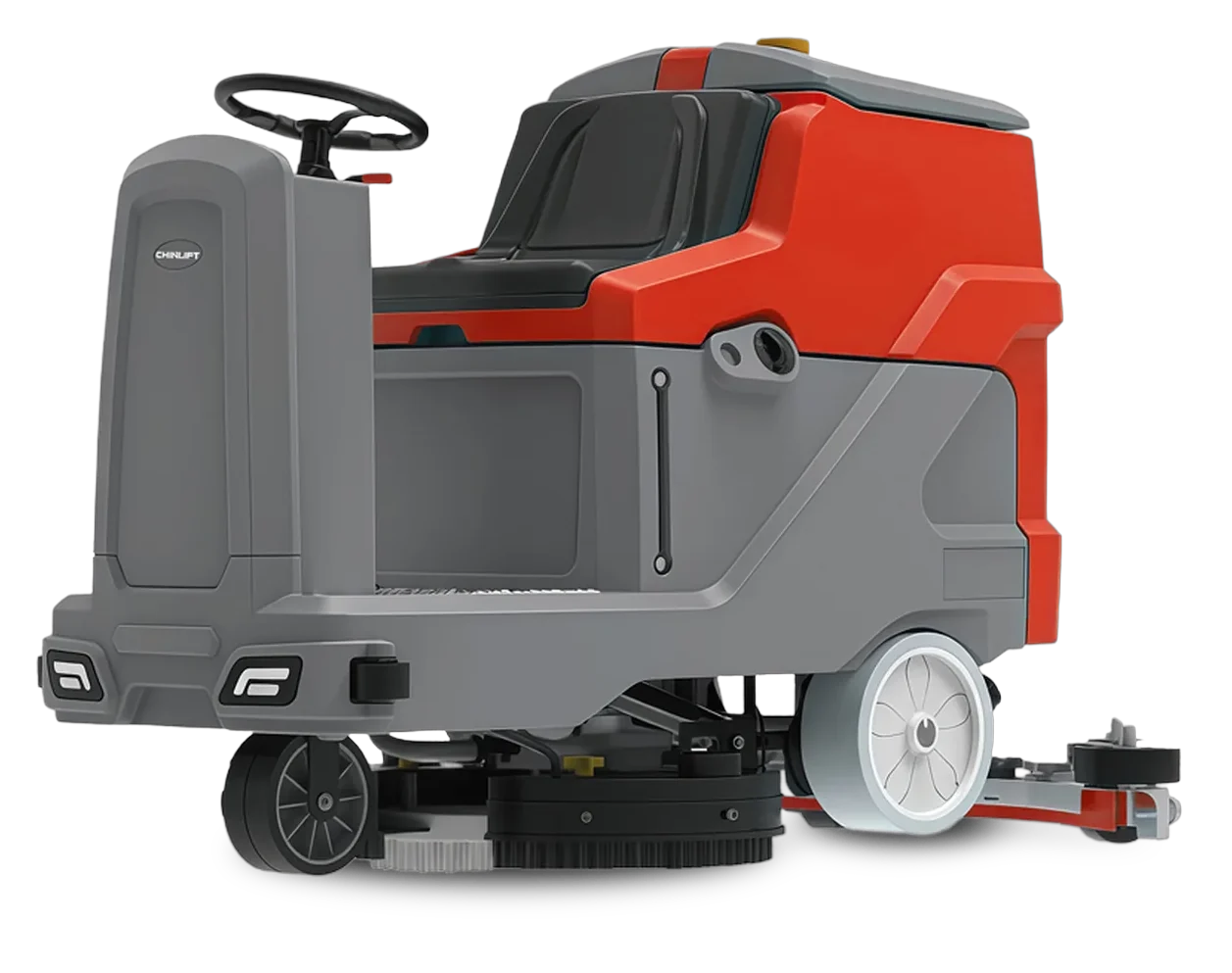
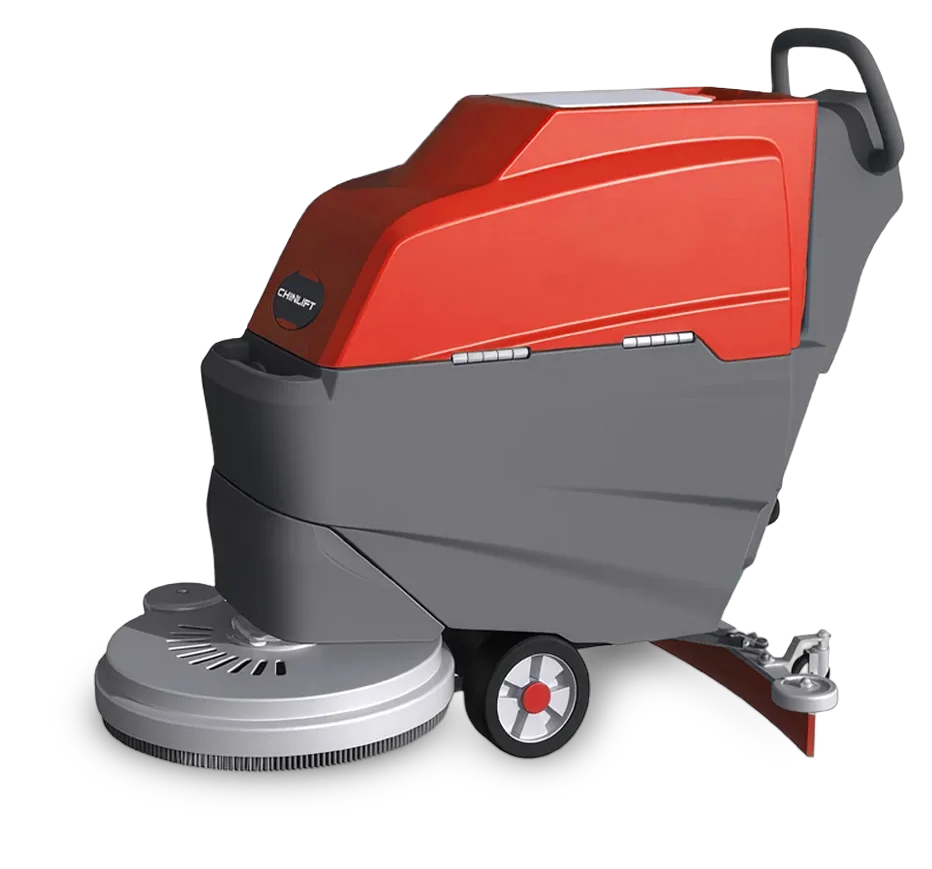
The main force that lifts dirt off the floor is the brush’s rotation and the pressure it applies to the floor. On the K1, the 510 mm brush turns at 160 rpm, powered by a 500 W motor; on the K2 the brush width is also 510 mm and the brush motor is 550 W. On the ride-on models the scale grows: the HY660 has twin brushes and cleans a 660 mm width, while the KL860 has an 860 mm brush width and two 550 W brush motors.
A brush and a pad do the same job in different ways. A bristle brush reaches into recesses such as joints and textured surfaces; a pad makes contact over a wider area on smooth surfaces. The wrong choice either leaves dirt behind or scratches the floor. We explain which to use on which floor in detail in our brush and pad selection guide.
Let’s also correct a misconception about pressure: the pressure the brush puts on the floor comes from the weight of the brush unit and, on some models, an adjustable pressure system. More pressure doesn’t always mean better cleaning; the motor is strained, the battery runs down faster, and the brush or pad wears faster. Try the right brush and the right dose first, and change the pressure last.
To be honest — a brush can’t make up for the wrong detergent or too much speed. Walking fast shortens the time the brush spends on any one spot; with stubborn dirt, slowing down is often more effective than changing the brush.
Squeegee and vacuum: the pair that leaves the floor dry
The squeegee is a V-shaped or curved rubber blade at the rear of the machine that touches the floor. Its job is to wipe up the dirty water spread by the brush and gather it in front of the vacuum inlet. The vacuum motor then sucks this water up through a hose.
If you look closely at the catalogue values, the squeegee is always wider than the brush: the K1 and K2 have an 800 mm squeegee for a 510 mm brush, and the KL860 a 1,200 mm squeegee for an 860 mm brush. The reason is that the water the brush throws to the sides in turns and at the edges also needs to be collected.
The second notable point is that the dirty water tank is larger than the clean water tank: 45 L against 40 L on the K1, 65 L against 55 L on the K2, 95 L against 90 L on the HY660 and 165 L against 155 L on the KL860. The water sucked up comes with air and foam; the extra margin stops the tank overflowing and water reaching the vacuum motor. On most machines, a float in the dirty water tank shuts off the suction when the tank is full; at that point the floor suddenly starts staying wet.
- Raise the squeegee when reversing: If the rubber drags in the opposite direction, it folds over, wears and leaves marks.
- Don’t turn sharply: The squeegee can drop water in a turn; turn in a wide arc.
- Check the edge of the blade: A nicked or worn edge leaves a thin wet line behind.
Chemistry, time, temperature, mechanics: the four pillars of cleaning
A widely used approach in cleaning science says the result is determined by four factors together: chemical action, contact time, temperature and mechanical force. When you reduce one, you need to increase one of the others. In machine cleaning, these four pillars translate as follows:
- Chemistry: The right detergent at the right dose. The product used in the machine must be non-foaming; details are in our detergent selection and dosing guide.
- Time: Walking speed and, if needed, a double pass. For heavy soiling, it works well to just wet and scrub on the first pass (squeegee up, vacuum off), wait a few minutes and collect on the second pass.
- Temperature: Warm water dissolves greasy dirt more easily, but the temperature limit for water in the tank is given in the manual; don’t exceed it.
- Mechanics: The type, pressure and speed of the brush.
This approach explains most “the machine doesn’t clean” complaints: usually one of the four pillars is missing, and the machine can’t make up for it on its own.
Same principle, different scale: walk-behind and ride-on models
Walk-behind and ride-on machines work on the same principle; the difference lies in width, tank volume and run time. All four models in the table are battery-powered floor cleaning machines; the battery determines the run time. In the table below we have put their catalogue values side by side:
| Model | Type | Brush / cleaning width | Squeegee | Clean / dirty water | Battery | Run time |
|---|---|---|---|---|---|---|
| K1 | Walk-behind | 510 mm | 800 mm | 40 L / 45 L | 24V 60Ah lithium | 3–4 h |
| K2 | Walk-behind | 510 mm | 800 mm | 55 L / 65 L | 2 × 12V 100Ah | 2–3 h |
| HY660 | Ride-on, twin brush | 660 mm | Not stated in the catalogue | 90 L / 95 L | Maintenance-free battery | 3–5 h |
| KL860 | Ride-on | 860 mm | 1,200 mm | 155 L / 165 L | 4 × 6V/200Ah | 4–5 h |
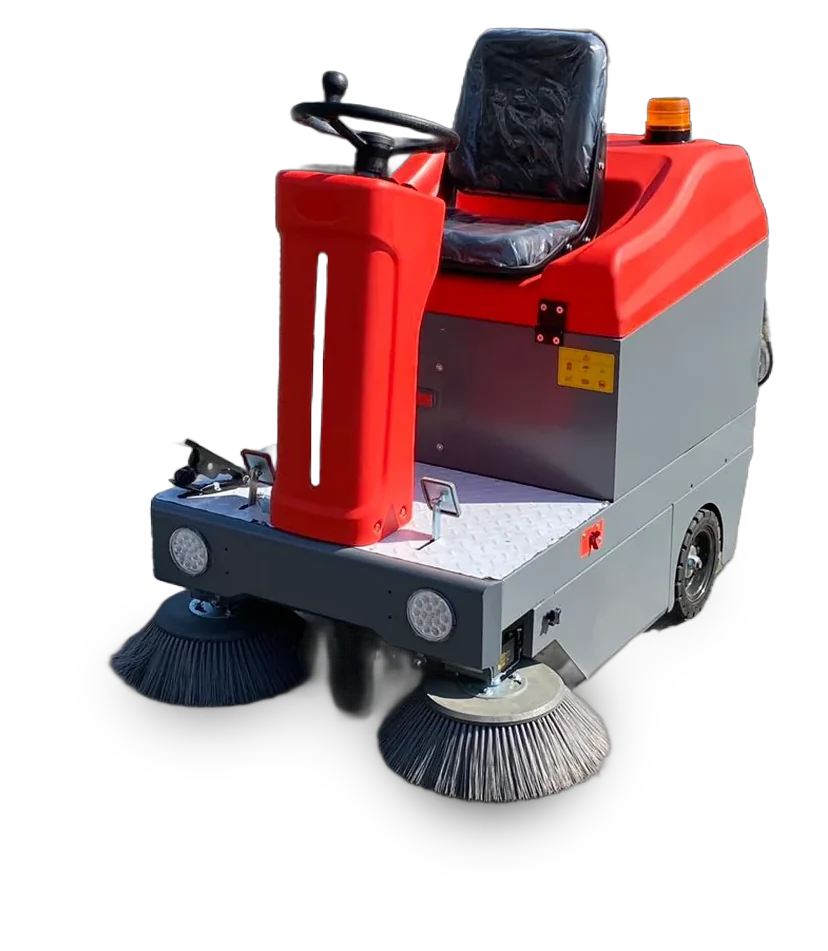
There is one more type of machine not in the table: the sweeper. Sweepers such as the S1 don’t wash with water and vacuum; they collect dust and debris into an 80 L hopper with a 500 mm main brush and a 400 mm diameter side brush. Outdoors and in car parks, the first step is usually sweeping; we explain the difference in our floor sweeper guide.
What do the marks on the floor tell you?
The machine talks to you through the floor it leaves behind. After cleaning, step back a few paces and look at the floor from the side, against the light. The table below links the most common marks to the system responsible:
| Sign on the floor | Which system? | Where to look first |
|---|---|---|
| Thin, straight wet lines behind the machine | Squeegee | Nick, wear or trapped debris on the blade edge |
| The floor stays wet all the way across | Vacuum | Is the vacuum on, is the dirty water tank full, is the lid seated properly, is the hose blocked? |
| Water left at the edges and in turns | Water + squeegee | Reduce the water flow, widen the turns |
| The floor is dry but the dirt is still there | Brush + chemistry | Too little water, wrong brush or pad, insufficient dose, too much speed |
| Foam overflowing from the dirty water tank | Chemistry | Foaming detergent or overdosing |
| The floor is sticky once dry | Chemistry | Excess detergent; lower the dose and, if needed, do a pass with plain water |
We explain routine jobs such as squeegee, filter and tank cleaning step by step in our maintenance guide.
Step by step on first use
In the first days after taking delivery of the machine, make this sequence a habit:
- Check that the dirty water tank is empty and its lid is fully closed.
- Fill the clean water tank; measure the detergent according to the ratio on the product label rather than pouring it by eye.
- Check that the brush or pad is fitted and suitable for the floor.
- Visually check the squeegee blade, then lower the squeegee.
- Try it first in a small, inconspicuous area: start the water flow at the lowest setting and increase it as needed.
- Work in straight lines, overlapping the previous strip by a few centimetres.
- Turn round now and then to look at the floor behind you; if you see wet lines or dirt, go back to the table above.
- When you have finished, empty the dirty water tank, rinse it out and leave the lid open to let it dry.
Plan in advance for the spots the machine can’t reach. A round brush can’t fully get into square corners or right along the base of walls; under racks, around columns and door thresholds are often finished by hand too. If you clean these spots with hand tools before the machine, the machine picks up the loosened dirt on its main pass and the same job isn’t done twice.
Don’t forget the wet floor warning. Even though the floor behind the machine dries quickly, the area under the brush and the turning points are wet while you work. Put a warning sign in the area you are working in; in areas with pedestrian traffic, plan the work for the quietest hours.
At EKSFORK we carry out the set-up and give basic operating training when we deliver the machine; most of the questions in the first week are answered in this training.
Summary
- The machine wets, scrubs, collects and dries in a single pass; the dirty water never returns to the floor.
- Water flow is a balance: too little leaves the dirt behind, too much leaves the floor wet.
- The squeegee is wider than the brush and the dirty water tank larger than the clean one; both are there so that no water escapes.
- The result depends on four pillars: chemistry, time, temperature and mechanics.
- The marks on the floor tell you which system is at fault; look there first.
To see which width and tank size suit your area, explore our floor cleaning machines; we have gathered the general selection criteria in our buying guide. For current prices and the right model for your floor, message us on WhatsApp.