On a factory floor, dirt isn’t just dust. Hydraulic oil dripping from under machine tools, cutting fluid splashing around lathes, tyre marks left by turning forklifts and the dust that sticks to all of it gradually form a dark, slippery film. This film not only spoils the appearance but also increases the risk of workplace accidents.
On a floor like this, a mop usually makes things worse: it spreads the oil over a wider area without dissolving it and leaves the surface even more slippery. A floor cleaning machine, on the other hand, really does lift oily dirt off the floor when used in the right order. The key phrase is “the right order”: a machine used the wrong way cuts its squeegee on swarf, sucks pools of oil into its tank, and the result is disappointing again.
In this guide we explain how to recognise the types of dirt in a factory, the five-step cleaning method, the logic behind the choice of chemical and brush, machine selection and the handling of oily waste water.
Know your dirt first: five types of dirt in a factory
Each kind of dirt has its own difficulty, and each needs a different first step. Before you start cleaning, walk round your area with this table:
| Type of dirt | Where is it found? | Why is it difficult? | First approach |
|---|---|---|---|
| Oil pools and leaks | Under machines, around hydraulic units, forklift parking spots | Slippery, spreads, contaminates the machine’s tank and hose | Collect with absorbent material; don’t let the machine suck it up |
| Oil and dust film | Walkways, around machine tools | Dust sticks to the oil and builds up layer by layer | Degreaser, dwell time and scrubbing; a double pass if needed |
| Cutting fluid residue | Around lathes, milling machines and CNC machines | Leaves a thin, slippery layer and can smell | Regular, frequent scrubbing; clean water on the final pass |
| Metal swarf and burrs | Around machining centres | Sharp; cuts the squeegee blade, blocks the hose | Always collect it dry before scrubbing |
| Tyre marks | Forklift aisles, turning points | The tyre material sticks to the floor | A more abrasive brush or pad; test on a small area first |
The most important row in this table is the swarf row. Going straight onto a floor covered in swarf with a scrubber-dryer is the fastest way to need a new squeegee.
Cleaning oil off factory floors: a five-step method
The sequence below is a general method that works on heavily soiled factory floors. In lightly soiled areas you can shorten some steps, but don’t change the order.
1. Prepare the area
Mark off the area to be cleaned with warning signs and divert forklift and pedestrian traffic to another aisle. Lift pallets, boxes and cables off the floor. Have ready the protective equipment (gloves, goggles, suitable footwear) specified in the Safety Data Sheet of the chemical you will use.
2. Dry pre-clean
First collect solid waste such as swarf, burrs, dust, packaging scraps and screws dry. In small areas a hand brush and a magnetic sweeper are enough; in large halls a sweeper does the job much faster. We explain the difference between sweeping and scrubbing in our floor sweeper guide.
3. Collect leaks with absorbent material
Don’t suck oil that is pooled on the floor into the machine’s tank. Collect it with absorbent granules or absorbent pads, and store the used absorbent material separately according to your facility’s waste procedure. Otherwise the oil sticks to every part of the dirty water tank, the hose and the squeegee, and cleaning it takes hours.
4. Pre-wetting and dwell time
Apply the degreaser solution to the floor. The practical way to do this is to make the first pass with the machine with the squeegee raised and the vacuum off: the machine spreads the solution and scrubs once. Then wait for the time stated on the product label. During this time the chemical breaks the bond between the oil and the floor. Don’t let the solution dry on the floor; work large areas in sections.
5. Scrub, collect and final check
On the second pass, lower the squeegee and switch the vacuum on, moving slowly and overlapping the strips. If the floor feels sticky once dry, there is chemical residue; do a rinse pass with plain water. Finally, take a few steps on the cleaned area: if the floor is still slippery, the oil hasn’t been fully removed and the process should be repeated.
The three most common mistakes with this method
- Letting the solution dry: If you wet a large area in one go and then try to collect it, the solution dries in places and deposits the dirt it has dissolved back on the floor. Wet only as much area as you can collect in a short time.
- Walking fast: When the brush spends less time on each spot, the oil isn’t fully dissolved. Slow down in stubborn areas.
- Using the same brush everywhere: A brush or pad used in an oily workshop carries oil into a clean office corridor. Keep separate brushes or pads for heavily soiled zones.
Chemical strategy: not the strongest, but the right one
Alkaline degreasers are usually used on oily dirt. But the idea that “a stronger product means a cleaner floor” is a common mistake in factories. Chemical that is more concentrated than necessary leaves residue on the floor, and the residue holds on to new dust, so the floor gets dirty faster. It can also damage painted or coated surfaces and is a risk to skin.
- Choose a product suitable for machines: It must be low-foam; foam fills the dirty water tank and can reach the vacuum side.
- Take the dose from the label: Don’t pour by eye; measure it against the tank volume.
- Never put flammable products in the tank: Solvent-based or flammable cleaners don’t go in the machine’s tank.
- Don’t mix products: Combining two different chemicals in the same tank can cause dangerous reactions.
- Test first: Try a new product on a small, inconspicuous area.
We explain dose calculation and product types in detail in our detergent selection guide.
Brushes and pads: the floor decides how abrasive
Uncoated concrete floors can generally take stiffer-bristled or abrasive-grit brushes, and only these brushes reach oil deep in the pores. On painted, epoxy or polyurethane-coated floors, however, the same brush can dull or scratch the coating. On these floors a softer brush or a suitable pad is preferred, and the chemical is chosen accordingly; for details, see our epoxy floor guide.
Tyre marks are a special case: they often don’t come off with the everyday cleaning brush and need a more abrasive pad. The rule doesn’t change here: test on a small area first. We compare the types of brush and pad in our brush and pad selection guide.
Choosing machines on a factory scale
In a factory, a single machine may not suit every area. Choose by type of area:
- Large workshops and production halls: The KL860 ride-on floor scrubber is designed for large areas, with an 860 mm brush width, a 1,200 mm squeegee and a 155 L clean water tank. It runs for 4–5 hours and has a catalogue output of 5,600 m²/h. Its maximum climbing angle of 18° helps on ramped routes inside the factory; take more care on wet ramps, though.
- Very large, open areas: The HY660 has twin brushes, cleans a 660 mm width and comes with a 90 L clean water tank and a reinforced suction hose.
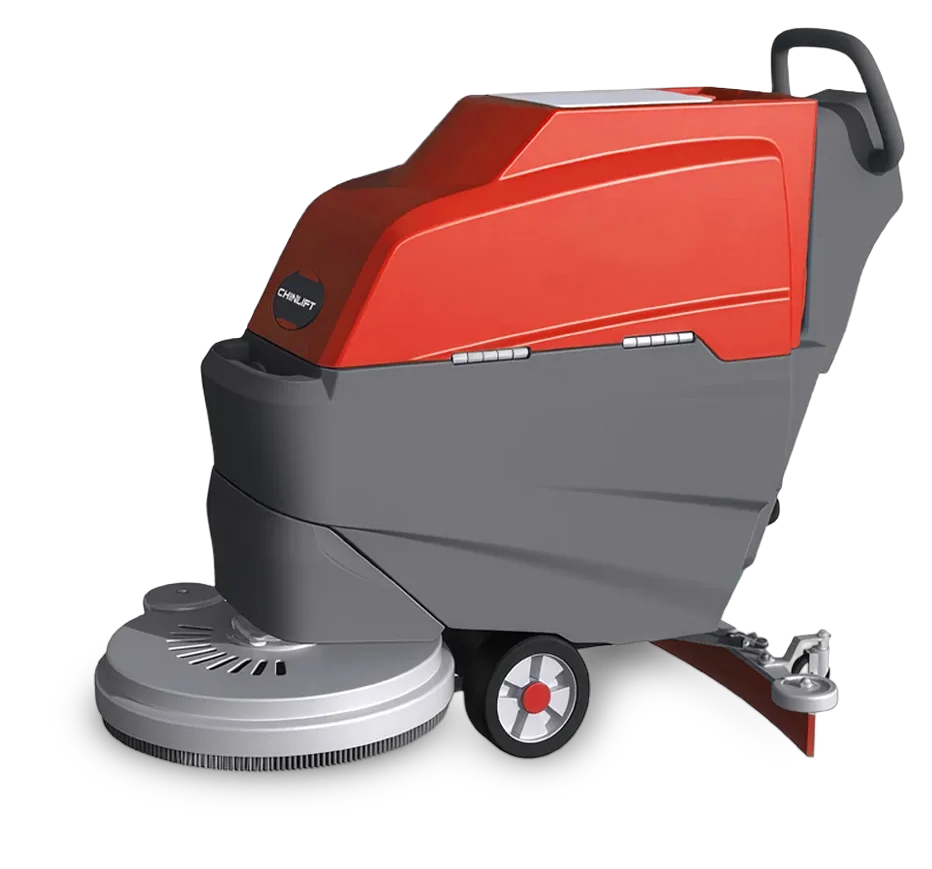
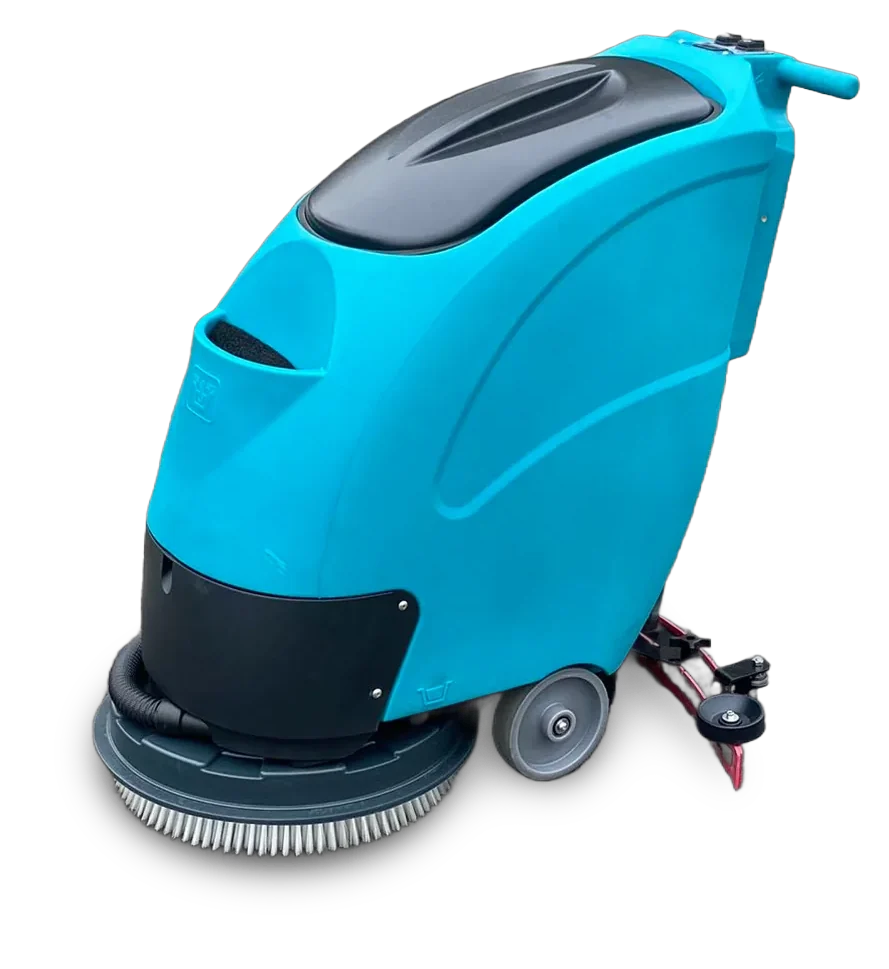
- Between machine tools and on narrow production lines: Walk-behind machines such as the K1 and K2, with a 510 mm brush and an 800 mm squeegee, reach places a ride-on machine can’t get into.
- Pre-sweeping: In large areas with a lot of swarf and dust, the S1 sweeper, with its 1,250 mm sweeping width, speeds up the dry clean before scrubbing.
Tank volume matters more with heavy soiling. On oily floors the water setting is usually kept higher and the dirty water tank fills faster. The dirty water tank holds 165 L on the KL860, 95 L on the HY660, 65 L on the K2 and 45 L on the K1. The bigger the tank, the less often you go to the water point to empty it; but the rule of not leaving oily water standing in the tank is the same for every machine.
Remember too that you will need to work slowly on oily dirt: the catalogue output doesn’t reflect the real output on a heavily soiled floor.
When to clean? A work plan that doesn’t disrupt production
In a factory, the hardest part of cleaning is often not the dirt but the timing. While production is running, aisles have to be closed, forklift traffic diverted and the wet floor kept safe. A practical plan has three layers:
- Immediate response: When a new leak is spotted, it is collected straight away with absorbent material and the area is marked. This job doesn’t wait for the machine.
- Light scrubbing between shifts: Busy aisles are scrubbed in a single pass at shift change or during breaks. The aim is to remove the thin film before it builds up in layers.
- Scheduled heavy cleaning: Heavily soiled zones, such as the areas around machine tools and turning points with tyre marks, are cleaned with the five-step method during a period when production is stopped.
Before opening a cleaned aisle to forklift traffic, make sure the floor is dry. On a wet floor the braking distance increases, and forklifts on solid tyres can lose grip on the slippery surface. If you plan the heavy cleaning zones piece by piece, the rest of the factory keeps working.
Oily waste water and absorbents: where do they go?
When you clean an oily floor, the water collected in the dirty water tank contains oil and chemicals. Don’t pour this water into a rainwater grating or onto the ground. Dispose of it according to your facility’s waste management procedure; confirm the current obligations for oily waste with your environmental officer or environmental consultant. The same rule applies to oil-soaked granules and pads.
Empty and rinse the dirty water tank after every use. If oily water is left standing in the tank, an oil layer sticks to the inner surface, odours develop and the float and filter don’t work properly. We explain tank, filter and squeegee maintenance step by step in our maintenance guide.
The best cleaning is reducing dirt at its source
Instead of a heavy clean once a month, a routine that stops dirt building up protects both the floor and the machine. Adapt the list below for your factory:
- Report leaking machines to the maintenance team; repairing a dripping connection is cheaper than cleaning up the same oil every day.
- Put a drip tray under equipment with a known leak and empty the tray regularly.
- Collect the swarf around machine tools dry at the end of every shift.
- Clean busy aisles every day with a light scrub; the thin film is removed before it builds up.
- Clean heavily soiled zones on a weekly schedule using the five-step method.
- Put mats and gratings at entrances to reduce the mud and dust coming in from outside.
- Keep chemical doses and cleaning times in a log; that is the only way to see what works.
Summary
- Know the dirt in your factory: oil pools, oil and dust film, cutting fluid, swarf and tyre marks each need a different method.
- Swarf and oil pools are collected before the machine goes in.
- With heavy soiling, the first pass is made with the squeegee raised; give the chemical time and collect on the second pass.
- Not the strongest chemical but the right one, at the right dose; any excess leaves residue.
- Oily waste water and absorbents are disposed of according to the facility’s waste procedure.
For large production areas, take a look at the features of the KL860 ride-on floor scrubber. For the right model for your floor and type of dirt, and current prices, message us on WhatsApp.