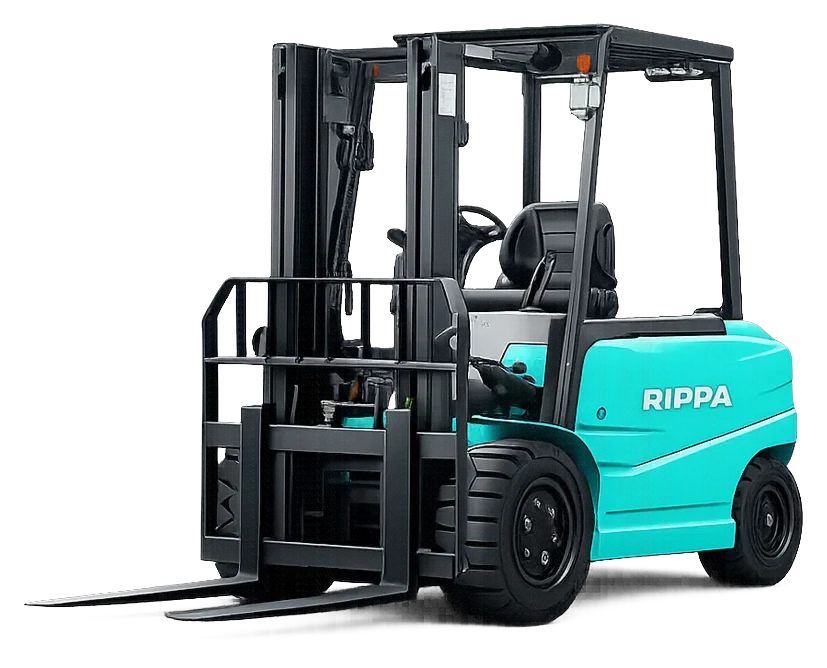
“This forklift lifts 2 tonnes” is an incomplete sentence. The correct version is: this forklift lifts 2 tonnes at the load centre and height stated on its plate, with the equipment stated on its plate. If the load is a little longer, the rack a little higher or an attachment has been added to the forks, the weight that can be lifted safely falls. The document that shows this difference is the small metal plate in front of the operator: the capacity plate and load chart.
In this guide we explain how to read the capacity plate line by line, what the load centre is, why capacity falls with height and distance, how attachments affect it and the most common reading mistakes. The aim is simple: to know your forklift’s limit from the plate, not from guesswork.
What is the capacity plate and where is it?
The capacity plate is the plate the manufacturer fixes to the machine, showing the loads that machine can lift safely with its current equipment. It is usually located where the operator can easily see it: next to the operator’s seat, on the dashboard or near the mast. Some plates carry only a few lines of information; others include a chart or table showing the values for different heights and load centres.
There are two basic rules about the plate:
- If the plate is illegible or missing, the machine’s capacity limit is unknown. In that case, obtain the correct plate from the manufacturer or seller before using the machine.
- If the machine’s equipment has changed (a different mast, attachment, tyres or battery), the old plate no longer describes that machine. Ask the manufacturer or an authorised service centre how the change affects capacity.
A practical tip: don’t leave the plate on the machine alone; put it to work in the warehouse. For the pallet types you handle most often, work out the maximum permitted load up to each rack level and post it as a simple table at the end of each rack. When preparing the table, also take into account the racking system’s own load limit; whichever is lower, the forklift’s value or the rack’s, is the one that applies. The operator doesn’t have to read the chart every time, and a newcomer can see the limits from day one.
The information on the plate, item by item
The layout of the plate varies by manufacturer, but most include the following information:
- Model and serial number: Shows which machine the plate belongs to. This information is also requested for spare parts and servicing.
- Rated (nominal) capacity: The maximum load the machine can lift at the stated load centre and up to the stated height. For the RF20E, the load capacity is 2,000 kg.
- Load centre distance: The load centre at which the rated capacity applies. Without this value, the capacity figure is meaningless.
- Lift height and the capacity at that height: Especially on high-lift machines, capacity falls at greater heights; the plate shows this separately.
- Mast type: Simplex, duplex or triplex. The RF20E has a triplex mast with free lift that reaches 4.5 metres.
- Attachment information: Which attachment the plate was prepared for, or whether it applies without an attachment.
- Tyre type, machine weight and, on electric models, battery information: On an electric counterbalance forklift, the battery pack is part of the balance, so using a battery different from the one stated on the plate can change the stability calculation.
Load centre: the distance that determines capacity
The load centre is the horizontal distance from the vertical face of the forks (the fork heel) to the load’s centre of gravity. In a load with evenly distributed weight, the centre of gravity is right in the middle of the load; in other words, the load centre is half the load’s length along the forks.
Take a standard Euro pallet (1,200 × 800 mm):
- If the pallet is picked up with its long side along the forks, the load centre of an evenly distributed load is about 600 mm.
- If it is picked up with its short side along the forks, the load centre is about 400 mm.
The same load is carried at a different load centre simply depending on which side you pick the pallet up from, and that changes the weight that can be lifted safely. The RF20E’s forks measure 40 / 100 / 1,070 mm (thickness / width / length); when you pick up a 1,200 mm pallet by its long side, the pallet overhangs the fork tips. That is normal, but the load must be pushed fully back against the heel of the forks.
Loads are not always evenly distributed. In a crate that is heavier on one side, or in a stack of different boxes, the centre of gravity shifts. Place the heavy side close to the mast; a load with its heavy side at the front can be dangerous even below the value on the plate.
Why does capacity fall with distance and height?
Think of a counterbalance forklift as a seesaw. The pivot point is the front wheels. On one side is the load; on the other, the machine’s body and counterweight. The load’s tipping effect is its weight multiplied by its distance from the front wheels. As the load moves forward, the same weight creates a bigger tipping effect, while the machine’s ability to counterbalance it stays the same. That is why the weight that can be lifted safely falls as the load centre increases.
Height makes things harder in a different way. As the load goes up, the combined centre of gravity of the machine and load rises too; small influences such as braking, turning, an uneven floor or tilting the mast forward upset the balance much more easily. At height, the mast and forks also flex more. That is why manufacturers give a lower capacity at greater heights.
The values on the plate apply with the machine on level, firm ground, the mast vertical or tilted slightly back and the load resting against the heel of the forks. Slopes, poor floors, sudden manoeuvres and forward tilt at height eat into the safety margin built into these values.
The stability triangle: a shortcut to understanding sideways tip-overs
The plate describes the machine’s limit against tipping forwards. But forklifts can also tip over sideways. The shortcut to understanding this is the stability triangle: most counterbalance forklifts rest on three points, the two front wheels and the central pivot point of the rear axle. As long as the combined centre of gravity of the machine and load stays inside the triangle formed by these three points, the machine is stable.
As the load moves forward, the combined centre of gravity shifts towards the front edge of the triangle; in a fast, sharp turn, it shifts towards a side edge. With the load raised, this shift is much greater. The practical rules that follow from this are:
- Always carry the load low, with the mast tilted slightly back.
- Slow down before turns; especially on an empty machine, a sharp turn quickly shifts the combined centre of gravity sideways.
- On a ramp, drive a loaded machine with the load on the uphill side: forwards going up, in reverse coming down.
- Never turn on a slope, and never raise or lower the load on a slope.
How to read the chart: a step-by-step example
The table below is the chart of a hypothetical 1.5-tonne forklift, prepared to make the explanation easier; these are not the values of any real machine, including the RF20E:
| Lift height | Load centre 400 mm | Load centre 500 mm | Load centre 600 mm |
|---|---|---|---|
| Up to 3,000 mm | 1,500 kg | 1,500 kg | 1,250 kg |
| Up to 4,000 mm | 1,400 kg | 1,300 kg | 1,100 kg |
- Find the height: What is the highest rack level you will lift the load to? If it is 3,600 mm, for example, use the “Up to 4,000 mm” row, never the row for the lower height.
- Find the load centre: Measure the length of the load along the forks and divide it by two. For example, if a 1,200 mm pallet is picked up by its long side, it is about 600 mm.
- Read the intersection: In this example, the 4,000 mm row and the 600 mm column meet at 1,100 kg.
- Work out the total weight of the load: Add the weight of the pallet and packaging to the weight of the goods.
- Compare: If the total weight is not below the value at the intersection, that load must not be lifted to that height. Also avoid working right at the limit.
- If you fall in between, take the cautious option: If your load centre is between two columns, use the larger one; if your height is between two rows, use the row for the greater height.
If your plate has no value for your load centre, a rough, cautious estimate can be made like this: estimated capacity = rated capacity × rated load centre / actual load centre. In our hypothetical example, 1,500 kg × 500 mm / 600 mm comes to about 1,250 kg. This estimate does not replace the manufacturer’s chart and does not take the effect of height into account; always ask the manufacturer or seller for the exact value.
Attachments and fork extensions change capacity
Every attachment added to a forklift has two effects: its own weight comes off the net load that can be lifted, and most attachments move the load further forward from the heel of the forks. The result is the same machine working with a lower net capacity.
- Side shifter and fork positioner: The RF20E has both. On delivery, ask whether the plate was prepared with this equipment fitted.
- Fork extensions: They make long loads easier to carry but move the load’s centre of gravity forward. When you work with fork extensions, capacity can drop noticeably; we cover the details in our forklift fork extensions guide.
- Cab: It doesn’t directly affect lifting capacity, but it changes the machine’s total weight and the operator’s visibility.
You can see the attachments available for the RF20E on our forklift attachments page.
Common reading mistakes
| Mistake | Consequence | The right way |
|---|---|---|
| Assuming the rated capacity applies at every height | Overloading on the upper racks, risk of tipping over | Read the row for your lift height |
| Forgetting the weight of the pallet and packaging | The limit is exceeded without anyone noticing | Calculate with the total weight |
| Assuming the load centre is always the same | Capacity is exceeded with long loads | Measure the load centre for each type of load |
| Carrying the load on the fork tips | The load centre increases and stability decreases | Push the load back against the heel of the forks |
| Tilting the mast forward at height | The tipping effect rises suddenly | Tilt forward only right in front of the rack, and as little as possible |
| Working with the old plate after fitting an attachment | The real capacity is unknown | Ask the manufacturer for the current value |
| Adding extra weight or a person at the rear | The machine and mast are overloaded | If capacity isn’t enough, use the right machine |
Let’s underline the last row: adding extra weight to the counterweight or having someone ride on the back to increase capacity must never be done. Even if the machine doesn’t tip over, the mast, chains, axle and tyres are loaded beyond their design limits. We have gathered the other rules of safe working in our forklift safety guide.
Quick checklist for the operator
- The plate is in place and legible, and it belongs to this machine and this equipment.
- I know the total weight of the load (goods + pallet + packaging).
- I have measured the load centre; the heavy side is close to the mast.
- I have read the row for the height I will lift to, and I am well below the value.
- If I am using an attachment or fork extensions, I know the current capacity value.
- The load is pushed back against the heel of the forks; I don’t tilt forward at height, and I carry the load low.
If you want to choose the right type of machine for your warehouse, our types of forklift guide is a good place to start, and for choosing a mast to suit your rack height, our forklift mast types guide. The Rippa RF20E electric forklift, with a 2,000 kg load capacity and a triplex mast that reaches 4.5 metres, is available from 599.000 ₺ + VAT. Message us on WhatsApp with your rack height and the dimensions and weight of your loads, and we’ll share the capacity value that applies to that height and load centre.