In forklift quotes, the mast line is one of the least noticed. Simplex, duplex, triplex, free lift, closed height… On paper these look like a handful of technical terms, but on site they answer very concrete questions: Will the forklift fit through the door? Can it put a second pallet on top inside the container? Will it reach the top rack?
In this guide we explain mast types through the logic of stages, show which jobs free lift is decisive for and list the measurements you need to take in your own warehouse before you buy. The aim is for you to decide by looking at the figures, not at the name in the catalogue.
What parts make up the mast?
What we call the “mast” or “upright” on a forklift is the vertical structure that carries the forks and the load upwards. To understand the difference between the types, you first need to know the parts:
- Outer mast: The main rails attached to the chassis, which do not extend upwards. The mast tilts forwards and backwards through this part.
- Inner mast or masts: Rails that slide upwards inside the outer mast like a telescope. Their number determines how many stages the mast has.
- Carriage (fork carriage): The plate the forks are mounted on. Equipment such as a side shifter and fork positioner is also fitted here.
- Cylinders and chains: While the hydraulic cylinder pushes the inner mast up, the chains run over the pulley at the top of the mast and pull the carriage upwards. Thanks to this arrangement, the carriage rises roughly twice as far as the inner mast travels, which is why the condition of the chains is a direct safety issue.
- Rollers and load backrest: The rails run on rollers. The load backrest is the grille that stops a raised load from sliding back towards the operator.
As the number of stages increases, so does the number of these parts. This is what determines both what the mast can do and how much maintenance it needs.
Simplex, duplex or triplex: the logic of stages
Mast types are named after the number of nested sections the mast extends in. The more stages there are, the higher you can lift for the same closed height; in return, the design becomes more complex.
Simplex (single stage)
A single-stage mast has no inner mast; the carriage rises along the fixed mast. The closed height is close to the lift height, so a simplex mast that lifts high cannot pass through low doorways. It is rare on counterbalance forklifts and is seen mostly on low-lift stackers.
Note: Some manufacturers use the word “simplex” or “standard” for a two-stage mast with limited free lift. Because names change from one catalogue to the next, compare quotes by the measurements, not the names.
Duplex (two stages)
It consists of one outer and one inner mast and is the most common arrangement on counterbalance forklifts. It comes in two versions. On a standard duplex mast, the inner mast starts to rise once the forks have lifted a short distance. On a full free lift duplex mast, an additional cylinder carries the carriage up to the top of the mast without the inner mast moving.
What is a triplex mast? (three stages)
It consists of an outer, an intermediate and an inner mast. Because the three stages nest inside one another, it lifts higher than a duplex mast for the same closed height. Free lift is usually standard on triplex masts: first the central free lift cylinder raises the carriage, then the side cylinders extend the inner stages.
There are also four-stage (quad) masts; they are for specialist warehouses with very high stacking and are rarely needed in small and medium-sized businesses.
| Feature | Simplex | Standard duplex | Full free lift duplex | Triplex |
|---|---|---|---|---|
| Number of stages | 1 | 2 | 2 | 3 |
| Lift relative to closed height | Low | Moderate | Moderate | High |
| Free lift | The mast doesn’t extend, but it is tall to begin with | Limited | ✅ Full | ✅ Usually full |
| Stacking pallets on top of each other in a container | ❌ | ❌ Difficult | Depends on lift height | ✅ Suitable |
| Number of parts needing maintenance | Fewest | Few | Moderate | Most |
| Typical work | Low-lift stacking | Outdoor yards, single-level stacking | Truck beds, low doorways | Racking, containers, low ceilings |
What is free lift, and when is it essential?
Free lift is the distance the forks can rise without the overall height of the mast increasing. While the forks move within this range, the top of the mast stays where it is; once the range is exceeded, the inner stages extend and the mast starts to grow upwards.
It makes a difference in these jobs:
- Stacking inside containers: A container has a low roof. When a mast with limited free lift raises the forks to put a second pallet on top, its top hits the roof. A mast with full free lift, on the other hand, carries the pallet up without extending the mast.
- Box trucks and enclosed trailers: Free lift is needed to lift pallets off the floor inside the body, move them and line them up. We describe the safe loading steps separately in our loading trucks and containers by forklift guide.
- Under mezzanines and in low-ceilinged areas: When you work just below ventilation ducts, lighting or sprinkler lines, the risk of the mast top hitting them is reduced.
- Adjusting loads in doorways: When you need to lift a pallet slightly in a doorway to straighten it, the mast doesn’t hit the door frame. Even so, don’t travel with the load raised; loads are always carried just above the floor.
If your warehouse has a high ceiling and your work consists only of single-level stacking in an outdoor yard, free lift may not be decisive for you. If your work involves containers, low ceilings or enclosed truck bodies, this line matters as much as the price line.
Don’t mix up these three measurements
The most common confusion when choosing a mast is between these three measurements:
- Closed height: The machine’s highest point with the mast fully lowered (the mast or the overhead guard). This measurement determines whether it fits through doors, goods lifts, container openings and truck body entrances.
- Lift height: The highest point the top surface of the forks can reach. This measurement tells you whether you’ll reach the top rack. On the Rippa RF20E, this value is 4.5 metres.
- Extended height: The highest point with the mast fully extended, usually the top of the load backrest. This measurement determines whether the mast will clash with the ceiling, beams, lighting and sprinklers.
Add the free lift value to these, and ask in writing for these four figures for every forklift you get a quote for. The RF20E’s technical specification gives the machine dimensions as 2,250 × 1,100 × 2,150 mm; when you compare them with the clear height of your door, confirm the closed mast height and the free lift separately with us.
Leave a margin when you measure
To find the lift height you need, take the level of the top of the highest beam and add a clearance allowance so that the pallet goes in without rubbing on the beam. As height increases, both mast flex and the difficulty of lining up for the operator increase, so the allowance should grow accordingly. When checking the ceiling, don’t forget the height of the load itself: the boxes on top of a pallet lifted into the rack are much closer to the ceiling than the point the forks reach.
Example (illustrative figures; do the calculation with your own measurements): If your top beam is at 3,900 mm and you allow 150 mm clearance, you need a lift height of at least 4,050 mm; a 4.5-metre mast reaches this level with margin to spare. If the beam is at 4,400 mm, there is almost no margin left, and you need to rethink the rack layout or the choice of machine.
Capacity changes with height
A forklift’s rated capacity (2,000 kg on the RF20E) is given for a specific load centre and lift height. As the mast rises, the load is carried higher relative to the machine’s point of balance, and the effects of mast flex and tilt grow. That is why, on many forklifts, the load that can be lifted safely at the top level is below the rated capacity at ground level.
How much you can lift at which height is shown on the capacity plate and load chart; we explain step by step how to read them in our load chart guide. The practical question is: Can you put your heaviest pallet on your highest rack? If you can’t read the answer from the plate, ask in writing before you buy.
Equipment on the carriage, such as a side shifter, fork positioner or fork extensions, can affect this value by moving the load centre forward. Make sure the capacity on the plate is valid for the equipment currently on the machine.
The price of a triplex: maintenance, visibility and weight
To be frank: although the triplex is one of the most practical solutions for high lift and free lift, it doesn’t come free.
- More moving parts: Three stages mean more chains, rollers and cylinders. Chain lubrication, checks for chain stretch and keeping the chain tension equal on both sides all need regular attention.
- Longer hose routing: The hoses for the side shifter and fork positioner run up the mast over pulleys to reach the carriage. With more stages, this route gets longer, and points where the hoses can rub or get pinched should be checked periodically.
- Visibility: The central free lift cylinder and the extra mast sections can affect forward visibility. Visibility varies with the design; before delivery, sit in the operator’s seat and check how well you can see the fork tips and rack beams.
- Weight and price: Within the same class, the more stages a mast has, the heavier it usually is and the higher the price.
If your work is only loading truck beds in an outdoor yard and single-level stacking, you may not need to pay this price. If there are racks, containers or low ceilings, the flexibility of a triplex mast is usually worth it.
Signs that reveal the mast’s condition
Mast faults usually give warning signs in advance. If you notice any of the following at the start of a shift or while working, don’t push the machine:
- The raised load creeps down on its own: There may be an internal leak in the lift cylinder or a valve problem. Nobody should be under the loaded forks, and the machine should be seen by the service team.
- Knocking or sticking as the stages change over: The rollers, rails or chain adjustment should be checked.
- One chain is slacker than the other: The carriage rises at an angle and the load is carried unevenly.
- Rust, dryness or stiff links in the chain: Lack of lubrication speeds up wear.
- Chafe marks on a hose or oil on the mast: The hose routing and fittings should be checked.
We explain how to spot these signs in a few minutes in our forklift daily checklist guide. If you see a symptom, simply fill in the service request form.
Who is the RF20E’s mast right for?
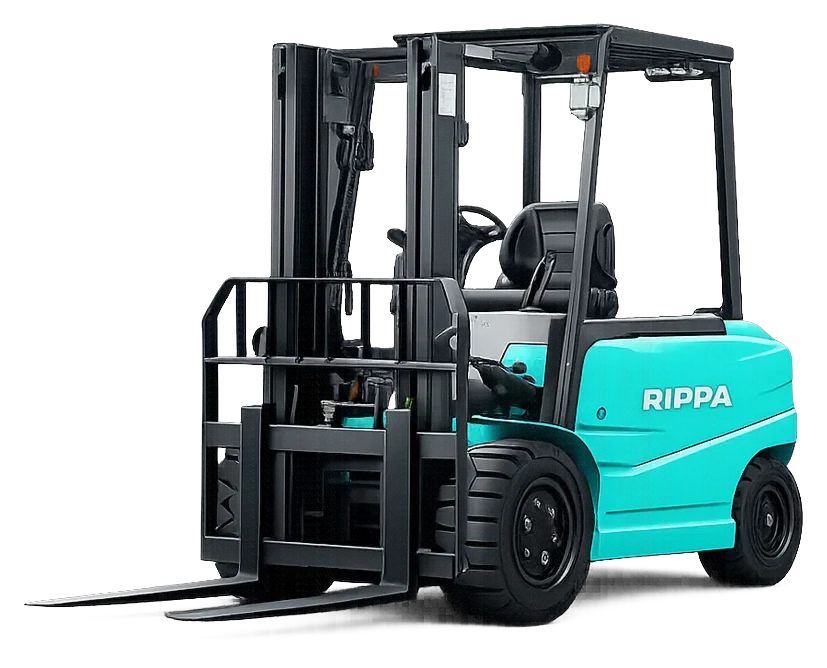
The Rippa RF20E electric forklift we offer at EKSFORK lifts its forks up to 4.5 metres with its three-stage triplex mast with free lift; a side shifter and fork positioner are also fitted. Prices start from 599.000 ₺ + VAT.
This set-up suits businesses that use medium-height racking in an enclosed warehouse, load and unload containers or enclosed vehicles, or work where height is limited, such as low doorways or under mezzanines. We cover other measurements, such as aisle width and floor, in our guide to choosing a warehouse forklift.
Quick checklist
- Measure the level of the top beam and add the clearance allowance: that is the lift height you need.
- Measure the clear height of the lowest door, beam and passage: the closed height must stay below it.
- Measure the level of the ceiling, lighting and sprinklers: the extended height and the top of the load must stay below it.
- If you will be working in containers, enclosed truck bodies or under mezzanines, ask for the free lift value in writing.
- Check on the capacity plate whether your heaviest pallet can be handled at the highest level.
- Before delivery, check the view through the mast from the operator’s seat.
- Add chain, roller and hose checks to your maintenance plan.
Let’s work out together which mast will do the job with your door, rack and ceiling dimensions: take a look at the RF20E’s technical specifications, send us your measurements on WhatsApp, and we’ll give you a clear answer.