When choosing a forklift, most businesses look at two numbers: capacity and price. Yet whether a forklift will actually do the job in your warehouse is usually decided by the building: the height of the racks, the width of the aisles, the condition of the floor, the doors and the ramps.
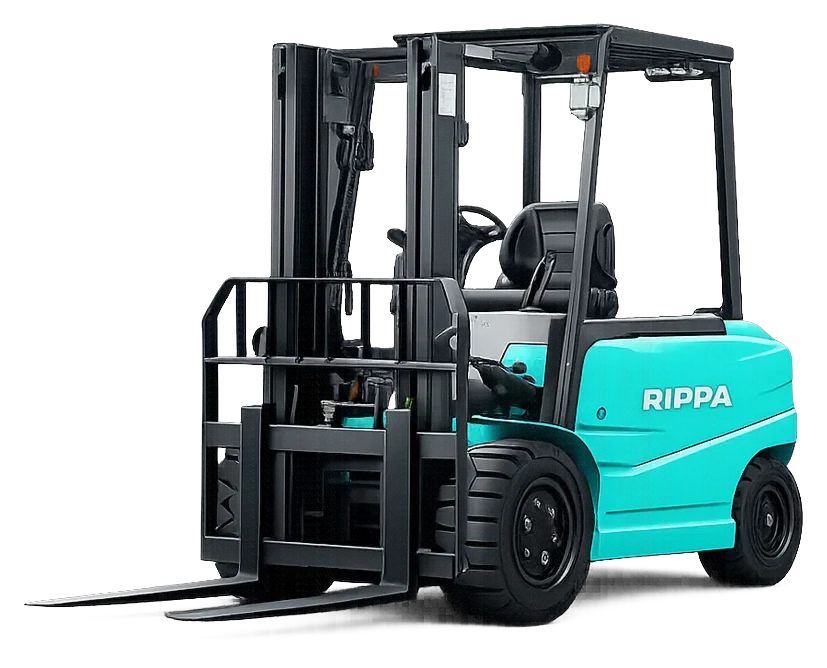
This guide explains how to measure your warehouse before you talk to a seller. It shows which technical value on the forklift each measurement corresponds to, gives you a method for calculating aisle width and provides a site survey list you can fill in and take along. Our example values are based on the Rippa RF20E.
Start with your load profile
Before you turn to the warehouse dimensions, be clear about what you will be carrying; the load dimensions feed into both the aisle calculation and the rack calculation:
- Pallet size and entry direction: 800 × 1,200 mm and 1,000 × 1,200 mm are common pallet sizes. Which side you pick the pallet up from changes the “load length” in the aisle calculation.
- Heaviest and most frequent load: The value you compare with the capacity plate is the heaviest load, while the speed and productivity calculation is driven by the load you move most often.
- Load height: You need the total height of the load including the pallet to check the rack openings and the ceiling.
- Non-standard loads: If you have loads such as long profiles, rolls or crates, note them separately; they change both the load centre and the aisle requirement.
Also note the intensity of use: how many hours a day it will work, how many pallets will move per hour and how many shifts you run. This determines both the energy plan and whether a single forklift will be enough. The RF20E’s stated working time is 8–10 hours and its charging time 6–8 hours, which fits comfortably with a single-shift pattern.
We explain how to compare the weight and centre of gravity of your load with the capacity plate in our load chart guide. If you haven’t yet decided between a counterbalance forklift and a stacker, start with our types of forklift guide.
Turning rack height into lift height
When you translate rack dimensions into forklift terms, what counts is not the total height of the rack but the top edge of the highest beam. Because the pallet will be set down on that beam, the forks need to be able to rise a little above it.
- Measure from the floor to the top face of the highest beam.
- Add a clearance so the pallet goes in without rubbing on the beam; the higher the level, the bigger this clearance should be.
- Compare the figure with the forklift’s lift height. The RF20E’s lift height is 4.5 metres.
- Check on the capacity plate that the heaviest pallet destined for the top level can be lifted to that height.
Two details are often overlooked. The first is fork size: the RF20E’s forks are 40 mm thick, 100 mm wide and 1,070 mm long, and the pallet’s entry opening and the clearance needed when setting down on the rack are assessed against these dimensions. The second is the rack’s own capacity: how much a rack beam will carry depends not on the forklift but on the rack manufacturer’s label.
We cover mast types, free lift and the lowered height calculation in detail in our forklift mast types guide.
Forklift aisle width: work it out with a formula
Most debates about aisles start with the question “will this forklift turn in a narrow aisle?” You can answer it by calculation instead of guesswork. The aisle width a counterbalance forklift needs to pick up and set down loads at right angles to the rack is calculated roughly as follows:
Aisle width = turning radius + distance from front axle centre to fork face + load length + safety margin
- Turning radius: The radius of the arc traced by the machine’s outermost rear point as it turns. On the RF20E it is 1,700 mm.
- Distance from front axle centre to fork face: Technical data sheets give this as a separate line; ask for it for every machine you get a quote for.
- Load length: The side of the pallet that extends towards the forklift. If you handle an 800 × 1,200 mm pallet lengthwise, use 1,200 mm.
- Safety margin: The clearance left for the rack, the load and operator error. A few hundred millimetres is commonly used in calculations.
Example (illustrative figures; do the calculation with your own values): With a 1,200 mm pallet and a 200 mm safety margin, the calculation for the RF20E looks like this: 1,700 + 1,200 + 200 = 3,100 mm, with the front axle to fork face distance added on top. Your aisle should not be narrower than this total.
This calculation is for a single forklift picking up and setting down loads at right angles to the rack. If pedestrians will use the aisle at the same time, two forklifts will meet or the operator is inexperienced, the margin should be bigger. As well as the machine width (1,100 mm on the RF20E), take the width of the load into account; if the load is wider than the machine, it is the load that decides in narrow passages.
The same calculation applies to areas without racking where goods are block-stacked on the floor. Here the height is set more by the product than by the forklift: don’t raise the stack until you know how much weight the bottom pallet and its packaging can bear.
Floor: flatness, load-bearing capacity and gradient
A forklift on solid tyres passes every floor defect straight on to the machine and the load. When you assess the floor, look for answers to these questions:
- Flatness: Are there cracks, potholes, broken joints or differences in level? Dropping into a pothole with a raised load turns a small difference at floor level into a big sway at the top of the mast.
- Surface: Is the floor oily, dusty or wet? A slippery floor lengthens the stopping distance. Also bear in mind that black tyres can mark epoxy and painted floors.
- Load-bearing capacity: The RF20E itself weighs 3,040 kg; add a 2,000 kg load and the total exceeds 5 tonnes. Mezzanines, goods lifts, manhole covers, drainage grates and dock bridges must carry this total with a safe margin. If you are not sure, get a written opinion from a structural engineer.
- Gradients and ramps: Measure the gradient and length of the ramps at the warehouse entrance and the height of the edges at transition points. Harsh transitions are hard on both the load and the tyres.
- Link to outdoor areas: If the forklift will go out into the yard or an open storage area, that ground has to be assessed too. There is a big difference between compacted, even ground and gravel or mud.
We explain how tyre type relates to the floor in our forklift tyres guide.
Doors and passages
A door should be comfortably wider than the machine and the load, and comfortably higher than the forklift’s lowered height. Bear in mind that strip curtains reduce visibility and that automatic doors take time to open. The RF20E’s machine dimensions are 2,250 × 1,100 × 2,150 mm; compare your door dimensions with these values and with the lowered height of the mast. For a laden machine to approach a door straight on, there must be room to manoeuvre on both sides of it; stock stacked right in front of the door wipes that space out.
Plan the charging point from the start
The charging point is something businesses buying an electric forklift often overlook. Instead of a “we’ll find a socket when the machine arrives” approach, decide where it goes from the outset:
- The RF20E’s charging system takes a 220V input; have an electrician check that the circuit and the socket are suitable.
- The charging point should be dry and ventilated, and well away from flammable materials and fire exits.
- Where the forklift parks during charging must not block an aisle or a walkway.
- Because charging takes 6–8 hours, this space has to be kept free for the machine overnight.
- Keep a fire extinguisher suitable for electrical fires near the charging area, and mark the area out on the floor.
We cover charging habits in detail in our forklift battery guide.
From measurements to forklift specifications: conversion table
| What you measure in the warehouse | What it means on the forklift | RF20E value |
|---|---|---|
| Top beam level + clearance | Lift height | 4.5 m |
| Lowest door, beam or passage | Lowered height | Confirm in the quote |
| Ceiling, lighting and sprinkler level | Extended height + load height | Confirm in the quote |
| Rack aisle width | Turning radius and aisle calculation | 1,700 mm turning radius |
| Door and passage width | Machine and load width | 1,100 mm machine width |
| Heaviest pallet | Capacity (as per the plate) | 2,000 kg |
| Load-bearing capacity of mezzanine, ramp or lift | Machine weight + load | 3,040 kg + load |
| Floor type and condition | Tyre type | Solid (front 650-10, rear 500-8) |
| Different pallet sizes | Fork spacing adjustment | Fork positioner fitted |
| Narrow rack openings, precise placement | Sideways shift | Side shifter fitted |
| Charging point | Charging system | 60V, 220V input, 6–8 hours |
We look at where a side shifter and fork positioner save time in the warehouse in a separate guide: what are a side shifter and fork positioner?
Traffic flow: where will the forklift turn and where will it wait?
The measurements tell you whether the machine fits in the warehouse; the traffic flow decides how efficiently and safely it will work. When you look at the warehouse plan, mark these points:
- Turning and manoeuvring pockets: At the ends of aisles, in front of doors and in the dispatch area there should be spaces where the machine can turn easily. If an aisle is closed off by a wall at the end, the forklift has to reverse out, which means both lost time and added risk.
- One-way flow: If possible, handle goods-in and dispatch through separate doors and set up a one-way loop in the main aisle. The fewer the encounters, the higher both speed and safety.
- Walkways: Separate walkways with floor markings, and with barriers where possible; put mirrors at blind corners. Don’t let the forklift aisle become a shortcut for pedestrians.
- Fast-moving products: Placing these products close to the dispatch area and on the lower levels cuts the forklift’s daily travel and the number of lifts.
- Parking and waiting area: The place where the forklift stands when it isn’t working must not block an aisle, a fire hose cabinet or an emergency exit.
Site survey list: before you talk to a seller
- Weight and dimensions of the heaviest pallet (width, length, height).
- The pallet sizes you use and which side the pallets are picked up from.
- Top beam level and number of rack levels.
- Lowest point of the ceiling, lighting and sprinkler lines.
- Width of the narrowest rack aisle and of the main aisle.
- Clear width and height of the doors.
- Condition of the floor: cracks, joints, ramps, gradients, wet areas.
- Load-bearing capacity of any mezzanine, goods lift or dock bridge.
- Ground surface of any outdoor area the forklift will use.
- Proposed location and power supply for the charging point.
- Daily working hours and number of shifts.
Common measuring mistakes
- Measuring the upright, not the beam: The top of a rack upright is higher than the top beam. Working out lift height from the upright pushes you towards a needlessly large machine.
- Measuring the door at the frame: The clear opening is what is left after deducting the door leaf, rails, shutter box and threshold.
- Forgetting the sprinkler heads: Even if the ceiling looks high enough, the lowest point is set by the sprinklers, lighting and cable trays.
- Ignoring overhanging loads: Boxes overhanging the pallet take up more room than the pallet itself, in both the aisle and the rack opening calculations.
If you send us this list along with photos, we can tell you much more quickly and clearly whether the machine suits your warehouse.
Summary
- In a warehouse, the building chooses the forklift: racks, aisles, floor and doors matter as much as capacity.
- For racks, add a clearance to the top beam level and compare the result with the lift height.
- Work out the aisle with the formula: turning radius + axle-to-fork distance + load length + safety margin.
- On the floor, allow for the combined weight of machine and load, and for the ramps.
- Plan the charging point before the machine arrives.
To compare your measurements with the RF20E’s values, see the RF20E product page; send us your site survey list on WhatsApp and we’ll assess together whether it suits your warehouse.