In most businesses forklift tyres only come to mind when there is a problem: the machine starts to judder, the load sways, the operator complains that the steering pulls. Yet the tyre is the only part of the forklift that touches the ground, and because most forklifts have no suspension, it is both the machine’s wheel and its shock absorber.
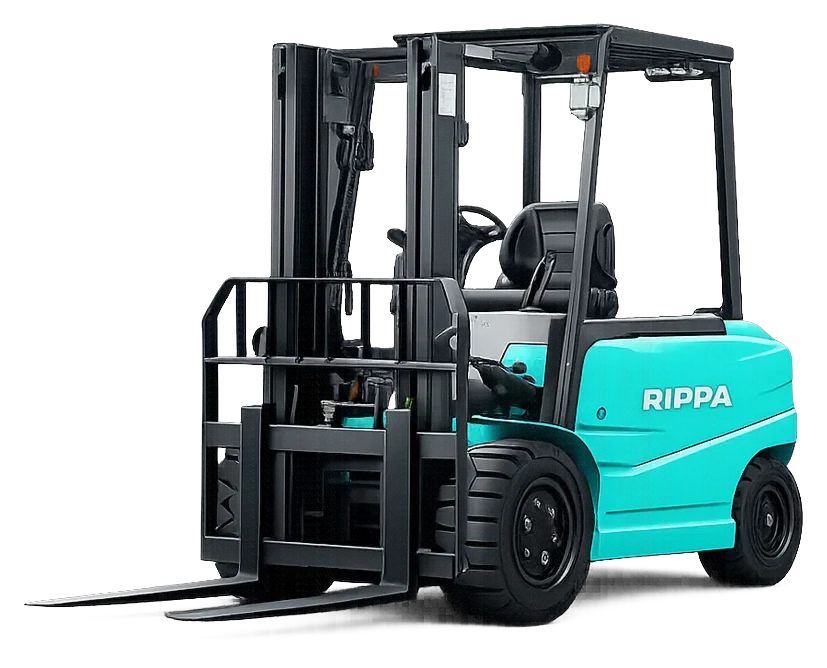
In this guide we cover the types of forklift tyre, how to read tyre sizes, the signs that it is time to replace them and the habits that wear tyres out early. We use the Rippa RF20E, which comes on solid tyres, as our example: 650-10 at the front and 500-8 at the rear.
Why do tyres matter so much?
In a car, the suspension soaks up bumps in the road; most counterbalance forklifts have no such system. Every impact from the floor passes through the tyre straight into the chassis, the mast, the load and the operator’s back. So the condition of the tyres affects several things at once:
- Stability: A worn or unevenly worn tyre tilts the machine sideways or forwards; with a raised load, that small tilt is magnified.
- Ground clearance: As the tyres wear, the machine sits lower; the underside of the chassis may start to scrape on ramps and thresholds.
- Load safety: Jolts shift goods on the pallet and loosen stacks.
- Machine life: A tyre that can’t dampen impacts strains many parts, from the bearings to the mast.
- The operator: Constant vibration increases fatigue and lapses in concentration.
Tyres also determine braking distance and grip on ramps. Seen this way, choosing and monitoring tyres is as much a safety matter as a maintenance one; we explain the basic stability rules in our forklift safety guide.
Types of forklift tyre: pneumatic, solid and press-on
Pneumatic tyres
This type is filled with air and resembles a car tyre. It absorbs impacts best and grips most strongly on rough ground, which gives it the edge on gravel, earth and uneven outdoor surfaces. In return, it can puncture, needs regular pressure checks, and a tyre that loses pressure tilts the machine to one side and upsets its stability.
Solid tyres
This type fits the same kind of rim as a pneumatic tyre but is solid rubber throughout; it is also sold as a “super elastic” tyre. It cannot puncture, needs no pressure checks and removes the maintenance hassle where sharp objects are around. Its shock absorption is lower than a pneumatic tyre’s, so jolts increase on very rough ground, and it can heat up over long, fast runs. The RF20E comes on this type of tyre.
Press-on tyres
A thin-profile tyre pressed onto a steel band. It is used mostly on compact warehouse machines that work on smooth concrete floors. It is quiet and efficient on smooth floors, but quickly reaches its limits on rough ground or outdoors.
There are also non-marking versions of these types made from a light-coloured compound. They are preferred in food, pharmaceutical and other facilities where cleanliness is critical, and on light-coloured painted floors. Since their wear behaviour may differ from standard tyres, ask before choosing them, and tell us about your floor and how intensively the machine is used.
| Feature | Pneumatic | Solid | Press-on |
|---|---|---|---|
| Puncture risk | Yes | ✅ None | ✅ None |
| Shock absorption | ✅ High | Medium | Low |
| Suitable surface | Rough ground, earth, gravel | Concrete, asphalt, smooth outdoor areas | Smooth indoor floors |
| Routine checks | Pressure, tread, sidewall | Tread, wear line, chunking | Tread, band separation |
| Replacement | Removal and fitting need care | Needs a press and equipment | Needs a press |
| Typical use | Outdoor yards, construction sites | Warehouse and outdoor areas combined | Compact warehouse machines |
Before you change tyre type
Some businesses want to switch from pneumatic to solid to get rid of punctures, or from solid to pneumatic for comfort. With a suitable rim this is often possible; however, the tyre type can change the machine’s height, footprint and stability, and the capacity ratings may have been given for a specific tyre type. So don’t change tyre type on your own initiative — do it only with the approval of the manufacturer or the service provider.
How to read tyre sizes: 650-10 and 500-8 as examples
The size printed on the sidewall of a forklift tyre is the first piece of information you need when ordering. Let’s take the sizes on the RF20E as an example:
- 650-10 (front): The first part gives the tyre’s nominal section width (6.50 inches), the second the rim diameter (10 inches).
- 500-8 (rear): 5.00 inches nominal width, 8-inch rim diameter.
The front tyres are larger because on counterbalance forklifts the front axle carries the load and usually provides the traction, while the small tyres at the rear do the steering. So the front tyres work harder under load, while the rear tyres wear by scrubbing against the floor in turns.
When asking about new tyres, give more than just the size: the tyre type (solid or pneumatic), whether it should be non-marking, the rim type and, if possible, a photo of the current tyre’s sidewall. The same size may come in versions for different rim designs.
When do forklift tyres need replacing? The wear line and other signs
Track tyre replacement by the condition of the tyre, not by the hours; even on the same machine, differences in use and floor surface change tyre life enormously. The signs that it is time to replace are:
- Tread down to the wear line: Many solid tyres have a wear limit mark on the sidewall. Once the tread is down to this line, the tyre has reached the end of its life.
- Chunking: Pieces of rubber breaking away from the tread increase jolting and imbalance.
- Deep cracks and sidewall damage: Cuts in the sidewall in particular can grow under load.
- Separation from the rim or band: If there is a gap, slip marks or separation where the tyre meets the rim, the machine should be shown to a service technician without delay.
- Flat spots: Skidding with a locked wheel or hard braking can leave flat spots on the tyre, causing a rhythmic thumping when driving.
- On pneumatic tyres: Frequent pressure loss, bulges, reduced tread depth and sidewall injuries.
What the operator feels is also an important indicator. Increased vibration, steering that pulls to one side, a machine leaning slightly on a level floor and a load swaying unusually are reason enough to bring the tyre check forward.
Don’t wait for a failure to replace tyres. When you notice a tyre approaching the wear line, plan the change before the busy season or for a quiet day, and ask in advance how long new tyres take to arrive. A photo taken from the same angle every month is the simplest way to see how fast the tyre is wearing and to estimate the replacement date.
Habits that wear tyres out early
The same tyre can last a long time in one warehouse and wear out much faster in another. The difference usually comes down to these habits:
- Wheelspin and harsh starts: Sudden starts, especially when loaded, tear rubber off the front tyres.
- Hard braking: A locked wheel skids and leaves a flat spot on the tyre.
- Fast turns on the spot: The rear tyres scrub on the floor in turns; turning tightly at speed multiplies this scrubbing.
- Overloading: Excess load increases heat build-up and deformation, especially in the front tyres.
- Sharp objects: Metal swarf, glass, pallet nails and broken bits of wood cut into the tread. Regular floor cleaning directly extends tyre life.
- Poor floors and hard transitions: Broken joints, ramp edges and manhole frames put impact loads on the tyre.
- Oil and chemicals: Oil on the floor and some chemicals degrade rubber over time.
- Dock plate edges: Hitting the edge of a loading dock plate hard and at an angle puts an impact load on the tyre sidewall; drive onto the plate straight and slowly.
We describe the floor and layout measures in our choosing a warehouse forklift guide. Remember too that tyres harden and grip less in the cold; details are in our electric forklifts in cold stores guide.
Doing the replacement right
- Replace the tyres on the same axle together. An axle with one new tyre and one worn tyre makes the machine lean to one side, and the mast and load carry that tilt.
- Use tyres of the same type and specification. Don’t mix pneumatic and solid tyres, or different compounds, on the same axle.
- Leave the job to a service provider with the right equipment. Changing solid and press-on tyres needs a press and suitable tooling. On pneumatic tyres, removing a split rim incorrectly can cause serious injuries.
- Check after the change. The wheel nut torque, the machine standing level on a flat floor and the mast being vertical should all be checked.
- Look at the old tyre. One-sided or irregular wear can be a sign of a problem with the track rod, the bearings or driving habits. Find the cause before the new tyre wears out the same way.
You can send us your tyre size and a photo of the sidewall via the service request form; these two pieces of information make it much easier to identify the right product.
If you keep a spare tyre, store it somewhere cool, dry and out of the sun; keep it away from ozone sources such as electric motors, and from oil and chemicals. Before fitting a tyre that has been in storage for a long time, check it for cracks and hardening.
Weekly tyre check
The start-of-shift check includes a quick look at the tyres; we describe this step in our daily checklist guide. Once a week, carry out a more thorough check:
- Park the machine on a level floor, lower the forks and switch the machine off.
- To check the parts of the tyres you can’t see, move the machine forward half a wheel turn and repeat the check.
- Look for metal, glass or nails embedded in the tread; remove them if it is safe to do so.
- Compare the tread height with the wear line.
- Note any chunking, cracks and sidewall damage.
- Check the rim or band joint, the wheel nuts and the rims for cracks.
- If the machine has pneumatic tyres, measure the pressure against the value in the manual.
- Record your findings with the date and the hour meter reading; that makes it easier to plan replacement.
Work out tyre costs per hour
Looking only at the price tag when buying tyres is misleading. If a cheaper tyre wears out in half the time, the choice that looks like a saving at first ends up costing more in the long run. Compare tyres with this formula:
Tyre cost per hour = (cost of the tyre set + fitting labour + cost of downtime during the change) / hours the tyres worked
The last item in the formula requires an hour meter record: note the hour meter reading when a tyre is fitted and when it is removed. Once you keep this record for two different tyres, you can see in figures rather than guesswork which one is more economical on your floor and for your use. Don’t underestimate the cost of downtime either; on a day when dispatch depends on the forklift, a machine standing idle can cost more than the price difference between two tyres.
Summary
- On a forklift the tyre is both wheel and suspension; its condition directly affects stability and load safety.
- Solid tyres stand out on smooth floors and wherever punctures are a risk, pneumatic tyres on rough outdoor ground.
- The wear line, chunking, cracks and band separation tell you when to replace.
- Tyres on the same axle are replaced together and with the same type; the job is left to a service provider.
- Wheelspin, hard braking, fast turns and dirty floors wear tyres out early.
For the RF20E’s tyre sizes and other technical data, see the product page; for a tyre change, send the size and a photo to our technical service line on WhatsApp.