The moments that waste time in a warehouse are usually not when the load is being moved, but when it is being set exactly in place: shuffling the forklift back and forth a few times to line up with the rack location, or getting off the machine to slide the forks by hand when a pallet of a different size arrives… Movements that seem to take only a few seconds each add up to a serious amount of time by the end of the day, and to unnoticed wear on racks, pallets and tyres.
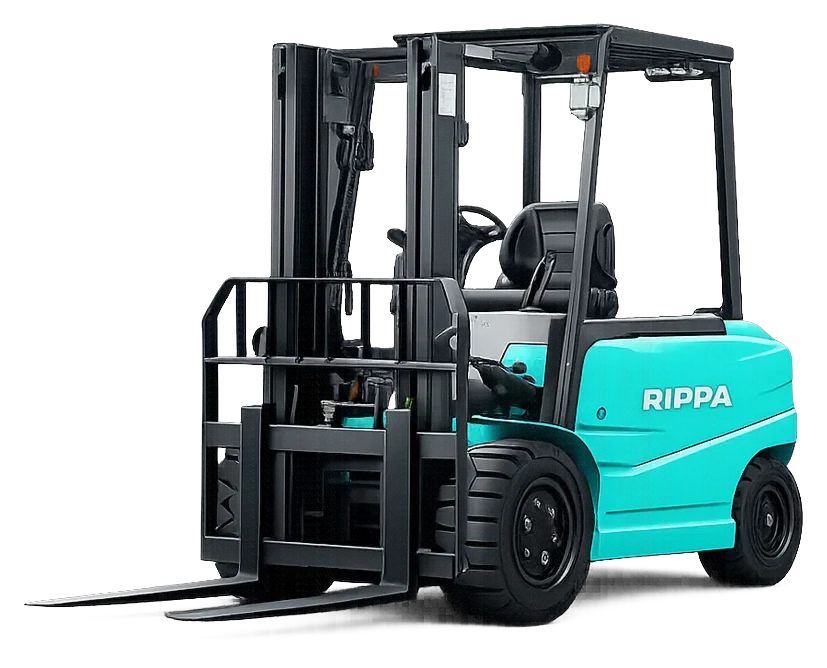
The side shifter and the fork positioner exist for exactly these moments. In this guide we explain how they both work, which jobs they really save time on, how they affect capacity and visibility, how to use them correctly and incorrectly, and how to maintain them. Both features are fitted to the Rippa RF20E, which we use for our examples.
Side shifter: moving the load, not the forklift
A side shifter lets the plate carrying the forks slide hydraulically left and right on the carriage. Using a control lever, the operator can move the load sideways over a limited distance without changing the forklift’s position. The shift distance varies from machine to machine and is stated in the user manual.
The difference shows most in the final alignment. When a forklift without a side shifter approaches a rack location slightly off line, it backs off, corrects the steering and approaches again. With a side shifter, the same correction is made without the machine moving an inch. A side shifter is especially valuable for:
- Precise placement into rack locations and between beams
- Pushing pallets up against the wall or the next pallet inside a truck bed or container
- Placing pallets tightly together in floor block stacking
- Small corrections in a narrow aisle without having to manoeuvre the machine again
Integrated or hook-on?
Side shifters come in two forms. Hook-on types hung on the carriage afterwards can be added to an existing machine, but they move the forks and the load slightly further forward. Integrated types built into the carriage move the load forward less and usually affect visibility less. When getting a quote, ask which type the equipment is and how it is reflected on the capacity plate.
Fork positioner: adjusting fork spacing from the seat
A fork positioner hydraulically opens and closes the distance between the two forks. On a standard forklift, changing the fork spacing means the operator has to get off the machine, lift the fork locks and slide the forks by hand. The RF20E’s forks are 40 mm thick, 100 mm wide and 1,070 mm long; sliding a fork of this size by hand takes time and carries a risk of trapped hands and fingers and back strain.
A fork positioner turns this job into a short control movement from the seat. Its real benefit shows in warehouses that handle loads of different sizes:
- Different pallet sizes: If 800 × 1,200 mm and 1,000 × 1,200 mm pallets arrive in the same shift, the right spacing for each is set in moments.
- Picking up a pallet from either side: The fork spacing you need changes depending on whether you take the pallet from its short or long side.
- Unpalletised or wide loads: With loads such as crates and boxes, you can open the forks to the most stable position for the width of the load.
- Loads with fixed lifting points: Setting the fork spacing to the load’s lifting points stops the load from sliding.
On many machines the two functions come in a single integrated unit; both side shift and fork spacing are controlled on the same carriage.
To get the most out of a fork positioner, rather than judging the fork spacing by eye for every load, set reference spacings for the pallet sizes you use most and show them to your operators. Some businesses indicate these spacings with small marks on the carriage; this also shortens the time it takes a new operator to get used to the machine.
Where do they save time? Five typical scenarios
- Rack placement: An operator approaching a high rack location adjusts the last few centimetres with the side shifter, not the machine. Back-and-forth manoeuvring, mast sway at height and the risk of scraping the beam all go down.
- Truck and container loading: To line pallets up side by side without gaps inside the truck bed, a side shifter is almost indispensable; pushing the last pallet up against the wall is a fiddly job that is hard to do by shuffling the machine back and forth. We describe the loading steps in our loading trucks and containers by forklift guide.
- Mixed pallet sizes: If different pallets arrive from different suppliers at goods-in, a fork positioner saves the operator from getting on and off for every pallet.
- Block stacking: Placing pallets tightly side by side and on top of each other on the floor saves space.
- Tight spaces: If the aisle is narrow and room to manoeuvre is limited, every correction means time and risk. A side shifter removes some of these movements.
The value of these features becomes clearer when you consider them alongside your aisle and rack dimensions; we give the measuring method in our choosing a warehouse forklift guide.
How much time? Do your own calculation
The size of the gain varies from business to business, so instead of giving a general figure we share the method. For a week, time a few typical jobs with a stopwatch and set up this calculation:
Daily gain (seconds) = number of pallets needing alignment × seconds saved per pallet + number of fork adjustments × seconds saved per adjustment
Divide the result by 60 to convert it to minutes.
Example (illustrative figures — calculate with your own values): If 80 pallets a day are placed into racks or trucks and the side shifter saves 15 seconds per placement, that comes to 80 × 15 = 1,200 seconds. If the fork spacing is changed 6 times a day and getting off and back on the machine takes 120 seconds each time, add 720 seconds. That is 1,920 seconds in total, or 32 minutes a day.
There are gains beyond time too: less scraping of rack uprights and beams, fewer broken pallets, less tyre wear because there is less turning, and an operator who is less tired at the end of the day.
Effect on capacity and visibility
To be honest, this equipment has a price too. A side shifter and fork positioner add an extra body, extra weight and extra thickness in front of the carriage. This means the load’s centre of gravity sits slightly further from the mast. As a result, the load the same forklift can lift safely may be lower than without the equipment.
So make sure the capacity plate is valid with the equipment currently fitted to the machine. If the equipment was added later, have the capacity value confirmed by the manufacturer or the service provider. We explain how to read the plate and the load chart in our load chart guide.
There is a small effect on visibility as well: the cylinders and hoses on the carriage can slightly narrow the operator’s view of the fork tips. It is enough for the operator to pay particular attention to this while getting used to the machine.
Correct use: dos and don’ts
- Shift the load while it is low wherever possible. If you need to shift at height when placing into a rack, use short, slow movements.
- Centre the load before you travel. Travelling a long distance with the load shifted to one side moves the centre of gravity sideways and weakens lateral stability.
- Set the fork spacing before you lift the load. Opening and closing the forks while they are under the load strains the pallet and the equipment.
- Open the forks wide and symmetrically for the load. The load should sit centred between the two forks on as wide a base as possible.
- A fork positioner is not a clamp. It is not designed to hold a load by squeezing it from both sides; using it this way can cause the load to fall and damage the equipment.
- Don’t push with the side shifter. Don’t use it to push a load or pallet sideways, or to press it against a wall or rack.
- Know your levers. Learn which movement the lift, tilt, side shift and fork spacing levers make by trying them without a load; the wrong lever can drop the load.
There is also a habit trap: relying on the side shifter and approaching the rack carelessly. The equipment is for the final fine adjustment after a correct approach; if every placement uses the full shift travel, the equipment wears unnecessarily and the load is constantly carried off-centre. Line the machine up correctly first, and use the side shifter for the last few centimetres.
A practical tip: to see the side shifter’s centre position at a glance, paint a matching mark on the carriage and on the shift plate. When the marks line up, the load is centred; the operator checks this with a single look before moving off.
Maintenance: slides, hoses and cylinders
Both units are hydraulic and made up of moving parts. Without regular maintenance, the movement first becomes stiff, and then leaks and wear set in:
- Sliding surfaces: The surfaces the side shifter slides on and the fork bearings of the fork positioner should be lubricated at the interval in the manual, and dirt and swarf cleaned off them.
- Hoses: The hoses for this equipment run up the mast over pulleys to reach the carriage. Chafe, crush and kink points should be checked regularly; we describe the hose routing and mast design in our forklift mast types guide.
- Cylinders and fittings: Wet patches, drips or oil traces point to a seal or connection problem.
- Even movement: When opening and closing, both forks should move at the same speed and over the same distance. If one lags behind, report it to service.
- Abnormal noise: Squeaking or sticking during shifting is the first sign of insufficient lubrication or wear.
A quick test of this equipment should be part of the start-of-shift check: shifting the carriage both ways and opening and closing the forks once takes a few seconds. We describe the full check in our forklift daily checklist guide.
Where do they really make a difference?
| Feature | What does it do? | Where it helps most | Watch out |
|---|---|---|---|
| Side shifter | Slides the carriage and forks sideways | Rack placement, truck and container loading, block stacking | Centre the load for long distances |
| Fork positioner | Opens and closes the fork spacing from the seat | Mixed pallet sizes, wide and unpalletised loads | Don’t use it as a clamp |
| Both together | Both alignment and spacing adjustment | Warehouses with heavy goods-in and dispatch traffic | Check the capacity plate with the equipment fitted |
For a business that moves a few pallets a day, works with a single pallet type and doesn’t stack high, these features are a convenience. In a warehouse that places dozens of pallets a day, loads trucks and containers or works with different pallet sizes, they are an important part of productivity.
If you are looking at a used machine, check this equipment separately: is there play or knocking during shifting, are the cylinders leaking, do both forks move evenly, are there chafe marks on the hoses? A problem at any of these points means an extra repair bill, even if the rest of the machine looks good.
Summary
- A side shifter moves the load sideways without changing the forklift’s position; a fork positioner adjusts the fork spacing from the seat.
- The biggest gains come in rack placement, truck and container loading, and mixed pallet sizes.
- Calculate the gain by timing your own work with a stopwatch.
- The equipment can affect capacity; confirm the plate with the equipment fitted.
- A fork positioner is not a clamp; centre the load before you travel.
Take a look at the technical specifications of the Rippa RF20E, which has both features; for options such as fork extensions and cabs, see the forklift attachments page, and send us your questions on WhatsApp.