Because they produce no exhaust fumes, electric forklifts are a popular choice in cold stores and indoor food facilities. But the cold affects every part of the machine, from the battery to the hydraulic oil and from the tyres to the electrical connections — and the operator too. Forklifts working outdoors in winter face similar problems: icy ground, condensation and batteries that run out early.
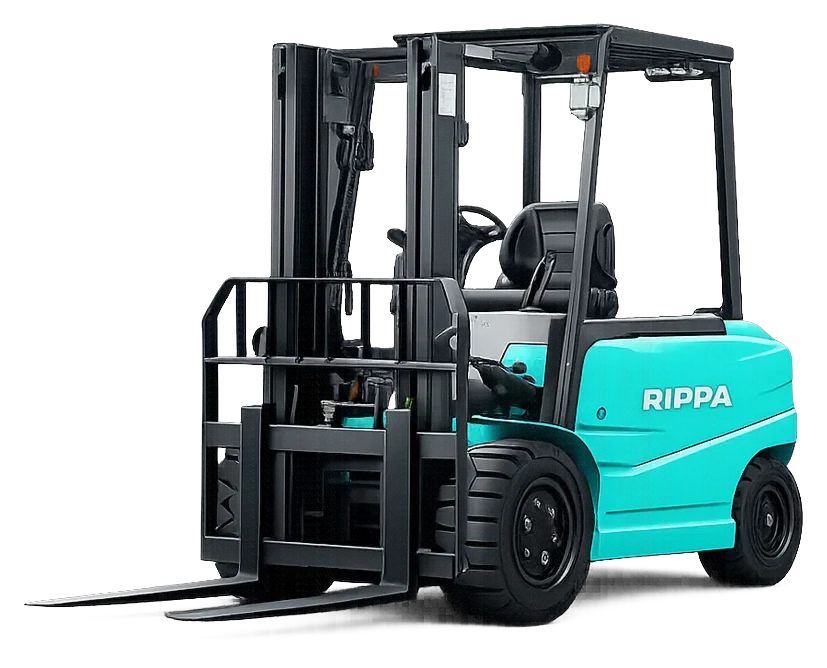
In this guide we explain what the cold does to an electric forklift, why moving between a cold store and warm areas carries risks, where and how charging should be done, and how to prepare before winter. We use the Rippa RF20E for our examples.
An honest note from the start: a chilled room working above freezing and a frozen goods store at sub-zero temperatures are not the same thing. Continuous work below zero may require special equipment on many forklifts. If you are thinking of using the RF20E in such an environment, share your store’s temperature range with us before you buy; we will work out together whether it is suitable and what precautions are needed.
What does the cold do to a forklift? Five effects
Each effect of the cold may seem small on its own; together, they noticeably change the machine’s performance and safety.
| Affected part | What happens in the cold? | Symptom | Precaution |
|---|---|---|---|
| Battery | Chemical reactions slow down, usable capacity drops | Shorter run time, gauge drops quickly | Start fully charged, don’t leave it flat, charge in a mild area |
| Hydraulics | Oil thickens | Heavy, slow lifting in the first few minutes | Unladen warm-up movements, oil to the manual’s spec |
| Tyres | Rubber hardens, the floor can ice up | Less grip, longer braking distance | Low speed, gentle braking, checking the floor |
| Electrics and connections | Condensation when moving between cold and warm | Error codes, oxidation, poor contacts | Fewer transitions, drying, socket checks |
| Operator | Hand dexterity and concentration drop | Rough control inputs, fatigue | Suitable clothing and gloves, warm-up breaks |
In the sections below we cover these headings one by one.
Battery and charging: managing energy in the cold
The run time given for the RF20E is 8–10 hours; figures like this are usually given for normal ambient conditions. On a cold shift the same battery can run out sooner. This isn’t a fault; it is the nature of lead-acid-based batteries. What you need to do is manage energy accordingly:
- Start the day fully charged. In the cold, a half-charged battery runs out much faster than on a mild day.
- Don’t leave a flat battery in the cold. A discharged battery is more vulnerable to the cold; when the shift ends, put the machine on charge without delay.
- Don’t charge inside the cold room. A cold battery accepts charge less readily. The charging point should be in a dry, ventilated, mild area.
- Connect sockets and connectors only when dry. A machine coming from a cold area may have condensation; make sure the socket is dry before plugging in the charger.
- Watch the gauge closely. In the cold the gauge can drop faster; when it nears the low zone, wrap up the job and go and charge.
Be aware too that some battery gauges may read lower than the true level in the cold and recover somewhat once the machine moves to a warmer area. Don’t rely on this recovery and go back into the cold room with a low battery; once the gauge has dropped into the low zone, organise the rest of the shift around the charging plan.
The most practical way to plan for the shorter run time in the cold is to collect your own data: for a few weeks, note the battery gauge and the outdoor or room temperature at the start and end of every shift. That way you can see in advance at which temperature the shift gets tight on battery. On tight days it also helps to schedule heavy lifting and long-distance jobs for the start of the shift, when the battery is full; not leaving the machine switched on during breaks is a small but real saving. We describe the general charging habits that extend battery life in detail in our forklift battery guide.
Condensation: the hidden risk of moving between cold and warm
A cold bottle taken out of the fridge is soon covered in droplets in a warm room. The same happens to a forklift coming out of a cold store: when chilled metal surfaces meet warm, humid air, water collects on and inside them. This water can reach the sockets, connections, the control unit and even the brake components.
A single transition may not cause a problem, but going in and out many times a day can lead to oxidation, poor contacts and electrical faults whose source is hard to find. When the machine goes back into the cold room, this moisture can freeze. To reduce the risk:
- Plan the workflow so that the forklift doesn’t shuttle unnecessarily between cold and warm areas.
- Group cold-room jobs together as much as possible; cut down on frequent short trips inside, while also keeping an eye on how long the operator stays in the cold.
- After the machine leaves the cold area, let it stand in a dry, ventilated area; don’t cover it with a tarpaulin straight away — let the moisture escape.
- Keep door thresholds dry; condensed water can turn to ice at the threshold.
- During the daily check, look for oxidation, moisture and blackening on the sockets and connections.
What faults caused by condensation have in common is that they come and go: the machine gives a warning shortly after leaving the cold room, and it clears once the machine dries out. In that case, note at what time, after which transition and for how long the fault occurs, and photograph any white or greenish oxide traces on the connections. Going to your service provider with this information noticeably shortens the diagnosis of a fault whose source is hard to find.
Hydraulic and mechanical parts
In the cold, hydraulic oil thickens. That is why the mast moves heavily and slowly on the first lift in the morning. Sudden, loaded movements with thick oil strain both the pump and the seals.
- Warm-up movements: Before starting work, do a few unladen lift-and-lower, tilt and side shift movements; let the oil warm up and circulate through the system.
- Oil grade: The oil grade in the user manual is what counts. If the machine will work continuously at low temperatures, discuss with your service provider whether the oil suits this environment.
- Seals: Seals that harden in the cold can leak more easily. Pay particular attention to the cylinders and fittings during the daily check.
- Chains and slides: Grease and oil that stiffen in the cold make movement harder on chains and slides. Ask your service provider whether the lubricant you use is suitable for low temperatures.
- Brakes: Moisture and ice can affect braking performance. After leaving the cold room, test the first braking at low speed.
For requests about hydraulic oil, lubrication and winter maintenance, you can use the service request form.
Tyres, floors and driving
In the cold, the rubber of solid tyres hardens and grip on the floor decreases. A thin layer of ice from condensation can form on cold store floors; outdoors in winter, snow, ice and mud come into play as well.
- Reduce speed and allow for a longer braking distance. Although the RF20E’s top speed is 14 km/h loaded and 16 km/h unladen, stay well below these figures on slippery floors.
- Avoid sudden steering, harsh starts and hard braking; on a slippery floor both the load and the machine slide more easily.
- Take extra care on ramps; an icy ramp is a serious risk for a loaded forklift.
- Outdoors, clean the machine after driving on salted surfaces; salt speeds up corrosion.
- Clear snow and ice from the forks, carriage and steps; a slippery step is a fall risk for the operator.
We cover how the different tyre types behave on slippery floors, and when to replace them, separately in our forklift tyres guide.
Passing through the cold room door
High-speed doors and strip curtains block the view. Slow down before going through the door, and stop and sound the horn if necessary; a pedestrian or vehicle on the other side may not see you. Water and ice collecting at the threshold make it the most likely spot for a loaded forklift to skid; have the threshold cleaned regularly and go through the door in a straight line.
Don’t forget the operator
The cold wears out not only the machine but also the person driving it. A cold operator loses hand dexterity, uses the controls more roughly and gets distracted. This increases the risk of accidents in cold environments.
- Suitable clothing: Layered, windproof clothing and safety footwear suited to the cold.
- Gloves: Choose gloves that insulate while still allowing precise use of the control levers; thick, slippery gloves can lead to the wrong lever movement.
- Breaks: Limit the time spent in the cold area and plan warm-up breaks in a heated area. Set the times together with your health and safety adviser.
- Visibility: Fogged glasses, mirrors and windows reduce visibility; keep a clean cloth with you.
- Working alone: Someone should always know where an operator working in the cold room is; make sure the room door can be opened from the inside and that there is a way to call for help for anyone left inside.
For forklifts working outdoors in winter rain, snow and wind, a cab option is among our attachments; you can explore it on the forklift attachments page. Ask separately whether the cab is suitable for use inside a cold store.
Where should the machine be kept?
A common question in businesses with cold stores is where the forklift should stay between shifts and overnight. The general principles are:
- Overnight and during long breaks, park the machine in a dry, frost-free, ventilated area; the charging point should be there too.
- During short breaks, leaving the machine where it is working rather than going in and out frequently sometimes means less condensation; strike this balance according to your own workflow.
- A forklift left outdoors overnight is exposed to both cold and moisture; in winter, bring it indoors if possible.
- Before winter holidays and long weekends, fully charge the battery, switch the machine off and leave it somewhere with no risk of freezing; when you return, check the battery level first.
We give detailed steps for periods when the machine won’t be used for a long time in our if your machine will stand idle guide.
Pre-winter preparation checklist
- Plan a general check with your service provider before the cold sets in; a breakdown mid-season means downtime at the busiest time.
- Have the battery pack measured by your service provider; a weak block is the first part to cause problems in the cold.
- Check that the charging point is in a dry, mild and ventilated place.
- Have the sockets, cables and connections checked for oxidation and damage.
- Discuss with your service provider whether the hydraulic oil and lubricants are suitable for low temperatures.
- Check the wear on the tyres; a worn tyre is even weaker on slippery ground.
- Make sure the headlights, beacon and horn work; the days get shorter in winter.
- Plan anti-icing measures for door thresholds, ramps and outdoor crossings.
- Prepare cold-weather clothing, gloves and a break schedule for operators.
- Add lines for condensation, ice and socket checks to the daily check form; for the full form, see our daily checklist guide.
Summary
- The cold affects battery capacity, hydraulic speed, tyre grip and the operator’s concentration.
- Start the day fully charged, don’t leave a flat battery in the cold, and charge in a mild, dry area.
- Reduce transitions between cold and warm; condensation is the silent source of electrical faults.
- On slippery floors, reduce speed and avoid sudden manoeuvres.
- For continuous work at sub-zero temperatures, confirm that the machine is suitable before you buy.
Take a look at the RF20E’s technical data on the product page; send us your store’s temperature range and workflow on WhatsApp and we will assess together what is needed for use in a cold environment.