In an electric forklift, the battery set is both the machine’s energy source and one of its most expensive parts. Forklift battery prices vary with capacity, voltage and battery type, so we don’t quote figures in this guide; but using the battery correctly is the most effective way to put off the cost of replacing it. The good news is that how long a battery lasts is not down to luck: it depends largely on the charging and usage habits repeated every day.
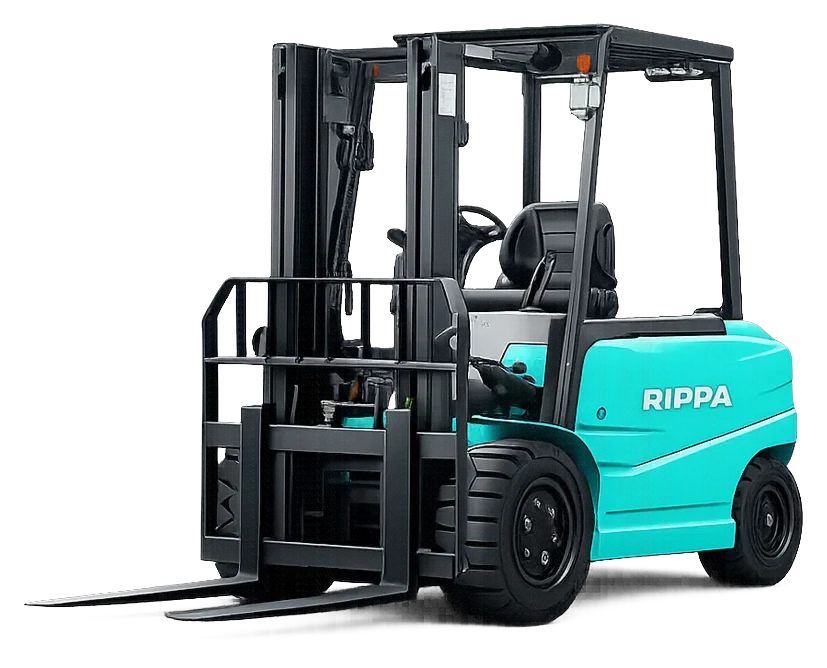
In this guide we cover the mistakes that shorten battery life, how a gel battery differs from a flooded one, the right charging routine and the signs that a battery is ageing. Our examples are based on the Rippa RF20E, which runs on a 60V battery set made up of ten 12V 200Ah gel batteries; most of the rules also apply to other forklifts with lead-acid batteries.
Three things that decide forklift battery life: cycles, depth and heat
A forklift battery’s life is measured not in years but in charge cycles. Using the battery and recharging it counts as one cycle, and every battery has a cycle life specified by its manufacturer. Three variables decide how close you get to it:
- Depth of discharge: Draining the battery right down every time means far more wear over the same number of cycles. Putting it on charge before the gauge reaches the low zone reduces the wear per cycle.
- Heat: High temperatures speed up the battery’s chemical ageing. A charging corner in direct sun or a room without ventilation quietly eats into battery life.
- Charging quality: Half-finished charges, the wrong charger and random plugging in and out during the day stop the blocks from charging evenly.
Cold, on the other hand, mainly reduces usable capacity: the same battery runs out sooner on a cold shift. If you work in cold stores or through the winter, we have gathered the details in our guide to electric forklifts in cold stores.
Gel battery forklifts: what does a gel battery do differently?
The batteries in the RF20E are gel batteries. In a gel battery the electrolyte is not a liquid but a gel, and the battery is a sealed, valve-regulated unit. This makes daily maintenance easier, but it also changes some habits:
- No water is added and the caps stay shut. The distilled water top-up done on flooded batteries is not done on a gel battery; opening the caps can damage it.
- It is sensitive to the charging profile. A gel battery must be charged with the charging curve that suits its type. A charger set up for a different battery type can overcharge it or fail to charge it fully.
- Gassing is low in normal use, but not zero. The charging area still needs ventilation.
| Aspect | Flooded (open) lead-acid | Gel | Lithium |
|---|---|---|---|
| Distilled water top-up | Required | ❌ Not done | ❌ None |
| Routine maintenance | Water level, cleaning | Cleaning, connection check | Cleaning, connection check |
| Opportunity charging during the day | Generally not recommended | Generally not recommended | May be suitable, depending on design |
| Charger | Profile for flooded batteries | Gel profile essential | Charger compatible with the battery management system |
| Gassing during charging | Noticeable | Low | None in normal use |
| Most common mistake | Forgetting the water level | Trying to add water, wrong charger | Charging with an incompatible charger |
The table shows general trends; for your own batteries, the instructions of the battery manufacturer and the machine’s operator’s manual take precedence.
How to charge a forklift battery: seven habits
- Don’t run the gauge right down. When the battery gauge reaches the low zone, wrap up the job and go and charge. Many electric forklifts protect themselves by restricting lifting when the battery gets very low; relying on that protection should not become a habit.
- Don’t interrupt charging. The RF20E takes 6–8 hours to charge. The final part of the charge is the stage that fills the battery completely and balances the blocks; pulling the plug early skips it.
- Avoid short top-ups during the day. With lead-acid-based batteries (gel included), plugging in for a few minutes over lunch means extra cycles and extra heat. If you do need opportunity charging, plan it according to the battery manufacturer’s recommendation.
- Use the right charger. Use the charging system supplied with the machine, or a charger confirmed as suitable for your battery type. The RF20E’s 60V charging system takes a 220V input; have an electrician check the socket and the circuit it will be plugged into.
- Choose the charging area carefully. Pick a spot that is dry, cool, ventilated, away from flammable materials and out of forklift traffic. There should be no smoking, sparks or naked flames near the charging point.
- Plug in and unplug properly. Connect with the machine switched off, and never pull the connector out by its cable. Don’t carry on charging with a blackened, melted or loose connector.
- Don’t leave a flat battery standing. Sulphation sets in faster when a discharged lead-acid battery is left uncharged. If the battery is low at the end of the shift, don’t put off charging until the next day.
Don’t forget the charger
A battery is only as healthy as the charger that fills it. Don’t block the charger’s ventilation holes, don’t put things on top of it, and in dusty environments have it cleaned regularly. Keep the charging cable away from forklift and pedestrian routes, and don’t carry on charging with a crushed or stripped cable. Don’t run the charger off an extension lead; plug it straight into a suitable socket. If the charger shows a fault light, or charging takes noticeably shorter or longer than usual, report it to the service team.
Shift planning: 6–8 hours’ charging, 8–10 hours’ work
The figures given for the RF20E are 6–8 hours of charging and 8–10 hours of working time. In a single-shift operation this means putting it on charge at the end of the day and starting the morning with a full battery, and that is the healthiest routine.
How long the working time will actually be in your operation depends on the workload. Frequent lifting, heavy loads, ramps, long distances and harsh starts drain the battery faster. Finding your own figure is simple: for two weeks, note the battery gauge and the hour meter reading in a notebook at the start and end of every shift.
Then look at your records. If the gauge regularly stays well above the low zone at the end of the shift, the battery is working comfortably. If it drops into the low zone before the day is out, you need to look at the workload, driving habits and battery health together.
Double shifts change the picture: if the machine has to work both day and night, there is no time left for charging. In that case you need a second machine, a change to the shift pattern or a different energy plan; let’s talk through which one suits you before you buy. For a general comparison of electric and diesel, see our electric or diesel forklift guide.
Habits that drain the battery for no reason
Of two operators doing the same job, one can run the battery flat by the afternoon while the other finishes the shift comfortably. The difference usually comes down to these habits:
- Holding the hydraulic lever against the stop: Keeping the lever pulled once the mast has reached the top or the tilt has reached its end runs the pump for nothing, and the energy used is simply turned into heat.
- Harsh starts and harsh braking: Every sudden acceleration draws a high current. Pulling away smoothly protects both the battery and the tyres.
- Unnecessary travel: Unplanned driving around, empty return trips and a disorganised layout drain the battery without getting any work done. Placing fast-moving products close to the dispatch area is a direct energy saving.
- Standing with the ignition on: Switch the machine off during long breaks; the lights, warning beacon and control unit draw current even while it is standing still.
- Dragging brakes and stiff wheels: A brake that doesn’t fully release or straining wheel bearings use a little more energy with every metre.
Weekly and monthly maintenance routine
Gel batteries may be called “maintenance-free”, but they shouldn’t be neglected. The list below sets out the checks that the operator and the person in charge of maintenance can do; jobs that involve measuring or dismantling are for the service team.
- Every shift: Battery gauge, charging connector and cable condition; any liquid, smell or abnormal heat on the battery. These checks are part of the daily checklist.
- Every week: Wipe the top of the battery with a dry cloth. When dust and moisture combine, a leakage current path can form between the terminals. Never leave tools, metal parts or cloths on top of the battery.
- Every month: White or greenish deposits or blackening on the terminals; cracked or crushed cable insulation. The tightness of the connections should be checked by trained staff or the service team.
- Periodic service: Measuring the block voltages one by one and checking the charger and connections. The interval is set by the maintenance schedule in the operator’s manual.
When working on the battery, wear safety glasses and gloves, take off metal jewellery such as rings and watches, and don’t use metal tools that could touch both terminals at once. Never wash the battery: water jets and pressure washing damage the electrical components.
Is your battery ageing? Symptom table
| Symptom | Possible cause | What to do? |
|---|---|---|
| Working time noticeably shorter | Loss of capacity, weak block, frequent deep discharge | Have the service team measure the block voltages |
| Charger says “full” very quickly | Loss of capacity, connection resistance | Have the connector and connections checked |
| Charging never seems to finish | Charger or battery fault | Stop charging and report it to the service team |
| Swollen or overheating battery case | Overcharging, internal fault | ❌ Don’t use it or put it on charge |
| Pungent smell | Overheating, gassing | Switch off the charger and ventilate the area |
| Gauge drops fast when lifting a load | Weak block, high internal resistance | Have it measured under load |
| Deposits on the terminals | Corrosion, loose connection | Have an authorised person clean them and check they are tight |
If you notice any of these symptoms, you can open a service request with photos and the hour meter reading, or write to our technical service line on WhatsApp.
One weak block wears out the whole set
The RF20E’s battery set is made up of 10 blocks that work together. When one block becomes weaker than the others, its voltage drops faster under load; because of that block the set signals “empty” too early, and the blocks don’t charge evenly. In the end, the healthy blocks are also strained more than they should be.
So when the working time suddenly gets shorter, don’t jump to the conclusion that “the battery is finished and the whole set needs replacing”. Block-by-block measurement by the service team shows whether the problem lies in a single block or in the general ageing of the set. The replacement decision is based on that measurement.
One small habit makes this tracking much easier: number the blocks and keep the result of every measurement with its date. At the next measurement you can see at a glance which block has deteriorated.
If it won’t be used for a long time
In businesses that work seasonally or close over the holidays, the battery can deteriorate even while it is standing. Follow this sequence before and after the idle period:
- Fully charge the battery before parking the machine.
- Switch the machine off and disconnect the battery as described in the operator’s manual; even small consumers drain the battery over a long idle period.
- Keep it somewhere dry, with no risk of freezing and no excessive heat.
- During the idle period, check the battery level at regular intervals and give it a top-up charge at the interval the manual recommends.
- Fully charge it before putting it back to work, and keep a close eye on the gauge for the first few days.
We cover the storage and restart steps for the rest of the machine in our guide on leaving a machine unused for a long time.
Summary
- Battery life is measured in cycles, and depth of discharge, heat and charging quality determine it.
- No water goes into a gel battery and its caps stay shut; charging with a gel profile is essential.
- Don’t run the gauge right down, don’t interrupt charging and don’t do random top-ups during the day.
- On a single shift, a full charge at the end of the day is the healthiest routine; plan double shifts from the outset.
- When working time gets shorter, have the battery measured first; the problem may be in a single block.
For all the specifications, including the battery set, charging system and working time, take a look at the RF20E product page; to discuss a charging plan that fits your shift pattern, write to us on WhatsApp.