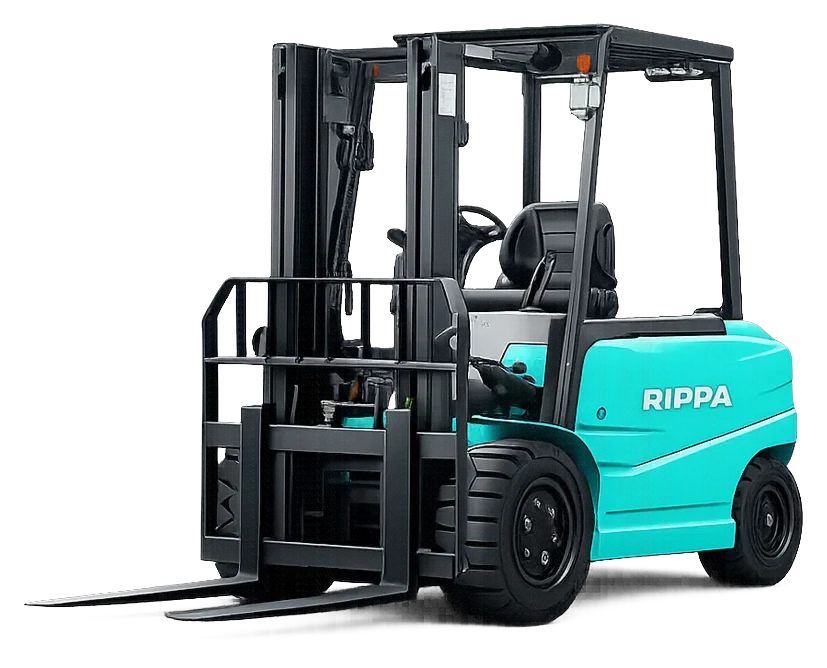
A forklift looks like a slow, simple machine, so its risks are easily underestimated. Yet when a body weighing several tonnes, a raised load and people on foot share the same space, a moment’s inattention can have serious consequences.
In this guide we focus on the three risks with the most serious consequences: tip-overs, falling loads and pedestrian strikes. All three have well-known causes, and most can be prevented with the right driving habits and the right warehouse layout. We explain in turn how each risk arises and which rules prevent it in your business.
This article is not a legal guide. Work through the obligations and risk assessment specific to your business with your health and safety adviser; what we describe here are basic rules you can apply on the warehouse floor.
The stability triangle: why do forklifts tip over?
A counterbalance forklift works like a seesaw. The front axle is the pivot point; the load at the front is balanced by the counterweight at the rear and the body of the machine. On electric forklifts such as the RF20E, the heavy battery pack is also part of this balance.
Seen from above, stability is described as a triangle formed by the two front wheels and the centre of the rear axle. As long as the combined centre of gravity of the machine and load stays inside this triangle, the forklift stays upright; the moment it moves outside, a tip-over begins. The movements that push the centre of gravity out of the triangle are well known:
- Raising the load: The higher the centre of gravity, the more easily it crosses the edge of the triangle; even a small movement at height has a big effect.
- Tilting forward at height: As the mast tilts forward, the load moves forward and the tipping effect over the front axle grows.
- Turning fast: The sideways force in a corner pushes the centre of gravity to the side. An empty forklift is exposed to this risk too; with no load, the centre of gravity sits near the rear tip — the narrow end — of the triangle.
- Slopes and potholes: A ramp, a pothole or a change in floor level tilts the machine sideways or forwards, effectively shrinking the triangle.
- Overloading: A load above the value on the capacity plate, or a load centre that has shifted forward, upsets the balance from the moment you lift.
How to prevent forklift tip-overs: driving rules
- Carry the load low. Carry the load only high enough to clear obstacles, with the mast tilted slightly back.
- Slow down before the corner. Reduce speed before you enter the turn, not during it, and avoid sudden steering movements while turning.
- Never drive or turn with the load raised. Lift and lower only while the machine is stationary.
- On a ramp, the load stays on the uphill side. When loaded, drive up the ramp forwards and come down in reverse; when empty, drive with the forks pointing downhill.
- Never turn on a ramp or drive onto it at an angle. On a side slope the stability triangle shrinks fast.
- Read the capacity from the plate. Never lift a load without comparing its weight and load centre with the plate; we explain how in our load chart guide.
- Know the floor. Manhole covers, drain gratings, broken joints and wet areas should be marked, and operators should choose their route accordingly.
A machine’s top speed is not a safe speed inside the warehouse. The RF20E reaches 14 km/h loaded and 16 km/h unladen; set a much lower limit for indoor work and signpost it.
When conditions change, the rules get stricter: on wet, dusty or oily floors speed is cut further, and ramps need extra care. Outdoors, wind can affect the stability of the load, especially with tall, light stacks; carry such loads low and slowly.
What to do if the forklift tips over
On counterbalance forklifts the general rule is that the operator does not jump. Stay in the seat with the seat belt fastened, grip the steering wheel firmly, brace your feet and lean away from the direction of the tip. That is why the seat belt must be worn even for jobs of a few metres; in a tip-over, the belt is what keeps the operator under the overhead guard.
Falling loads: the load usually warns you first
Falling loads usually come down to the load itself or the way it is picked up. Common causes include:
- Broken or cracked pallets, or pallets with missing boards
- Unwrapped or unstable stacks, or stacks that overhang the pallet
- Forks not fully inserted under the pallet, or set too narrow for the width of the load
- Hard braking at height, sudden starts or hitting a rack beam
- Loads stacked higher than the load backrest
The precautions are just as clear: insert the forks fully under the pallet, set the fork spacing to the pallet width, rest the load against the load backrest and use forward tilt only when setting the load down in the rack — and as little as possible. The fork positioner on the RF20E makes it easy to adjust the fork spacing from the seat, but it is still the operator who decides which spacing is right.
Instead of forcing a damaged pallet with the forklift, move the load onto a sound pallet first. The rule is simple: a doubtful load is never lifted. And most importantly: nobody stands or walks under a raised load. This rule has no exceptions, however experienced the operator.
Placing and retrieving loads safely in the racking
Rushing up to the rack is a typical starting point for both falling loads and rack damage. Make this sequence a habit when you place a load in the rack:
- Approach the rack at a right angle and come to a complete stop in front of it.
- Bring the mast to vertical and raise the load slightly above beam level.
- Move forward slowly and stop when the load is exactly over its rack location. Correct small misalignments with the side shifter.
- Lower the load onto the beam and keep lowering gently until the forks are clear of the pallet.
- Reverse out, making sure the forks are not dragging the pallet.
- Lower the forks to travel height; only then start manoeuvring.
When retrieving a load, the same sequence applies in reverse: the forks go straight into the pallet openings, the load is lifted slightly off the beam, the forklift reverses out, and you only move off once the load has been lowered close to the floor.
An impact on a rack upright can reduce the rack’s load capacity even if it looks minor from the outside. Don’t hide impacts — report them; a damaged upright should be marked, and that bay should not be used until it has been unloaded. Fitting protectors to the uprights at aisle entrances is a simple, effective precaution.
Pedestrian traffic: the risk of a quiet machine
The quietness of an electric forklift is a big plus for the working environment, but an extra risk for pedestrians. A machine with no engine noise can approach unnoticed, especially when reversing and at blind corners. To manage this risk, apply technical measures and rules of behaviour together:
- Visibility: A warning beacon, a reversing alarm and, where fitted, a warning light projected onto the floor let pedestrians notice the machine without hearing it.
- Horn: A short blast of the horn at junctions, doorways and blind corners should be standard practice.
- Segregated routes: Pedestrian walkways are separated with floor lines, and with barriers where possible; pedestrian crossing points are clearly designated.
- Eye contact: The operator does not continue a manoeuvre without making eye contact with the pedestrian, and the pedestrian does not step into the forklift’s path without being sure the operator has seen them.
- Loads that block the view: If the load blocks the view ahead, the forklift is driven in reverse while looking back the whole time; a banksman is used if necessary.
- No passengers: A forklift carries no passengers; people are never carried on the forks, a pallet or a load, and nobody rides on the forks to reach a height.
Also allow for people who don’t know the rules: visitors, delivery drivers and subcontractor crews are not familiar with forklift traffic. Give them a short briefing, hand out high-visibility vests and, if necessary, have them escorted inside the warehouse.
Three steps at junctions and doorways
At blind corners, doorways and the points where rack aisles open onto the main route, turn this habit into a rule: slow down, sound the horn, look. Don’t pull out onto the main route until you can see clearly. If there is another forklift ahead of you, leave enough distance to stop comfortably if it brakes suddenly; a loaded machine needs a longer stopping distance than an empty one, and longer still on a wet floor.
Risk table: cause, layout, behaviour
| Risk | Typical cause | Warehouse layout measure | Operator behaviour |
|---|---|---|---|
| Tip-over | Fast cornering, turning on a ramp, travelling with the load raised | Speed limit signs, ramp markings, floor repairs | Carrying the load low, slowing down before corners |
| Falling load | Damaged pallet, unstable stack, forward tilt at height | Pallet inspection point, stretch-wrap rule | Inserting the forks fully, never lifting a doubtful load |
| Pedestrian strike | Blind corner, reversing, silent approach | Segregated walkway, mirror, warning light | Horn, eye contact, looking back the whole time when reversing |
| Crushing and trapping | Forks left raised, walking under the load | Designated parking area, warning sign | Parking with the forks lowered to the floor |
| Charging area accident | Sparks, poor ventilation, damaged cable | Dedicated, ventilated charging point | Never charging with a damaged socket |
| Loading dock and truck bed | Moving vehicle, weak dock plate | Wheel chocks, dock plate with a known capacity | Checking that the vehicle is secured before driving onto the truck bed |
We cover the extra risks of loading trucks and containers separately in our loading trucks by forklift guide.
Parking, charging and the end of the shift
Some accidents happen when the machine isn’t even working: a foot caught on forks left raised, a machine rolling down a slope, a forklift started by someone unauthorised. At the end of the shift and during breaks, make this routine a rule:
- The forks are lowered fully, with the tips touching the floor.
- The parking brake is applied, the machine is switched off and the key is removed.
- The forklift is never parked on a ramp, in front of a door, a fire hose cabinet or an emergency exit.
- Charging is done only at a dedicated, ventilated point; charging never continues with a damaged socket or cable.
- The key is kept where nobody but authorised operators can reach it.
Rules alone are not enough: keeping safety going
However neatly they are written down, rules that nobody follows up are forgotten over time. A lasting safety system stands on three legs:
- Authorised operators: Only people who have been trained and authorised by the employer use the forklift. Occupational safety legislation makes operator training compulsory; confirm the current requirements with your health and safety adviser. We describe the training and authorisation process in our becoming a forklift operator guide.
- A sound machine: A short check is carried out at the start of every shift, and a faulty machine is not used. We set out the order of the checks step by step in our daily checklist guide.
- A business that learns: Near misses — narrowly avoided collisions, swaying loads and slipping pallets — are recorded and discussed as a team. Today’s near-miss report prevents tomorrow’s accident.
If you share an outdoor yard or a construction site with other machinery, our machine safety on construction sites guide will also be useful.
Quick checklist
- Has an indoor speed limit been set and signposted?
- Are pedestrian walkways separated with floor lines or barriers?
- Are there mirrors at blind corners and a horn rule at junctions?
- Are ramps, manholes, gratings and floor defects marked?
- Is the capacity plate legible, and can operators read it?
- Is there a dedicated inspection and transfer point for damaged pallets?
- Is the seat-belt rule applied without exception?
- Have parking and charging areas been designated, and are emergency exits kept clear?
- Do only authorised operators use the forklift, and are the keys controlled?
- Are near misses recorded and discussed?
To choose the right forklift for your warehouse layout, explore our forklift models; to find out about the set-up and basic operator training we provide on delivery, message us on WhatsApp.