Most of the work in a warehouse happens between the racks, but at the end of the day everything comes together at the loading dock: the truck waits at the door, the driver is in a hurry, the pallets don’t arrive in order and the forklift operator works against the clock. Crushed boxes, overloaded dock plates and loads sliding in the truck bed are usually the product of this rush.
In this guide we cover loading trucks and containers by forklift from start to finish: three compatibility checks before the first pallet, securing the truck, loading from the rear, from the side and with a mobile ramp, the special rules of containers, loading order and weight distribution. In the final section there is a checklist you can use for every truck.
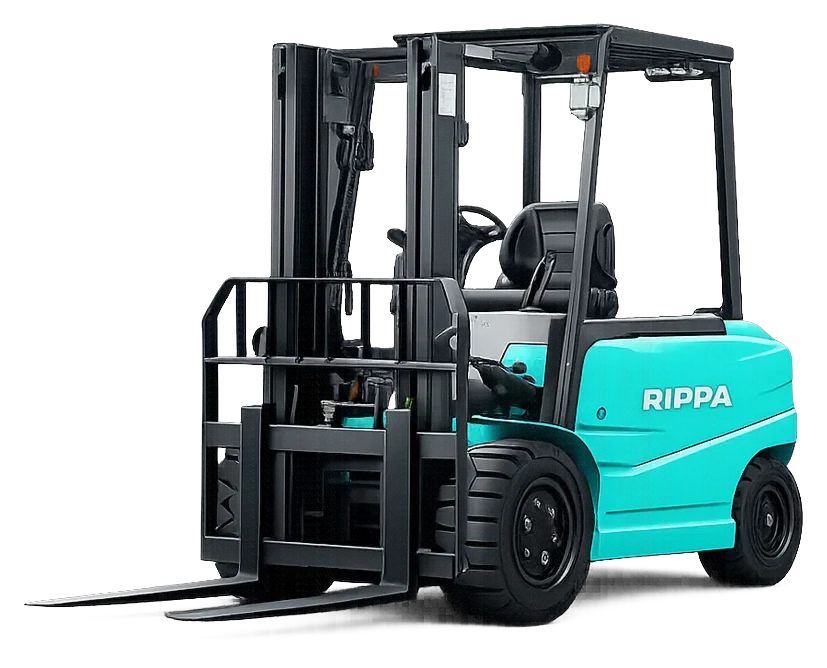
Our examples are based on the 2-tonne Rippa RF20E electric forklift. The method described applies to every counterbalance forklift, together with the limits in your own machine’s user manual.
Compatibility first: do the dock, the truck bed and the forklift suit each other?
What speeds up loading isn’t the operator’s hands but the right preparation before work starts. Before picking up the first pallet, get clear answers to three questions.
1. Can the dock plate and the truck floor carry this weight?
If the forklift drives into the truck bed or container, the dock plate and the floor carry not just the load but also the forklift’s own weight. The RF20E weighs 3,040 kg; with a full-capacity load of 2,000 kg the total comes to 5,040 kg. What’s more, when carrying a load most of the weight bears on the front wheels, so the pressure is concentrated on a small area.
Find out the load capacity of the dock plate and ramp from its label or manufacturer. If you see rotten boards, holes or patched areas in the truck floor, don’t drive in with the forklift; load that vehicle from the side or from the edge of the dock, without entering the bed.
2. Are the door and roof heights enough?
In box trucks and containers, the most common obstacle is the door and roof height. Measure the door opening and compare it with the highest point of the forklift: the top of the lowered mast or the overhead guard, whichever is higher. The RF20E’s machine dimensions are given as 2,250 × 1,100 × 2,150 mm; check with us before buying which dimension will be the limiting one at your door.
Inside, the mast can start to extend as soon as you lift the load. How high you can lift before the mast touches the roof is determined by free lift; we come back to this in the container section.
3. Is the load within the forklift’s capacity under those conditions?
The 2,000 kg capacity applies to a specific load centre and lift height. With long or tall pallets, or pallets whose centre of gravity has shifted, the real capacity drops. If you don’t know the pallet’s weight, don’t guess; check the delivery note, the label or a scale. We explain step by step how to read the capacity plate in our load chart guide.
Securing the truck: wheel chocks, handbrake and the risk of early departure
One of the most dangerous scenarios at the dock is the truck moving while the forklift is inside the bed. The driver may think loading is finished and pull away, or the trailer creeps forward a little each time the forklift enters, opening an unnoticed gap between the dock and the bed. The rules that prevent this are simple, but they must be applied to every truck:
- Engine off, handbrake on: During loading the driver doesn’t wait in the cab; they stand at a designated safe point.
- Wheel chocks: Chocks are placed in front of the rear wheels. No chocks, no loading.
- Key procedure: Many warehouses keep the truck key with the loading supervisor until loading is finished. It is the simplest and cheapest precaution against early departure.
- Trailer uncoupled from the tractor unit: If the trailer is standing only on its own landing legs, the forklift driving into the front section strains those legs. Don’t drive in without placing a support stand under the front section.
- One voice: Agree the start and finish signals with the driver in advance. Only the loading supervisor says “loading complete”.
Loading trucks by forklift: three methods, and when to use each
The type of truck and your site’s infrastructure determine the method. The table below puts the three common methods side by side:
| Method | When it suits | Does the forklift enter the bed? | Main risk | Critical check |
|---|---|---|---|---|
| Rear loading from a dock | Box body, refrigerated body, container; warehouse with a dock | Yes | Truck creeping, gap between the plate and the bed | Chocks, dock plate capacity, truck floor |
| Side loading from the ground | Curtain-sided or drop-side body; yard without a dock | No | Tip-over while carrying the load high, hitting curtain posts | Level, firm ground; lifting the load only when stationary |
| Loading with a mobile ramp | Box body or container at a site without a dock | Yes | Ramp slipping, falling off the edge, losing control on the slope | Ramp secured, slope limit, side rails |
Rear loading from a dock
This is the most controlled method, because the forklift works in a straight line. Drive onto the dock plate at a right angle; don’t turn or brake on the plate. Inside the bed, keep the forks only high enough off the floor to clear the pallet, and slow down as you approach the bed wall.
Side loading from the ground
This method is often used for curtain-sided trucks. The forklift doesn’t enter the bed; it lifts the load to the level of the truck floor and reaches in. The rule here: never lift the load while moving. Approach the truck, stop, lift the load, move forward slowly and set the pallet down, withdraw the forks and only then lower them. On wide beds it is often impossible to reach the far side from one side; place the pallets from both sides in turn, and never carry the load on the tips of the forks to reach further.
Loading with a mobile ramp
At sites without a dock, a mobile ramp (yard ramp) gives access to the bed from the ground. The ramp’s connection to the bed must be secured, its slope must not exceed the limit allowed in your forklift’s user manual, and it must have rails along its edges. On a wet ramp, solid tyres can lose grip; on rainy days always check the surface. We explain how tyre type affects behaviour on different surfaces in our forklift tyres guide.
Loading containers by forklift: the special rules
A container is a narrow, dim box closed on all four sides. Many details that cause no trouble in a truck bed become problems here:
- No exhaust — a big advantage: Working with a combustion-engine forklift in a closed box means exhaust fumes building up inside. A battery forklift such as the RF20E removes this problem completely.
- Free lift: With a free-lift mast, the forks rise to a certain height without the overall height of the mast increasing. That is how you avoid hitting the roof when stacking pallet on pallet inside a container. The RF20E’s triplex mast has free lift; check the free lift figure for your machine in the manual. We explain the differences between mast types in detail in our simplex, duplex and triplex guide.
- Light: The far end of the container is dark. Use portable lighting; never drive a pallet towards a spot you can’t see.
- Floor check: If there are holes, breaks or wet patches in the container floor, report them to the shipper before loading.
- The last rows: The last pallets near the door are placed without the forklift fully entering. Don’t push pallets with the fork tips; you can puncture both the load and the container wall.
- Gaps: Gaps left between pallets let the load shift in transit. Prepare void-fill and securing materials before loading.
Loading order and weight distribution
Fast loading starts on paper before the truck arrives. A good loading plan answers three questions:
- Which pallet comes off first? If there are several delivery points, the load to be delivered last goes into the bed first. A truck loaded in the wrong order has to be half unloaded at the first stop.
- How will the weight be distributed? Heavy pallets at the bottom, light ones on top; the load should be spread evenly along the bed and between the two sides. Piling all the heavy pallets on one side or right at the front upsets the vehicle’s handling. If the haulier has loading instructions, follow them.
- Can it be stacked? Crushable goods, glass, liquids or loads without a flat top are not stacked. If the pallet label shows no stacking limit, ask the shipper.
Securing the load to the bed (ratchet straps, lashing belts) is usually done by the driver and the haulier; clarify the division of responsibility in your own contract. The forklift operator’s job is to leave the pallets ready to be secured: pushed up against the wall and each other, with no unnecessary gaps.
Where does speed come from? Habits that shorten the cycle time
Speed at the dock comes not from driving fast but from cutting out wasted movements. The RF20E can reach 14 km/h loaded, but that speed is for long, empty aisles; at the dock and inside the bed, walking pace is enough.
- Staging area: Before the truck arrives, line the pallets up in an area near the dock in loading order. The operator doesn’t search the warehouse for pallets; they take the next one.
- Pallets are checked beforehand: Broken pallets, loose stretch wrap and overhanging boxes are sorted out in the staging area. A problem noticed in the truck bed holds up the whole line.
- Let the forks do the aligning: Instead of shuffling the forklift back and forth to line a pallet up with the bed wall or the next pallet, slide the forks sideways with the side shifter. If pallets of different sizes arrive, adjust the fork spacing from the seat with the fork positioner. We describe what these two features do on the job in a separate guide.
- Keep the manoeuvring area clear: The RF20E has a turning radius of 1,700 mm. No empty pallets, rolls of stretch wrap or bins are left in front of the dock.
- Plan the battery: The RF20E has a run time of 8–10 hours and a charging time of 6–8 hours. Finish charging the night before a busy dispatch day; a battery running flat in the middle of loading is the most expensive kind of downtime.
Example: In a 20-pallet load, saving just 30 seconds per cycle adds up to 10 minutes in total. That time is gained not by driving fast but by not searching for pallets and by aligning with the forks. The figures are illustrative; time your own loads for a week to get your real picture.
Driving rules on the dock and in the truck bed
These rules are not up for negotiation. They are the basic principles described in our forklift safety guide, adapted to the loading dock:
- When loaded, the load stays on the uphill side: Drive forwards when going up a sloping ramp loaded, and in reverse when coming down loaded. When empty, the opposite applies; the forks stay on the downhill side.
- No turning or parking on a ramp: Turning on a slope increases the risk of tipping sideways.
- Forks low, mast back: When travelling with a load, the forks should be close to the ground and the mast tilted slightly back. The load is raised only at the point where it is to be set down.
- If your view is blocked: If the load blocks your view ahead, drive in reverse or work with a banksman standing where they can see you. The banksman never stands between the forklift and the truck bed.
- Nobody stands under raised forks, and while the forklift is working inside the truck bed, no second person is inside.
- No sudden braking or sudden turns: Braking on the dock plate in particular strains both the plate and the truck bed.
Pre-loading checklist for every truck
This list doesn’t replace the start-of-shift machine check; it is applied for every vehicle in addition to it. You can find the machine check itself in our daily checklist guide.
- Is the truck’s engine off, the handbrake on and the chocks in place?
- If the trailer is uncoupled from the tractor unit, has a front support stand been placed?
- Is the dock plate sitting fully on the bed, with no gap or step between them?
- Is the truck bed or container floor sound and dry?
- Is the door height enough for the highest point of the forklift?
- Are the pallets lined up in the staging area in loading order?
- Is the weight of every pallet known and within the limit on the capacity plate?
- Have broken pallets, loose stretch wrap and overhanging boxes been sorted out?
- Is the inside of the container lit well enough?
- Will the battery charge last for the whole load?
- Have the start and finish signals been agreed with the driver?
Summary
- Speed comes from preparation: the loading order, staging area and pallet checks are completed before the truck arrives.
- The dock plate and truck floor carry the forklift’s weight as well as the load; with the RF20E at full load the total is over 5 tonnes.
- The forklift doesn’t enter the truck bed until the truck is chocked and the signals have been agreed with the driver.
- In a container, a battery forklift causes no exhaust problem; a free-lift mast allows stacking without hitting the roof.
- On a ramp the load always stays on the uphill side, and there is no turning on the ramp.
To see the triplex mast, free lift, side shifter and fork positioner together, take a look at the RF20E electric forklift’s technical specifications. For the price, starting from 599.000 ₺ + VAT, and to check whether it suits your dock or container door, message us on WhatsApp.