Say “forklift” and most people picture a single machine. Yet the materials-handling machines that work in warehouses and yards differ greatly, both in their energy source and in their body design. A business that picks the wrong type ends up with an exhaust problem in an enclosed warehouse, a machine bogged down in an outdoor yard or a forklift that can’t reach its racks. Whether they’re called forklifts, fork-lift trucks or lift trucks, these machines all belong to the same family, but they don’t all do the same job.
In this guide we classify forklifts along two lines: energy source (electric, diesel, LPG) and body type (counterbalance forklift, stacker, pallet truck, reach truck). We explain the strengths and weaknesses of each type, which jobs it suits and the questions to ask when you decide.
Think in two dimensions: energy source and body type
To define a forklift, ask two questions together: What does it run on? and How does it carry the load? The energy source determines where the machine can work and how it is powered. The body type determines which loads it can carry, to what height and in how narrow a space.
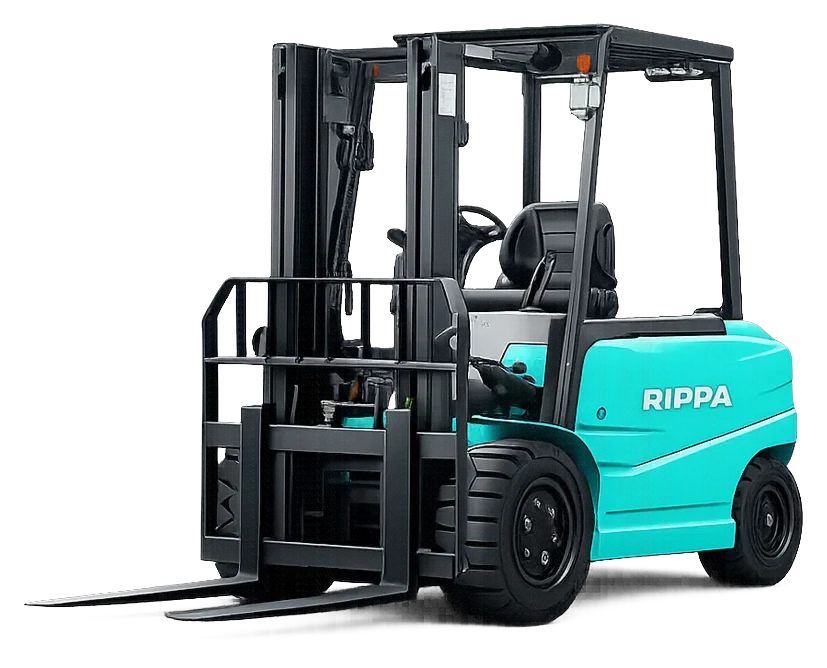
For example, the Rippa RF20E we sell at EKSFORK is an electric counterbalance forklift: with a 2,000 kg load capacity, a triplex mast that reaches 4.5 metres and a 60V gel battery pack, it is designed for work inside warehouses and factories. A diesel forklift or a battery-powered stacker could also try to do the same job, but each one comes into its own under different conditions.
Counterbalance forklifts: the classic forklift we all know
On a counterbalance forklift, the load is carried on forks that project beyond the front axle. Stability comes from the heavy counterweight at the rear of the machine; on electric models, the battery pack is also part of this weight. With no support legs at the front, the forks go straight under the pallet and can pick up the load from any side.
This design has three big advantages:
- Truck loading: With nothing in front of the forks, it can load a truck bed from the side or from the rear.
- Different surfaces: It can work on a wide range of surfaces, from a concrete warehouse floor to a compacted outdoor yard; but which surface is suitable depends on the tyre type and energy source.
- Versatility: Pallets, crates, long materials: with the right attachment it can carry many different loads.
The downside is that it needs plenty of room to manoeuvre. Because the machine turns together with its load, aisle width must be planned around the machine’s turning radius and the length of the load. The RF20E has a turning radius of 1,700 mm; we explain the aisle width calculation step by step in our guide to choosing a warehouse forklift.
Wheel layout and tyre type
Counterbalance forklifts also differ among themselves. On three-wheel models, the single steer wheel at the centre rear lets the machine turn in a tighter space, so they are preferred for cramped indoor warehouses. Four-wheel models offer a wider support base and are generally better suited to ramps, trips across outdoor yards and more variable surfaces.
Tyre type also determines where the machine can be used. Solid tyres can’t burst, need no maintenance and work well on smooth, hard floors; but on poor surfaces they pass the shocks on to the machine and the load. Pneumatic tyres grip better on rough and loose ground and reduce vibration, but they can puncture and need regular pressure checks. In facilities with clean floors, non-marking tyre options are also used. The RF20E runs on solid tyres: 650-10 at the front and 500-8 at the rear.
By energy source: electric, diesel and LPG
What is an electric forklift used for? (Battery forklift)
An electric forklift produces no exhaust gases at the point of use, runs quietly and has far fewer moving parts than an internal combustion engine. That makes it the natural choice for enclosed warehouses, factory interiors and areas where cleanliness matters, such as food and pharmaceuticals.
The RF20E has a 60V gel battery pack made up of ten 12V 200Ah batteries, plus a 12 kW AC drive motor and a 12 kW AC lift motor. The charger runs on a 220V supply; charging takes 6–8 hours and run time is 8–10 hours. It reaches 14 km/h loaded and 16 km/h unladen. In a single-shift business it is easy to set up a routine of charging overnight and working during the day; in a multi-shift operation, the charging plan should be worked out from the start. You’ll find the charging habits that extend battery life in our forklift battery care guide.
Diesel forklifts
Because it can keep working non-stop with refuelling and stands up well to rough, sloping or loose ground, the diesel forklift is the machine for outdoor yards: building materials depots, timber and scrap yards, ports and open storage areas. Its exhaust gases and noise make it unsuitable for enclosed spaces. It also has regular maintenance items such as engine oil, filters and the cooling system.
LPG forklifts
The LPG forklift sits between the two worlds. Because a cylinder change has it ready to work again within minutes, it keeps shift work running, and it burns cleaner than diesel. However, LPG forklifts produce exhaust gases too; indoor use should only be considered with adequate ventilation and a health and safety assessment. Storing, carrying and changing the cylinders is subject to its own safety rules, so work on this together with your health and safety adviser. Some models are dual-fuel, running on both petrol and LPG.
Also take a look at our electric or diesel forklift guide, where we compare the costs and uses of electric and diesel machines in more detail.
By body type: stackers, pallet trucks and reach trucks
Pallet truck
A pallet truck lifts the pallet just a few centimetres off the floor and moves it horizontally. The manual version is pumped and pulled by hand; the battery-powered version is driven by a motor. It is ideal for driving into a truck bed level with the loading dock, moving pallets around the warehouse and lining them up in the dispatch area. But it cannot stack; it doesn’t lift loads into racks.
Stacker
A stacker is essentially a pallet truck with a lifting mast added, so it can raise the pallet into a rack. The operator usually walks behind the machine or stands on a small platform. On most stackers, stability comes from support legs at the front rather than a counterweight. That makes them compact and light, but they need a level, smooth indoor floor, their travel speed and capacity are limited, they can’t load a truck bed from ground level and they aren’t suitable for outdoor yards.
Let’s be honest: in a small warehouse with limited rack height, little daily pallet traffic and truck loading done from a loading dock, a stacker may well be enough. If there is truck loading, travel across outdoor areas or heavy traffic, you need a counterbalance forklift.
Reach trucks and narrow-aisle machines
On a reach truck, the mast moves forwards and backwards: the machine stays in the aisle and reaches into the rack to pick up the load. This lets it work in narrow aisles and at high rack levels. In return, it needs a very level floor, a well-organised racking system and an experienced operator; it is usually used only indoors and isn’t suitable for truck loading. It is the machine for large warehouses with high racking and limited aisle width.
Comparison table
| Type | Strengths | Limitations | Typical work |
|---|---|---|---|
| Electric counterbalance | Enclosed warehouses, factories, clean areas; quiet and exhaust-free | Needs a charging plan; rough and muddy ground | Rack stacking, in-plant transport, truck loading |
| Diesel counterbalance | Outdoor yards, rough ground, non-stop work | Exhaust and noise indoors; regular engine maintenance | Materials yards, timber, open storage |
| LPG counterbalance | Continuity through cylinder changes; mixed use | Produces exhaust gases; cylinder safety and supply | Outdoor and well-ventilated areas |
| Stacker | Small and medium warehouses, tight spaces, low to medium racking | Level indoor floor essential; limited speed and capacity | Rack stacking, short-distance transport |
| Pallet truck | Horizontal pallet moves, on the loading dock and inside the truck bed | Cannot stack | Dispatch areas, transfers within the warehouse |
| Reach truck | High racking, narrow aisles | Needs a very level floor and an indoor area; not suitable for truck loading | Large warehouses with high racking |
Decision flow: seven questions to find the right type
- Where will it work? If it’s mostly indoors, electric comes out ahead; if it’s mostly outdoors on rough ground, diesel does.
- What is the floor like? Smooth concrete, asphalt, compacted earth or a muddy yard? Machines on solid tyres such as the RF20E need a smooth, hard surface.
- Will you be loading trucks? If you have a loading dock, a pallet truck or stacker may be enough; if loading is done from ground level, you need a counterbalance forklift.
- What are your rack height and aisle width? The mast type and height are chosen based on this answer; we explain the differences in our forklift mast types guide.
- What is your heaviest and largest load? Capacity depends as much on the load’s size and centre of gravity as on its weight. To read the capacity on the plate correctly, see our forklift load chart guide.
- How many hours a day, and how many shifts? On a single shift an electric forklift copes easily; with round-the-clock shifts, the charging or fuelling plan is decisive.
- What infrastructure do you have? Is there a suitable socket and space for charging, an LPG supply or somewhere to store fuel?
Mixed fleets: for most businesses the answer isn’t a single type
In many businesses the most efficient solution is to use different types together: for example, a counterbalance forklift for truck loading and high-rack stacking, and a pallet truck for short pallet transfers within the warehouse. That way the forklift only works on the jobs that really need it and doesn’t waste hours and battery cycles.
Attachments also extend what a type can do. The RF20E comes with a side shifter and fork positioner, and its forks measure 40 / 100 / 1,070 mm. You can see the fork extension options for long loads and the cab option for protection from the weather on our forklift attachments page; we give current attachment prices on WhatsApp.
To be straightforward: the forklift we offer at EKSFORK today is the RF20E, an electric counterbalance forklift with a 2-tonne capacity. If your work calls for heavy outdoor use, muddy ground or narrow aisles with very high racking, we’ll tell you so plainly. For small businesses buying their first forklift, we cover the capacity question separately in our first forklift for a small business guide.
Summary
- Choose a forklift on two dimensions: energy source (electric, diesel, LPG) and body type (counterbalance, stacker, pallet truck, reach truck).
- Electric comes out ahead indoors and diesel outdoors on rough ground; LPG produces exhaust too.
- A pallet truck doesn’t stack; a stacker needs a level indoor floor; a reach truck is for high racking and narrow aisles.
- Truck loading, travel across outdoor areas and heavy traffic call for a counterbalance forklift.
- For most businesses, the most efficient solution is a mixed fleet.
The Rippa RF20E electric forklift, with a 2-tonne capacity and a 4.5-metre triplex mast, starts from 599.000 ₺ + VAT and comes with a 2-year / 2,000-hour warranty. Message us on WhatsApp with your warehouse dimensions, your loads and your working pattern, and we’ll work out together which type suits you.