Wholesalers, workshops, e-commerce warehouses, DIY stores, food distributors… Every growing small business reaches the same question at some point: “Do we need a forklift now, and if so, are 2 tonnes enough?”
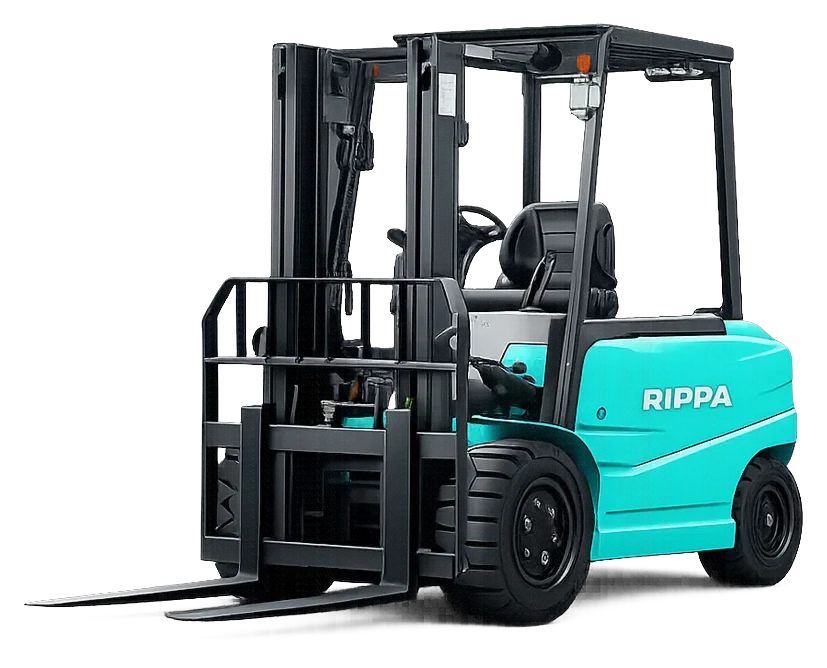
2 tonnes is a popular capacity class for counterbalance forklifts. But to answer “enough”, you need to know what the figure on the plate means, the real weight of your loads and how much the forklift will work each day. In this guide we show you how to answer the question with calculation rather than guesswork, using the 2-tonne Rippa RF20E as our example.
What does “2 tonnes” mean? The conditions behind the rated capacity
A forklift’s 2,000 kg capacity doesn’t mean it can lift 2 tonnes in every situation. The figure applies at a specific load centre distance, up to a specific lift height and with the machine’s current equipment. When one of those conditions changes, the safe lifting capacity changes too:
- As the load gets longer: The load’s centre of gravity moves further from the fork face, so the same weight puts more strain on the forklift’s stability.
- As the load goes higher: The permitted weight may drop for loads raised high in the racking.
- As equipment is added: Attachments such as fork extensions move the load centre forward and reduce capacity.
So the right question isn’t “is our load lighter than 2 tonnes?” but “is our load, at this size and at this height, below the limit the plate allows?” We explain step by step how to read the plate and the load chart in our load chart guide.
Load inventory: weigh and take notes for a week
Businesses buying their first forklift often know the weight of their loads only roughly. Turn that estimate into figures before you decide. A simple one-week inventory is enough:
- List the load types: Write down every type of incoming and outgoing load: palletised boxes, sacks, drums, rolls, crates, long materials.
- Verify the weights: Find the real weight from delivery notes and packaging information, using a weighbridge if necessary. Calculate the weight per pallet as “unit weight × quantity + pallet weight”.
- Write down the dimensions: Note the width, length and height of each load type. Mark loads that overhang the pallet separately.
- Separate the heaviest from the most frequent: The heaviest load determines the capacity decision; the most frequently moved load determines the productivity calculation.
- Note where it goes: Does the load wait on the floor, which rack level does it go up to, is it loaded onto a truck?
- Count the daily movements: How many pallets are unloaded, moved and loaded each day?
Example (illustrative figures — calculate with your own values): Suppose a pallet holds 40 sacks of 25 kg and the pallet itself weighs 25 kg. The load comes to 40 × 25 + 25 = 1,025 kg. If this pallet is moved from the floor to a truck or to the lower rack levels, the 2-tonne class leaves a wide margin; even so, check the load centre and height against the plate. If you are thinking of carrying two of these pallets stacked on top of each other, the calculation changes completely.
Is a 2-tonne forklift enough? When it is, and when it isn’t
| Load or job type | Are 2 tonnes enough? | Watch out for |
|---|---|---|
| Palletised boxes, packaged goods | ✅ Usually | Verify the pallet weight by weighing it |
| Pallets of sacks (flour, feed, fertiliser, cement) | ✅ Usually | Do the unit weight × quantity calculation |
| Dense loads such as drinks, water, paper, ceramics | May be borderline | Weigh it; check the capacity at rack height on the plate |
| Long profiles, pipes, timber | Length is usually the limiting factor | Allow for the load centre and the effect of fork extensions |
| Single items over 2 tonnes (moulds, machines, coils) | ❌ | A higher capacity class is needed |
| Rack levels above 4.5 metres | ❌ For the RF20E | Reconsider the rack layout or the machine class |
| Muddy, gravelly, uneven outdoor yards | The issue is the ground, not the capacity | An electric machine on solid tyres struggles on this ground |
If you often work with long loads, we look at how fork extensions affect capacity in our forklift fork extensions guide.
How much will it work? Usage intensity and alternatives
How often you use a forklift determines your need for one as much as capacity does. A business that moves a few pallets a week and one that unloads several trucks every day don’t have the same needs.
- Very occasional use: A few pallets a week, no high stacking. A manual or powered pallet truck, plus occasional hire, may be the sensible choice.
- Regular but light use: A few hours of unloading, loading and low-level stacking every day. A forklift starts to prove its worth in both time and workplace safety.
- Intensive use: Constant movement throughout the shift, rack stacking and truck traffic. The forklift is no longer an option but the backbone of the operation; the energy and maintenance plan needs to be set up from the start.
You can roughly calculate the time a forklift will save you like this:
Time saved per day = pallets per day × (current time per pallet − time per pallet with a forklift)
Multiply this time by your staff’s hourly cost and you get a daily value. Add product damage from manual handling, waiting trucks and the risk of workplace accidents, and the picture becomes clear. Take the figures from your own business; a week of observation is enough.
Example (illustrative figures — calculate with your own values): In a business that moves 30 pallets a day, if a pallet takes 6 minutes to reach its place by hand or pallet truck and 2 minutes by forklift, the daily saving is 30 × (6 − 2) = 120 minutes, or 2 hours. Multiply these 2 hours over a month by your own staff costs and compare the result with the machine’s monthly instalment or annual cost.
Pallet truck, stacker or forklift?
These are usually the three options compared for a first purchase. A pallet truck only moves loads at floor level; it can’t lift a load into a rack or reach a truck bed from the ground. A stacker can lift into racks but usually needs a smooth indoor floor and isn’t suited to unloading a truck from the side or from the ground. A counterbalance forklift can unload a truck from the ground, stack into racks and also work in smooth outdoor areas; in return it takes up more space and is a bigger investment. A detailed comparison of the types is in our types of forklift guide.
Should it be electric? A small business’s point of view
In small businesses the forklift usually works indoors, among products and staff. Here an electric forklift stands out: there are no exhaust fumes, it is quiet and the daily maintenance load is light. Businesses with an office or shop next to the warehouse, or that handle food products, notice the difference immediately. Low noise is also an advantage in warehouses near homes and for early-morning or late-evening dispatch.
The figures given for the RF20E’s 60V gel battery pack are 8–10 hours of operation and a 6–8 hour charging time; in a single-shift business it is enough to put the machine on charge at the end of the day and start the morning with a full battery. The charging system runs on a 220V supply. Outdoors, on rough ground and in round-the-clock shifts, the assessment may be different; we compare the two types in detail in our electric or diesel forklift guide.
Beyond the price: items for the first-year budget
The Rippa RF20E starts from 599.000 ₺ + VAT; it comes with 2-tonne capacity, a 4.5-metre triplex mast, a side shifter and a fork positioner. EKSFORK applies a single-price policy, so the price doesn’t change with haggling. But budgeting a first forklift on the machine price alone is misleading. Add these items to your list as well:
- Charging point: A suitable circuit, socket and ventilated area. Have an electrician check what is needed from the start.
- Operator training: The basic operator training we provide on delivery is machine-specific; formal operator training should be planned separately. Details are in our becoming a forklift operator guide.
- Warehouse set-up: Floor lines, blind-corner mirrors, speed and warning signs.
- Periodic inspection and maintenance: Regular inspection of lifting equipment and the maintenance plan in the user manual.
- Long-term items: Tyres and, later on, the battery pack. These are costs for later years rather than the first, but you should know the numbers from the start.
- Insurance: Ask your insurer how the machine will be included in your business insurance.
To pull these items into a single figure, you can roughly calculate the annual cost of ownership like this: machine price / planned years of use + annual energy + annual maintenance and inspection + annual insurance. Compare the result with the annual value of the time savings you calculated in the usage section.
You can pay in cash or in instalments; we explain the options in our machine payment options guide.
Common mistakes when buying a first forklift
- Saying “let’s get a big one”: A machine bigger than you need costs more, takes up more space and makes manoeuvring in tight areas harder.
- Not measuring doors and aisles: If the machine won’t fit through the door or can’t turn in the aisle when it arrives, capacity no longer matters. The RF20E is 1,100 mm wide with a turning radius of 1,700 mm; compare these with your own measurements.
- Thinking only about today: If you will add racking, change load types or increase volume over the next few years, factor this in now.
- Not asking about service and parts: If the machine stands idle for weeks after its first fault, a cheap purchase becomes expensive. Ask about the warranty period, the service network and parts stock before you buy.
- Leaving the operator until later: If there is no trained person to use the machine when it arrives, the forklift either sits idle or gets used unsafely.
At EKSFORK, forklifts come with a 2-year or 2,000-operating-hour warranty; we provide set-up and basic operator training on delivery, and we deliver to all 81 provinces.
Final check before you buy
- Have we verified the weight and dimensions of our heaviest load by weighing it?
- Is this load within the plate’s limits at the highest level we will use?
- Do we have long, wide or non-standard loads, and if so, have we calculated the load centre?
- Do our door, aisle and rack dimensions match the machine’s dimensions?
- How do we unload trucks: from the side, from the rear or from a dock? Is the machine suited to this method?
- Does our daily usage time fit the battery’s run time?
- Have we decided on the charging point and the electrical supply?
- Who will use the machine, and has their training been planned?
- Do we have the warranty, service and spare parts terms in writing?
Getting ready for delivery day
A few preparations on the day the machine arrives speed up delivery and set-up. Set aside a flat, clear area where the delivery vehicle can pull up and unload the machine, have the charging point ready, and make sure the people who will use the machine are present for the basic operator training. On delivery, take the user manual and the warranty certificate, and note the hour meter’s starting reading; you will track the first service from this figure.
Summary
For small businesses working with standard palletised loads, the 2-tonne class usually does the job; the definitive answer to “is it enough?”, however, comes from your heaviest load, its size and the height it has to reach. Make the decision with a one-week inventory rather than guesswork, check your door, aisle and rack dimensions, and budget not just for the machine but for the charging point, training and maintenance too.
Take a look at the technical specifications of the 2-tonne Rippa RF20E; send us your load inventory on WhatsApp and we will assess together whether it suits your work.