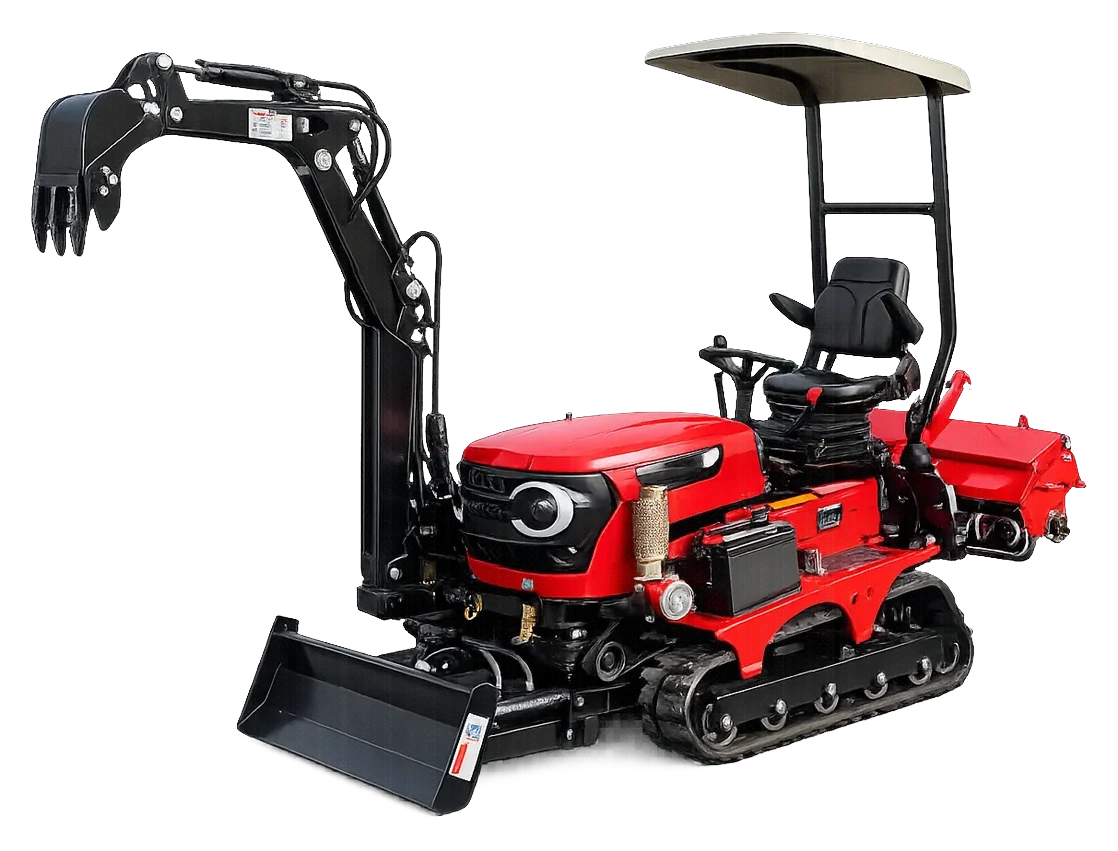
A construction machine is an investment you will work with for years. Yet the buying conversation is often squeezed into a single question: “How much is it?” In reality, what a machine really costs you is determined by how quickly the service team arrives, whether parts can be found, what the warranty covers and whether the machine really suits your work.
In this guide we have arranged the 15 questions you should ask the seller into five groups. For each question we explain why it should be asked, what a good answer looks like and what the answer is at EKSFORK. You can put the list to us or to any other seller in the same way.
Our aim is not to steer you towards one seller but to give you a yardstick for comparing the answers. A good seller won’t be put out by any of these questions.
How to ask the questions
- Ask everyone the same questions. A comparison only means something when it is based on answers to the same questions.
- Ask for critical answers in writing. The price, payment plan, delivery date, warranty and documents should be in the written quote.
- Don’t settle for general answers. Instead of accepting “we have service everywhere”, ask “where is the service point nearest to me?”
- If there is no answer, note it. An answer of “we’ll look into it and get back to you” is information too.
If you are considering a second-hand machine, add a few more questions to this list: what does the hour meter show, and does this match the service records; what work has the machine been used for; has it had an accident or a major repair; are its documents and operator’s manual complete? If no records can be shown, the answer becomes your risk, not the machine’s.
The machine and how it fits your work
1. Does this machine suit my work, and where will it struggle?
Any seller can say their machine can do every job. The real information lies in the machine’s limits: beyond what depth, in what ground and with which attachment it struggles. A good answer is concrete and given against your job list; so before asking, describe your work: the ground type, the digging depth needed, the access width on site and the attachments you will use. We state the limits openly too: for example, the R10 struggles in very stony, hard ground or with large root removal, while the R350 with its enclosed cab is limited in narrow passages by its 1,350 mm width.
2. What make and model is the engine, and where can its parts be found?
The engine is the most critical and most expensive part of the machine. Filters, gaskets and injectors for an engine of known make and model are easier to find, and a service mechanic works more comfortably on an engine they know. At EKSFORK, the R327 uses a Kubota D722, the R350 a Kubota D1703, the R10 a Koop 192F and the QD35 a Quanchai–Changzhou diesel engine. See the engine model in the quote. You can ask the same question about other main components such as the hydraulic pump and travel motor; how clear the answer is also gives a clue about after-sales support.
3. What is in the standard equipment, and what is included in the price?
Before comparing the prices of two machines, you need to level out their equipment: cab and air conditioning, the number and width of buckets, thumb, dozer blade, quick coupler, auxiliary hydraulic line. A good answer is a written equipment list. For example, the R350 comes with an enclosed cab and air conditioning; the R327 with an articulated hydraulic thumb, telescopic tracks and 120° boom swing; and the R10 with a hydraulically moving thumb.
Price and payment
4. Are VAT and transport included in the price?
Two prices for the same machine can’t be compared when one includes VAT and transport and the other doesn’t. A good answer shows each item on a separate line. The prices on our website are starting prices excluding VAT; we state in writing in the quote whether transport is included. If you are buying attachments such as an extra bucket, an auger or a breaker, ask for them to appear on separate lines in the quote too.
5. What are the payment options, and what is the total payable on credit?
When buying in instalments, what matters is not the monthly amount but the total payable on credit and the difference from the cash price. Also ask whether the instalments are fixed in Turkish lira or linked to the exchange rate. EKSFORK offers cash, credit card, bank transfer/EFT and instalment options; we are flexible on the payment plan. We explain how to compare offers in our payment options guide.
6. Is the price the same for everyone?
With a price list that is open to haggling, you can’t know what the first figure quoted really means, nor whether the next buyer pays less. At EKSFORK we work on a single-price policy: the price is not negotiable and is the same for everyone. Starting prices (+ VAT) are 299.000 ₺ for the R10, 549.000 ₺ for the R327 (479.000 ₺ on promotion), 249.000 ₺ for the QD35, 349.000 ₺ for the QD35 with excavator arm and 599.000 ₺ for the RF20E; for other models we share the current price in a quote. If a promotional price is involved, ask in writing for its expiry date and conditions too.
Delivery, training and documents
7. How will the delivery time and place be confirmed?
“Quick delivery” is not an answer; a written date is. Discuss special conditions such as a village road, a site entrance or a factory gate at this stage too. Also ask what is expected of you to prepare the delivery point: the road for the lorry, the unloading area, the person who will be on site. At EKSFORK we deliver to all 81 provinces, villages included. We explain the process step by step in our delivery to all 81 provinces guide.
8. Is there set-up and training on delivery?
For someone who will be using the machine for the first time, the training on delivery directly affects safety in the first weeks and the life of the machine. Ask who the training is for, how long it lasts and what topics it covers. We provide set-up and basic operator training on delivery. To be honest, basic training does not replace the operator training and certification required by occupational health and safety legislation; confirm the current requirements with your health and safety adviser.
9. Which documents will be handed over?
The invoice, warranty certificate, operator’s manual and declarations of conformity are the machine’s identity. On delivery, check that the model and serial number in the documents match the machine’s plate. At EKSFORK, machines are CE certified and we provide the conformity documents on delivery. We explain what this document means in our CE marking guide.
Warranty and service
10. What is the warranty period and scope, and what voids the warranty?
As important as the warranty period are its scope and the situations in which it is considered void, such as servicing not done on time, unauthorised work or improper use. Ask for these in writing. At EKSFORK, machines come with a warranty of 2 years or 2,000 operating hours. We have collected the ways to keep your warranty valid in our warranty guide.
11. Where is the nearest service point, and how does the process work when there is a fault?
Know from the outset whom you will call when there is a fault, how the service team will reach you and what is needed for the diagnosis. “We have a service network” isn’t enough of an answer; ask for the point nearest to you. EKSFORK has 14 authorised sales and service points in 12 provinces and a contracted service network in all 81 provinces; you can see the points on our dealer and service network page. Our technical service line is 0552 947 92 09. Also ask which channel service requests are opened through, and whether photos or a short video of the fault are used for the initial diagnosis; this directly affects how long you wait on site.
12. How is scheduled maintenance carried out, and when is the first service?
Ask about the service intervals, at what hour the first service is due and which parts are replaced at each service. You need this information to calculate the machine’s annual running costs. A good answer is based on the manual and also covers where, and how quickly, service materials can be obtained. Clarify the division of work too: your operator does jobs such as the daily checks and greasing; find out from the start which services must be done at an authorised service centre and how this relates to the warranty.
Spare parts and the long term
13. Are spare parts in stock, and how long do they take to arrive?
Waiting days for a hose or a filter in the middle of the season costs far more than the price of the part. Ask whether frequently replaced parts are in stock and how long shipping takes. Don’t leave the question general; ask about the most frequently replaced parts one by one: fuel, oil, air and hydraulic filters, hydraulic hoses, bucket teeth, pins and bushings, tracks and rollers. At EKSFORK, 382 spare parts are shipped from stock on the same day; the parts are divided into hydraulics, engine, undercarriage, electrical, bodywork and fasteners.
14. How will I find the right part?
Parts that look similar can differ between models. Find out how the model, serial number and part code are used when ordering parts, and keep a photo of the machine’s plate from the start. We explain this process in our finding the right spare part guide.
15. Can I see the machine before buying?
Seeing the machine up close lets you assess the control layout, the ergonomics of the cab and the build quality. Ask for your nearest authorised sales point and request an appointment to inspect the machine. During the inspection, look at these points: are the controls smooth and intuitive, what is the visibility like from the cab or canopy, can the filters and level indicators be reached easily when the service covers are opened, and are the hoses neatly routed and protected? You can ask the questions on this list on the spot too.
Put the answers side by side
If you are talking to more than one seller, write the answers in a table. The criteria below help you tell a good answer from one that needs watching:
| Topic | Good answer | Answer to watch |
|---|---|---|
| Suitability for the job | States the limits concretely | “It does every job” |
| Engine | Make and model in writing | “A good engine” |
| Price | VAT, transport and equipment on separate lines | A single figure with unclear items |
| Payment | Total payable on credit and instalment dates in writing | Only the monthly amount |
| Delivery | A written date and delivery terms | “As soon as possible” |
| Documents | List in the quote, documents on delivery | “We’ll send them later” |
| Warranty | Period, scope and conditions in writing | Only the period |
| Service | The point nearest you and a contact line | “We have service everywhere” |
| Spare parts | Stock and shipping time clear | “We’ll get it in to order” |
Quick checklist
- I have found out where the machine will struggle in my work.
- I have the engine make and model and the equipment list in writing.
- I have seen VAT, transport and equipment as separate items.
- I have compared the payment options on the total payable on credit.
- I have asked whether the price is the same for everyone.
- I have confirmed the delivery date, place and training.
- I have the list of documents to be handed over.
- I have seen the warranty period, scope and conditions in writing.
- I have found out the nearest service point and the fault process.
- I know the service schedule and the hour mark for the first service.
- I have asked about the spare parts stock and shipping time.
- I have kept the serial number and plate details for ordering parts.
Ask us these questions too: after exploring our machine models, send the list on WhatsApp and we will send you our answers in writing.