Most firms that want to buy machinery for landscaping start with the same question: “Which machine?” But the right question is one step back: “Which of our jobs eat up the most manual labour and time?” A machine fleet pays off when it is built from your job list, not from a catalogue.
A landscaping firm’s range of work is wide: tree planting, lawn preparation, irrigation and drainage lines, levelling, placing stone and rock, breaking up old concrete, maintaining large areas. Each of these jobs calls for a different machine or attachment, and investing in all of them at once is neither possible nor sensible for most firms.
In this guide we set out a staged, job-based machine fleet plan for landscaping firms: which machine solves which job, why the first machine is usually a mini excavator, when a tractor comes in and how to work out whether a machine is really paying its way.
Job list first: what have you done over the past year?
Before deciding on a machine, put the past twelve months’ jobs down on paper. For each job, write three things: the type of job, how many days it took and how many people did it. Then sort the jobs into five groups:
- Digging: tree and sapling pits, irrigation and drainage lines, kerb and wall foundations
- Soil preparation: ploughing, tilling and fine levelling for lawns
- Moving and placing: moving soil, stone, rock, logs and materials
- Hard landscaping: breaking up old concrete and kerbs, opening up ground, preparation before laying stone
- Maintenance: weed clearing on large areas, opening and closing irrigation channels
See which group takes the most person-days. The job type that eats up the most manual labour is where your first machine belongs. For most landscaping firms this group is digging; but for a firm maintaining large parks and residential estates, soil preparation may come first.
Matching jobs, machines and attachments
The table below matches common landscaping jobs with machines and attachments from EKSFORK. Always confirm which attachment fits which model before ordering.
| Job type | Machine | Attachments | Note |
|---|---|---|---|
| Tree and sapling pits | R10 / R327 | Auger (earth drill) or narrow bucket | For planting in rows, an auger speeds things up noticeably |
| Irrigation and drainage lines | R10 / R327 | 20, 30 or 40 cm bucket | The pipe and trench size determines the bucket width |
| Lawn soil preparation | QD35 | Rotary tiller (rotavator) | The biggest time saving on large areas |
| Fine levelling | R10 / R327 | 100 cm grading bucket, 60 cm rake | Used together with the dozer blade |
| Screening and reusing soil | Mini excavator | 60 cm screening bucket | Reduces bought-in soil and rubble haulage |
| Rock, logs and roots | R327 / R350 | Hydraulic grapple, thumb, ripper | For large roots, a class up works more comfortably |
| Breaking old concrete and kerbs | Mini excavator | Hydraulic breaker | Confirm breaker–machine compatibility |
| Opening and closing irrigation channels | QD35 | Trench opening and closing auger | On large, farm-type areas |
| Weed clearing on large areas | QD35 | Weed clearing | On maintenance-contract jobs |
The first machine: why does a mini excavator stand out for landscaping?
Digging in landscaping is both the job that eats up the most manual labour and the one that tires the crew the most. While a mini excavator takes over this job, it also adds levelling with the dozer blade, holding stones and roots with the thumb, and new types of work with attachments. That is why the first machine is usually a mini excavator. The question is which class.
Tight, finished gardens: the R10
The Rippa R10 is in the 1.2-tonne class, with a machine weight of 900 kg and machine dimensions of 2,200 × 930 × 2,200 mm. A width of 930 mm means it can get through many garden gates; but measure the gate opening including hinge and latch projections, and leave some clearance at the sides. It comes with a Koop 192F diesel engine, a 40 cm bucket, a 100 cm dozer blade and a hydraulically moving thumb, and starts at 299.000 ₺ + VAT. To be honest, the R10 struggles in very stony, hard ground or with large root removal.
Along walls, through narrow passages and at a busy pace: the R327
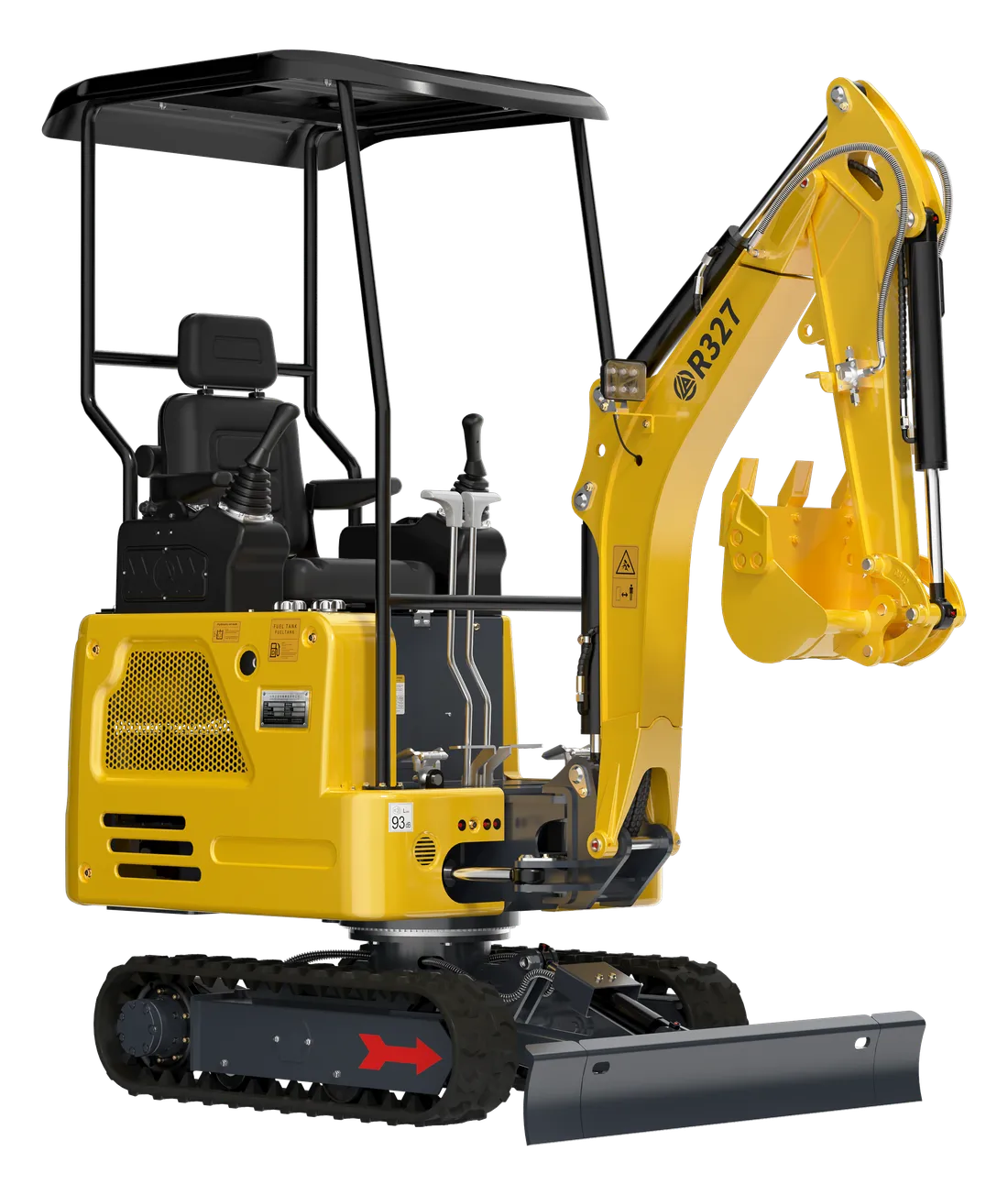
The R327 stands out with its 21 HP Kubota D722 engine, telescopic retractable tracks and 120° boom swing. The retractable tracks let you narrow the machine for tight passages and widen it while working for greater stability; the boom swing lets you dig along walls and fences without angling the machine. The articulated hydraulic thumb and 110 cm adjustable dozer blade are equipment often used in landscaping. It is priced at 549.000 ₺, starting at 479.000 ₺ with the current promotion (+ VAT).
A quick rule: if most of your jobs are in small, finished gardens, the R10; if you have more than one job a day and lots of digging along walls, the R327. If very stony, hard ground or large root removal comes up often, the R350, with a bucket digging force of 22.5 kN, works more comfortably; the R10 and R327 have the same digging force (11 kN). We set out a step-by-step plan for garden work in our garden landscaping with a mini excavator guide.
The second machine: when does a tracked tractor come in?
If your firm takes on maintenance of large lawns, parks, residential estate gardens or orchards, soil preparation soon becomes a bottleneck. Preparing an area of several decares with a mini excavator or by hand ties up the crew for days. This is where the tracked tractor comes in.
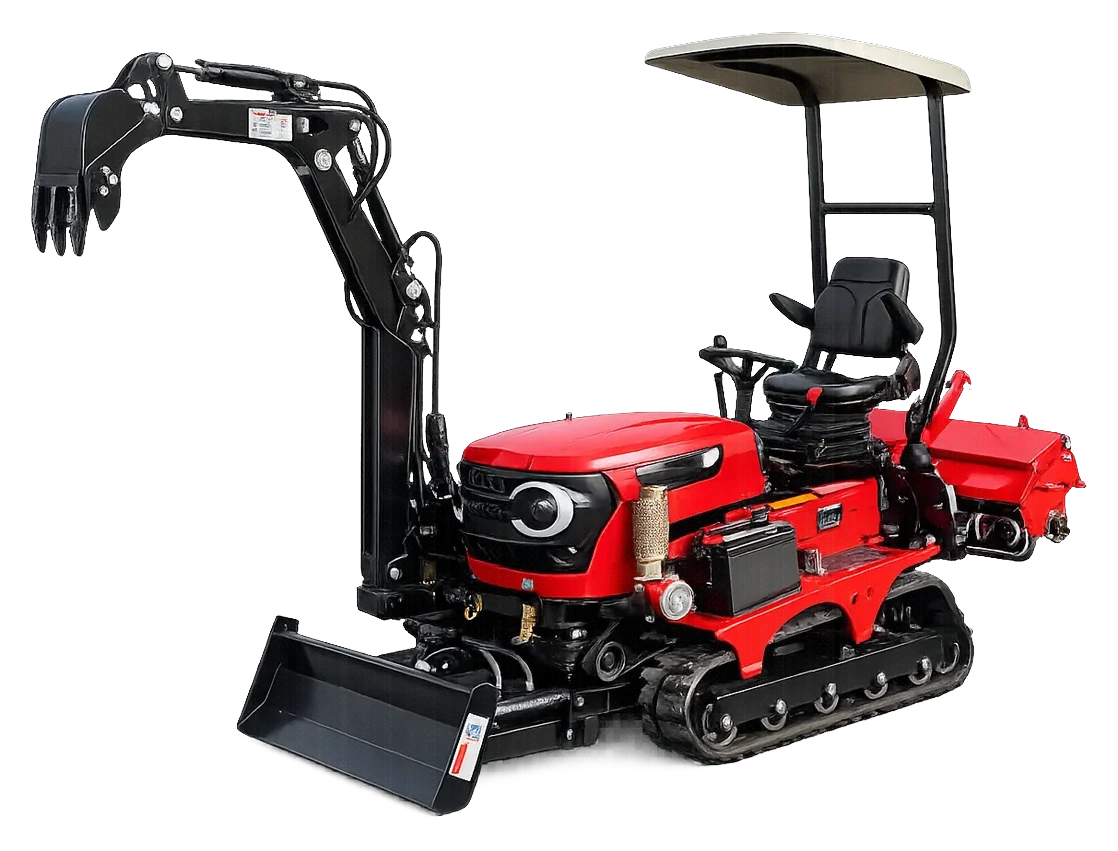
The QD35 tracked tractor has 35 HP; according to its spec sheet, it can work about 2 decares per hour with a rotary tiller and uses 1–2 litres of fuel per decare. It is 980 mm wide and weighs 750 kg. Because tracks spread the weight over a larger surface, on soft, damp ground they usually leave fewer marks than small wheeled tractors. It starts at 249.000 ₺ + VAT.
If your work is mostly on large areas but digging comes up too, the QD35 with excavator arm, with its rear digging arm (from 349.000 ₺ + VAT), combines both jobs in one machine. To be honest, a tractor 3,100 mm long can’t manoeuvre as easily as a mini excavator in tight, finished gardens. If your main work is in small gardens, the tractor should be the second machine, not the first.
Attachments: a new revenue stream from the same machine
For a landscaping firm, an attachment is an investment that reduces the days the machine sits idle and opens up new types of work. The standouts:
- Auger: Digs neat, accurately sized holes for planting saplings and fence posts. We explain how to use it in detail in our digging holes with an auger guide.
- Screening bucket: Screens excavated soil on site and separates out the stones; after screening, the soil can often be reused.
- Grading bucket and rake: Speed up fine levelling and stone picking before sowing a lawn.
- Hydraulic grapple and thumb: Make it easier to grip and place decorative rocks, logs and large stones.
- Quick coupler (Quick Up): If you change attachments several times a day, it saves time at every change.
Use a simple measure for your assessment: divide the cost of the attachment by the number of extra working days you will get in a season thanks to it. If the result is a small fraction of your daily earnings from that work, the investment makes sense. You can see all the options on our mini excavator attachments page and ask for current prices on WhatsApp.
Usage calculation: how many days a year will this machine work?
The most important number in deciding whether a machine pays its way is the number of days it is used per year. Set up the calculation in three steps:
- Usage days: Add up the days the machine will work on your existing jobs and the new jobs you could take on thanks to the machine.
- Daily machine cost: (purchase price − estimated resale value) ÷ total working days over the period of use + daily fuel + maintenance allowance + transport.
- Daily contribution: the labour the machine replaces (people × day rate) + the extra work you can charge for thanks to the machine.
If the daily contribution is clearly above the daily machine cost, the machine is paying its way. Because day rates, fuel and service prices vary from region to region, do this calculation with your own records. For a machine you will need for only a few weeks a year, also do the rent or buy calculation; some machines are better hired than kept in the fleet.
Hidden items: transport, storage and the operator
Transport: A landscaping machine goes to a different address every day; the trailer and towing vehicle are part of the fleet. The R10’s operating weight is 1,200 kg (machine weight 900 kg), while the R327’s is 1,700 kg (net weight 1,692 kg); because of the difference of about 500 kg, the R327 may need a higher-capacity trailer and towing vehicle. Check the permitted load limits of the vehicle and trailer and the driving licence requirements in advance; confirm the current requirements with the relevant authority. We explain tie-down rules in our transport guide.
Storage: Plan a locked, dry area for the machine and attachments. If attachments such as buckets and the auger are kept on a tidy rack, you go out to site with everything you need and damage is reduced.
Operator: Don’t depend on just one person who can operate the machine; on their days off or sick days, the machine stands idle. We provide basic operator training on delivery; confirm the current requirements of occupational health and safety legislation on operator training and certification with your health and safety adviser.
Maintenance and parts: A machine that breaks down mid-season is the most expensive machine of all. 382 spare parts are shipped from stock on the same day; plan the scheduled service before the season starts.
A staged machine fleet plan
For most landscaping firms, a sensible order looks like this; move on to each stage once the previous stage’s machine is busy enough:
- Starting out: One mini excavator, two or three buckets of different widths, a grading bucket or rake.
- Specialising: Depending on your job list, an auger, screening bucket or grapple; a quick coupler if you change attachments often.
- Expanding: A tracked tractor and rotary tiller if work on large areas has grown.
- Second crew: If the workload supports two crews, a second mini excavator in a different class; for example an R10 for finished gardens and an R327 for work along walls; the R350 if hard ground and deep digging dominate.
This order is not a rule but a way of thinking. If maintenance-contract work on large areas dominates, the tractor may even move to first place; what decides is always your job list.
Summary
For a landscaping firm, a machine fleet pays off when it is built from the job list, not the catalogue. Before adding a new machine or attachment, run through this checklist:
- I have listed the past year’s jobs by type, days and number of people.
- I have identified the job type that eats up the most manual labour; the new machine solves it.
- I have realistically estimated how many days a year the machine will work.
- I have calculated the daily machine cost and daily contribution with my own figures.
- I have compared the gate and access widths of the gardens I will work in with the machine’s width.
- The transport vehicle, trailer and driving licence requirements are in place.
- There are at least two people who can operate the machine.
- I have confirmed the model compatibility of the attachments.
To choose your first machine, you can compare our mini excavator models and share your job list to ask on WhatsApp which machine and attachment combination suits you.