When a job calls for a mini excavator, the first thought is usually to look for a mini digger to hire: you pay a one-off fee, and when the job is done, the responsibility ends too. But when you need the machine not a few times a year but frequently, the total of the hire fees you pay starts to approach the price of a machine.
In this volume we give you a method for answering the question “should I hire a digger or buy one?” with calculation instead of gut feeling: the real cost items on both sides, the break-even days formula, the factors outside the figures and a decision table for your situation.
Because hire rates vary from region to region and season to season, we don’t give you a ready-made hire figure. We give you the formula and the table to fill in; you put in the figures from quotes in your own region. The calculation is the same for all tracked mini excavators, whether listings call them hire diggers, small diggers or compact excavators.
The first question: how many days a year do you need a machine?
The whole calculation is built on this number, so draw up an honest list. Write down the jobs for which you hired a machine or had someone else do the work last year; then add the ones you are planning this year. Note the approximate number of days next to each job; don’t leave out half-day jobs either.
Add one more column to the list: “I’d have done it if I had the machine.” When hiring requires delivery and a minimum hire period, jobs such as a water pipe repair, a small drainage trench or removing a tree stump get postponed or done by hand. With your own machine, these jobs become doable. Keep this column realistic; don’t count jobs you only say “maybe” to.
Finally, look at when the jobs come up. If your needs pile up in periods such as spring and autumn when everyone is looking for a machine, it may be hard to find a mini excavator for hire on the day you want. This is the first item in the calculation that isn’t a figure.
The real cost behind mini digger hire rates
Comparing only the daily rate when getting hire quotes is misleading. To see the whole bill, ask every hire company these questions:
- What are the daily, weekly and monthly rates separately? Is there a discount for long hire?
- Is there a minimum hire period? Will you pay for a full day for a half-day job?
- Is delivery included in the price, or are the outward and return trips charged separately?
- Is an operator included? With operated hire, how are out-of-hours charged?
- Who covers fuel? Is the machine delivered full and expected back full?
- Damage and breakdown liability: If the machine breaks down while it is with you, who bears the downtime, and is there a deposit?
- Attachments: Are the bucket width, breaker or auger you need available, and what is the extra charge?
After collecting these answers, work out the total cost of a working day to you: hire + share of delivery + operator (if any) + fuel. This is the figure you will use in the break-even calculation, not the daily rate in the quote.
The real cost of buying
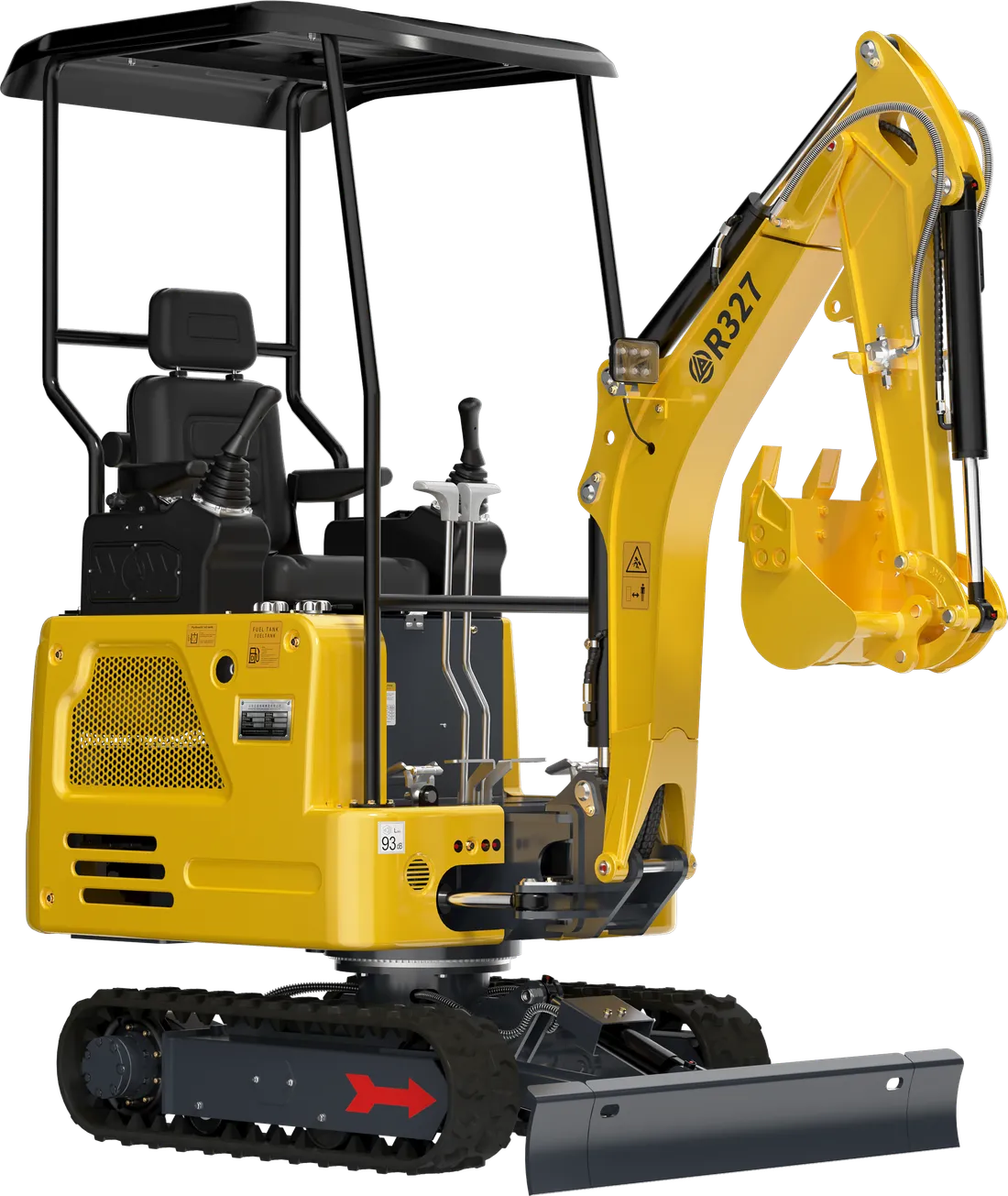
On the buying side too, the price tag is only the start of the story. At EKSFORK the 1.2-tonne R10 starts from 299.000 ₺ and the 1.7-tonne R327 from 549.000 ₺ (479.000 ₺ with the campaign); prices exclude VAT. For the 3.5-tonne R350, we share the current price in a quote. The annual cost of ownership includes these items:
- Depreciation: The difference between the purchase price and the price you expect to get when selling a few years later, divided by the years of use. We explain the factors that affect second-hand value in the second-hand or new volume.
- Financing: If you use instalments or a loan, the interest and fees; if you pay cash, you give up what that money could have earned elsewhere. We compare the options in the payment options volume.
- Maintenance and consumables: Filters, oils, grease and, over time, wearing parts such as tracks and bucket teeth.
- Insurance: Get a quote from your insurer for the machine and third-party liability.
- Storage and security: Keeping the machine somewhere enclosed, or at least secure.
- Transport: If you don’t have your own trailer and towing vehicle, every job needs haulage. We explain the options in our transport guide.
Another advantage of a new machine is that the risk of major repairs in the first years is limited by the warranty. At EKSFORK, machines come with a 2-year or 2,000-operating-hour warranty; as long as you keep to the warranty terms and the maintenance schedule, periodic maintenance items make up the bulk of your budget in the first years.
The break-even formula: after how many days does buying pay off?
The essence of the calculation rests on a single question: how many days’ worth of hire difference is the annual fixed cost of owning the machine equal to? For this you need three figures:
- O — Annual ownership cost: (Purchase price − estimated sale price) ÷ years of use + annual financing + insurance + storage.
- R — Total cost of one hire day: Daily hire + share of delivery + operator (if any) + fuel.
- V — Variable cost of one day on your own machine: Fuel + hourly maintenance allowance + transport and operator (if any).
Break-even days = O ÷ (R − V)
If your annual need is above this number, buying is more economical; if it is below, renting is. If the two are close, factors outside the figures decide.
Example (the figures are only for interpretation): Say the break-even point comes out at 45 days with your own values. If you use a machine 20 days a year, renting clearly makes sense. If you use it 70 days a year, on each of the 25 days beyond break-even you gain the difference between the hire cost and your own machine’s daily variable cost; buying comes out ahead. If you are between 40 and 50 days, the two options are close in cost.
Know the sensitive points of the formula too. If you enter the estimated sale price optimistically, O shrinks and the break-even point looks earlier than it really is; so use a cautious estimate. As the difference between R and V shrinks, the break-even point moves out quickly: if hire rates are low in your region, or you have to haul your own machine a long way for every job, the advantage of buying decreases. Do the calculation not once but with two scenarios: one cautious, one realistic. If both scenarios give the same result, your decision is sound.
To make the calculation easier, fill in the table below with your own figures:
| Item | Where do you find it? | Your figure |
|---|---|---|
| Annual days of use | Your job list: last year, this year’s plan and the “I’d have done it if I had the machine” column | …… days |
| Total daily cost of hiring (R) | Quotes from at least three companies, including delivery, operator and fuel | …… ₺ |
| Machine purchase price | Quote by model and equipment (list prices exclude VAT) | …… ₺ |
| Estimated sale price and years of use | Second-hand listings in your region, your own plan | …… ₺ / …… years |
| Annual financing, insurance, storage | Payment plan, insurance quote, your own facilities | …… ₺ |
| Daily variable cost (V) | Fuel measurement, maintenance allowance, transport | …… ₺ |
| Break-even days | O ÷ (R − V) | …… days |
Five factors outside the figures
- Timing: Your own machine is on site the first day the weather allows. With hire, waiting your turn can push the job back by days, especially in the busy season; for calendar-bound jobs such as sowing or irrigation, the cost of this delay can be greater than the hire difference.
- Knowing the machine’s condition: You hold your own machine’s maintenance history. You can’t know how a hired machine was operated by previous users; that is why a short check when taking delivery is a good habit.
- Operator skill: If you will operate the machine yourself, owning it lets you become skilled over time; you don’t have to get used to a different machine with every hire. If you won’t operate it, don’t forget to add the operator cost to the calculation.
- Attachment flexibility: With your own machine you can take on new jobs with attachments such as an auger, a stone-screening bucket or a hydraulic breaker. With hire, it may not always be possible to find the attachment you want on the day you want it.
- Cash flow and risk: Hiring frees up your capital; buying ties up capital but creates an asset. If you are in an uncertain period, this difference may matter more than a few days’ difference in the calculation.
Which one in which situation?
| Your situation | Sensible choice | Why? |
|---|---|---|
| One-off project (house foundation, pool, large drainage job) | Hire or an operated service | The machine sits idle once the job is done |
| Short jobs a few times a year | Hire | Reaching the break-even point is hard |
| Farm, garden, greenhouse: small jobs spread throughout the year | Buy (R10 or R327 class) | Hire and delivery are paid again for every small job |
| You plan to sell services with the machine | Buy | The machine is an income-generating tool |
| Frequent light work, occasional heavy work | Buy a small machine, hire for heavy work | Fixed costs stay low and flexibility stays high |
| You’re not sure | Hire a few times first | You will see on site which class suits you |
If you have selling services with the machine in mind, we cover the income side of the calculation separately in the starting a business with a mini excavator volume.
The third option: hiring an operated service
Between hiring and buying there is another often-forgotten route: having the job done by a service provider who comes with their own machine and operator. With this option you don’t need to know how to operate the machine, transport it or insure it; you buy the job description and the result.
An operated service makes particular sense in three situations: if there is nobody to operate the machine, if the job is delicate and one-off (for example, digging a foundation right next to an old structure), or if the job’s duration is hard to estimate. When getting a quote, put the scope of the job in writing: the dimensions of the excavation, where the soil will be tipped, delivery, and how it will be priced if unexpected ground turns up. Also clarify whose responsibility it is to get information from the relevant authorities on electricity, gas and water lines before digging.
If you are thinking of buying, this route has another benefit: while watching the operator work, you see on site which machine class, which bucket and which attachment are enough for your job. In the same way, when hiring a few times first, choose a machine in the class you are thinking of buying and note down the answer to the question “what did I feel was missing here?”
If you decide to buy
If the calculation points to buying, two decisions remain: the right class and the right payment plan. Buying a machine one class bigger “just in case” upsets your break-even calculation: the purchase price and fuel go up, and a machine that can’t get into tight spaces struggles in your main work. We explain in detail which tonnage is enough for which job in the what size machine to buy volume.
At EKSFORK we apply a single-price principle: the price doesn’t change through haggling; it is the same for everyone. In return, we offer flexible options on the payment side; we can set up a plan that suits your cash flow together. Machines are delivered to all 81 provinces, villages included; at delivery we provide installation and basic operator training.
Quick checklist
- I worked out my annual days of use with a realistic job list.
- I got total quotes, including delivery, operator and fuel, from at least three hire companies.
- For buying, I calculated depreciation, financing, insurance and storage on an annual basis.
- I worked out the variable cost of one day on my own machine (fuel, maintenance allowance, transport).
- I calculated the break-even days and compared them with my annual need.
- I weighed up non-numerical factors such as timing, attachments and the operator.
- If I’m buying, I have settled on the right class and a payment plan that suits my cash flow.
Once you have done your calculation, you can ask about current prices and payment options for the R327 or our other mini excavator models on WhatsApp.