“I’ll buy a mini excavator, run it myself, and the machine will pay for itself in a few years.” Plenty of people say this, and the idea stands on solid ground: small digging jobs are everywhere, and there is real demand for mini excavators in places large machines can’t get into.
But what decides your earnings in this business is not the hourly rate, as most people think; it is how many hours a year you can actually bill. In this guide we work through the sums for earning from contract work with realistic figures: who you will sell what to, which machine and equipment to start with, how to calculate your hourly cost, how to price your work and where to find your first customers.
Because service rates, fuel prices and labour costs vary from region to region, we don’t give a ready-made profit figure; instead, we give you the formulas to plug your own numbers into. If you haven’t yet decided whether you are buying the machine to sell services or for your own jobs, take a look at our rent-or-buy guide first.
First, define your business model: which services, for whom?
Starting out with “I’ll take any job” spreads your machine choice, attachment budget and marketing effort too thin. In the first year, focus on one or two customer groups. The main groups and what they expect:
- Homeowners and garden owners: Garden landscaping, trenches for water and sewer connections, pool or pond digging, stump removal. Jobs are short; the customer wants a clean finish and a clear price.
- Landscaping firms: They call you in as a subcontractor. The work can be regular, but you may face pressure on price and long payment terms.
- Building and utility subcontractors: Foundations in tight spaces, service trenches, clearing up after demolition. Turning up on time and following site safety rules come first.
- Farmers and greenhouse growers: Drainage, irrigation lines, fence posts and planting holes. The work is seasonal: busy in season, quiet outside it.
- Public sector and village work: Procurement procedures and paperwork requirements are different. Rather than planning on it as your main line of business at the start, consider it as you gain experience.
The group you choose will determine your machine class, your attachments, your work calendar and how you price your work.
The machine and your initial investment list
In contract work, you choose the machine to suit the work you will sell; the biggest machine is not the one that earns the most. Here are the options at EKSFORK and the services each one stands out for (prices are starting prices excluding VAT):
| Service profile | Suitable machine | Why? |
|---|---|---|
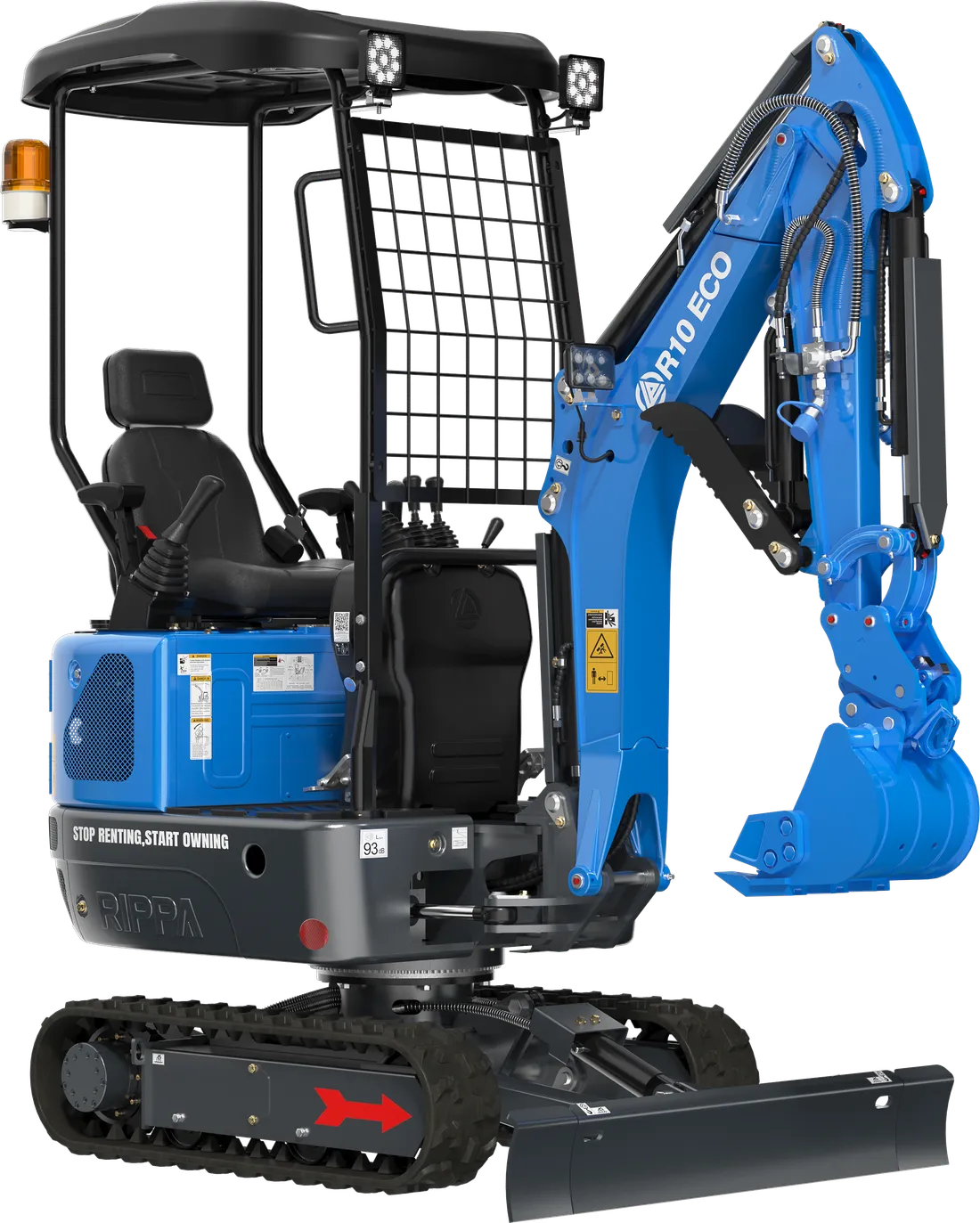
| Gardens, landscaping, narrow yards | R10 — 1.2 tonnes, from 299.000 ₺ | Light and easy to transport; its 1,650 mm digging depth is enough for garden work |
| Service trenches in tight spaces, digging along walls | R327 — 1.7 tonnes, from 549.000 ₺ (479.000 ₺ on promotion) | Telescopic tracks, 120° boom swing, 21 HP Kubota D722 engine |
| Deep digging, heavy earthmoving, long working days | R350 — 3.5 tonnes, ask us for the price | 2,927 mm digging depth, 22.5 kN digging force, enclosed cab with air conditioning |
| Tillage and digging in rural areas | QD35 with excavator arm — from 349.000 ₺ | 35 HP; tractor and digger in a single machine |
Alongside the machine, add these items to your initial investment:
- Transport: A trailer and towing vehicle suited to the machine’s weight, or a haulage arrangement for each job. In contract work, moving the machine is part of the daily routine, so be sure to read our transport and tie-down guide.
- Attachments: Buckets in different widths, a grading bucket, an auger, a hydraulic breaker, a screening bucket and a quick coupler each open up new services. Your chosen customer group decides which to buy first; the full list is on our mini excavator attachments page.
- Consumables and spares: Filters, oil, grease and the small parts you often need on site. A single day with the machine standing idle costs more than a small stock of parts.
- Personal protective equipment and site kit: Hard hat, hi-vis vest, gloves, barrier tape and basic hand tools.
What really decides it: billable hours
The concept at the heart of the calculation is this: billable hours are the working hours you invoice to customers. Not every day on the calendar is a working day; rain, mud, frost, public holidays, maintenance days, gaps between jobs and hours spent on the road all bring this number down.
Annual billable hours = Days with work per year × Average hours billed per day
Example (purely hypothetical figures): Suppose you work 10 months of the year, find work on an average of 15 days a month in those months, and bill 6 hours on each working day, not counting travel and preparation: 10 × 15 × 6 = 900 hours. If the same business can only find work on 10 days a month, the figure drops to 600 hours.
The gap between the two scenarios decides the fate of the business: your fixed costs stay the same, while the number of hours you spread them over falls by a third. For the first year, plan with the cautious scenario, not the optimistic one; if the optimistic one comes true, that’s a bonus for you.
The way to increase billable hours is often not to look for more work but to cut down on wasted hours: grouping jobs in the same neighbourhood on the same day, leaving the machine on a secure site instead of taking it a long way back every evening, and agreeing with the customer up front whether hours spent waiting for materials that haven’t arrived are paid.
Work out your hourly cost
Before you quote a price, you need to know what an hour costs you. Split your costs into two groups.
Fixed costs (annual)
- Machine instalments, or the financing cost of paying in cash
- Depreciation: the annual share of the difference between the purchase price and the estimated resale price a few years later
- Insurance, accounting, phone and marketing costs
- Storage for the machine and trailer
Variable costs (hourly)
- Fuel: Your measured L/h × the price per litre. We explain how to measure it in our fuel consumption guide.
- Maintenance allowance: Divide the cost of the periodic maintenance items (filters, oil, grease) by the number of operating hours in the service interval.
- Wear allowance: The hourly share of the cost of replacing parts such as tracks, bucket teeth, pins and bushings.
- Transport: Average transport cost per job ÷ average hours billed per job.
- Operator: If you don’t operate the machine yourself, the operator’s hourly cost.
Hourly cost = (Annual fixed costs ÷ Annual billable hours) + Hourly variable costs
This figure is your floor price: every job you take below it loses you money. Payment for your own labour and your profit go on top of this floor. Next, collect prices from others offering the same service in your area. If the market rate is below your floor, the problem usually lies not in your price but in your cost structure or your billable hours.
Pricing models: hourly, daily, fixed price
- Hourly: The fairest method for jobs of uncertain length. Read the machine’s hour meter together with the customer at the start and at the end. Setting a minimum charge for small jobs covers your transport and preparation costs.
- Daily: Easy for the customer to budget for. Put in writing how many hours make up a day, between which times you will work and how breaks are counted.
- Fixed price (per job): The model customers like best and the one where you take the most risk. State from the outset how the price will change if you hit unexpected ground conditions such as rock, old concrete, roots or water.
Whichever model you choose, give your quote in writing; even a message will do, as long as it covers the essentials: a description of the job and its dimensions, the estimated time, whether transport is included, where the soil will be tipped, when payment is due and who is responsible for underground services. Getting information from the relevant utilities about electricity, gas and water lines before digging is essential, both for your safety and for liability if anything is damaged.
Finding your first customers
In the machinery business, the strongest advertisement is a finished job. At the start, these steps help:
- Get to know complementary trades: Plumbers, pool builders, fencing and wire mesh firms, plant nurseries and landscapers all need digging done but have no machine of their own.
- Take before-and-after photos: Photograph every job from the same angle at the start and at the end. On social media and in messages with customers, these are the most convincing advertising there is.
- Be visible on maps: List your business on map apps so that customers searching for digging services nearby can find you.
- Leave a clean site: Levelling the soil and tidying up before you leave is the quickest way to get recommended.
- Plan for the off-season: Agree in advance on work that can be done in winter or in the rainy season; don’t leave your calendar to good weather alone.
Realistic risks and how to manage them
- Empty days: In the first months, work comes in irregularly. Plan your instalments so they can withstand a few months of low income; we compare payment plan options in our payment options guide.
- Breakdowns and downtime: In contract work, a machine standing idle is lost income. Don’t skip the daily checks or periodic maintenance; we explain how to keep your warranty valid in our warranty guide. EKSFORK keeps 382 spare parts in stock and ships them the same day, with support from 14 authorised sales and service points in 12 provinces and a contracted service network across all 81 provinces.
- Getting paid: Agree on when payment is due before you start the job; on large jobs, asking for a part payment up front is reasonable practice.
- Damage and liability: Damage to an underground service, a wall, a vehicle or landscaping can wipe out the profit on a job in one go. Talk to your insurer about third-party liability insurance.
- Certificates and registration: Operating construction machinery requires an operator certificate; confirm which certificate is needed and the current conditions with the relevant authorities. Work with your accountant on setting up the business, invoicing and tax.
When should you grow the business?
The real benefit of keeping records is that you can base the decision to grow on data rather than guesswork. For each job, note the date, customer group, hours billed, fuel, transport distance and payment date. After a few months, this table will give you three signals:
- Jobs you turn down for the same reason: If you have said “no” several times to “Have you got an auger?” or “Can you bring a breaker?”, your first step in growing is not a second machine but that attachment. For fence post and tree planting work, see our auger guide.
- A calendar booked up weeks ahead: If you are constantly booking jobs for later dates and losing customers, a second machine and operator may be worth considering. Make this decision with the same hourly cost calculation too, this time including the operator’s wage.
- Jobs that pay and jobs that drain you: Some customer groups pay on time; others pay late or need long transport runs. Compare the net contribution per hour by customer group and point your marketing at the group that pays.
The most expensive mistake in growing is buying a second machine before your records have told you anything. Don’t plan a second machine until you have seen how many hours a year the first one bills.
Quick checklist
- I have chosen one or two customer groups to focus on.
- I have decided on the machine class and first attachments that suit this group.
- I have settled on my transport solution (trailer, towing vehicle or haulage arrangement).
- I have calculated my annual billable hours using the cautious scenario.
- I have worked out my hourly floor price from my fixed and variable costs.
- I have collected service prices in my area from several sources.
- I have prepared my pricing model, minimum charge and written quote template.
- I have discussed insurance, the operator certificate and tax registration with the relevant specialists.
- I have made a cash plan that can withstand the low-income period of the first months.
To choose the right machine for the services you will offer, take a look at our mini excavator models, and talk to us about your business plan and payment options on WhatsApp.