In construction subcontracting, profit is usually lost in two places: labour that takes longer than expected and a schedule that slips. A drainage channel, a service trench, a small foundation or breaking up old concrete in a courtyard — on paper each is a job of a few days, but on site it drags on because of the ground, the weather and the struggle to find workers.
A mini excavator changes both the labour and the time on these jobs. But it is not the right investment for every subcontractor; a machine bought before it is clear how many days a year it will work, which jobs it will take over and who will operate it ages in the yard, not on site.
In this guide we set out a method so you can make the decision with numbers, not gut feeling: which jobs suit a machine, how to compare hand work with machine work, how to turn time savings into money and which hidden costs must be taken into account. You will supply the figures; we provide the formula and the checkpoints.
The subcontractor’s real problem: labour, time and uncertainty
The cost of digging by hand isn’t made up of day rates alone. Finding workers, getting them to site, covering their meals and travel, paid hours lost on rainy days and the job taking longer than expected are all part of that cost. What is more, digging is usually on the job’s critical path: pipes can’t be laid until the trench is dug, and concrete can’t be poured until the foundation is excavated. Every delay in the digging holds up all the crews that follow.
So what a machine really earns a subcontractor comes in two layers. The first layer is the visible one: fewer person-days. The second is talked about less but is often bigger: a predictable schedule. A job whose finish date you know lets you keep your promise to the main contractor and move on to the next job on time.
Mini excavators in construction: which jobs suit the machine?
On subcontracting jobs, the mini excavator earns its keep most on these items:
- Drainage and waterproofing excavation around buildings: At the foot of a retaining wall you need to position the machine parallel to the wall and dig. The 120° boom swing (on the R327 and R350) makes this much easier; we explain this in our boom swing guide.
- Service trenches: Accurately sized trenches with a narrow bucket for water, sewer connections and electrical conduit runs.
- Small structure foundations: Detached houses, outbuildings, garden walls and retaining wall foundations. We cover the planning and sequencing steps in our foundation digging guide.
- Breaking work: A hydraulic breaker for breaking up courtyard concrete, old screed and kerbs. Details are in our small demolition jobs guide.
- Loading rubble and soil: Loading small quantities into lorries or skips.
- Backfilling and levelling: Backfilling the trench after the pipe is laid and levelling with the dozer blade.
To be honest, large-volume basement excavation and bulk earthworks are not jobs for a mini excavator. Larger-class machines are much faster here; making a mini excavator compete with them wears out both the machine and your calculations.
The calculation method: by hand or by machine?
Make the comparison with the same two formulas for every job:
- Cost of hand work = number of workers × days × day rate + extra costs per person (such as meals, travel and insurance)
- Cost of machine work = machine days × daily machine cost + operator + labourer if needed + transport
The daily machine cost is made up of these items:
| Item | How it is calculated | Where the data comes from |
|---|---|---|
| Depreciation share | (Purchase price − estimated resale value) ÷ total working days | The quoted price and your own usage plan |
| Fuel | Hourly consumption × hours per day × price per litre | The spec sheet value or your own measurement; 1.3 L/h for the R350 according to the spec sheet |
| Maintenance and parts allowance | Annual maintenance cost ÷ working days per year | The service intervals in the operator’s manual |
| Insurance and other | Annual amount ÷ working days per year | Your own policy quotes |
| Operator | Daily wage or day rate | Conditions in your area |
The most critical figure is productivity: work out from your own past jobs how many metres of trench your crew digs by hand in a day, or how many cubic metres they excavate. Measure and note the machine’s productivity on the first jobs too. Because the ground, the depth and the operator’s experience change this number a great deal, your own records count, not someone else’s figures.
Worked example: a drainage job
Example (entirely hypothetical figures; recalculate with your own values): A drainage channel is to be dug around a detached house. According to your own records, this job takes 4 people 5 days by hand, i.e. 20 person-days. With the machine, it takes 1.5 days with an operator and one labourer.
- By hand: 20 × P (P = total daily cost per person)
- By machine: 1.5 × M + 3 × P (M = daily machine cost; for simplicity we have counted the operator and labourer at P)
The machine work is cheaper as long as the total of 1.5 × M + 3 × P stays below 20 × P, which means M must be below roughly 11 × P. In this hypothetical job, the machine pays off if the daily machine cost is below the daily cost of about eleven workers. This ratio varies a great deal with the type of job, the ground and your crew; the point is not the ratio itself but the habit of making this comparison on your own jobs.
There is one more gain the calculation leaves out: the job finished 3.5 days early. We calculate the value of those days in the next section.
The schedule effect: turning time savings into money
Because time savings are invisible, they usually don’t make it into the calculations at all. Yet for a subcontractor they are worth at least as much as labour. They come from three places:
- Waiting crews: The cost of plumbing, concrete or waterproofing crews kept waiting because the digging isn’t finished.
- Weather window: Completing the digging, pipe laying and backfilling on the same day stops an open trench from collapsing or filling with water in the rain. Work that has to be redone is the most expensive work there is.
- Jobs per year: If every job finishes a few days early, the same crew can take on more jobs in a year.
A simple formula: Value of time saved = days saved × (cost of waiting crews + daily overheads) + the contribution of jobs brought forward. When you include this item, you may find that a machine that looks borderline on labour alone actually pays off by a wide margin.
There is another gain that is hard to measure but real: reliability. A subcontractor who finishes the job on the promised date is the first person the main contractor calls for the next job.
Quoting with a machine: the unit-price approach
The most common mistake after buying a machine is not changing the way you quote. With hand work, the price is usually thought of in person-days; with machine work, it is better to think in units (metres of trench, cubic metres of excavation, square metres of breaking). That way, the gain from the machine’s higher productivity stays with you.
When building a unit price, add up these items:
- Machine days × daily machine cost
- Operator and labourer costs
- Transport to and from the site
- Haulage, if the excavated material has to be removed from site
- A risk margin for unexpected ground conditions
The last item matters. Write into the contract the type of ground and what happens if rock or old concrete turns up. Soil dug with a bucket and rock that needs a breaker can’t be done at the same unit price; settling this before work starts prevents arguments mid-job.
Choosing the model: R10, R327 or R350?
For a subcontractor, choosing a model means finding where the job you do most often meets your hardest access conditions:
- R10 (1.2 t): Narrow courtyards, inner gardens and around finished buildings. Machine width 930 mm, maximum digging depth 1,650 mm according to the spec sheet, bucket width 40 cm. Starts at 299.000 ₺ + VAT. In hard ground and on breaker work, use it knowing its limits.
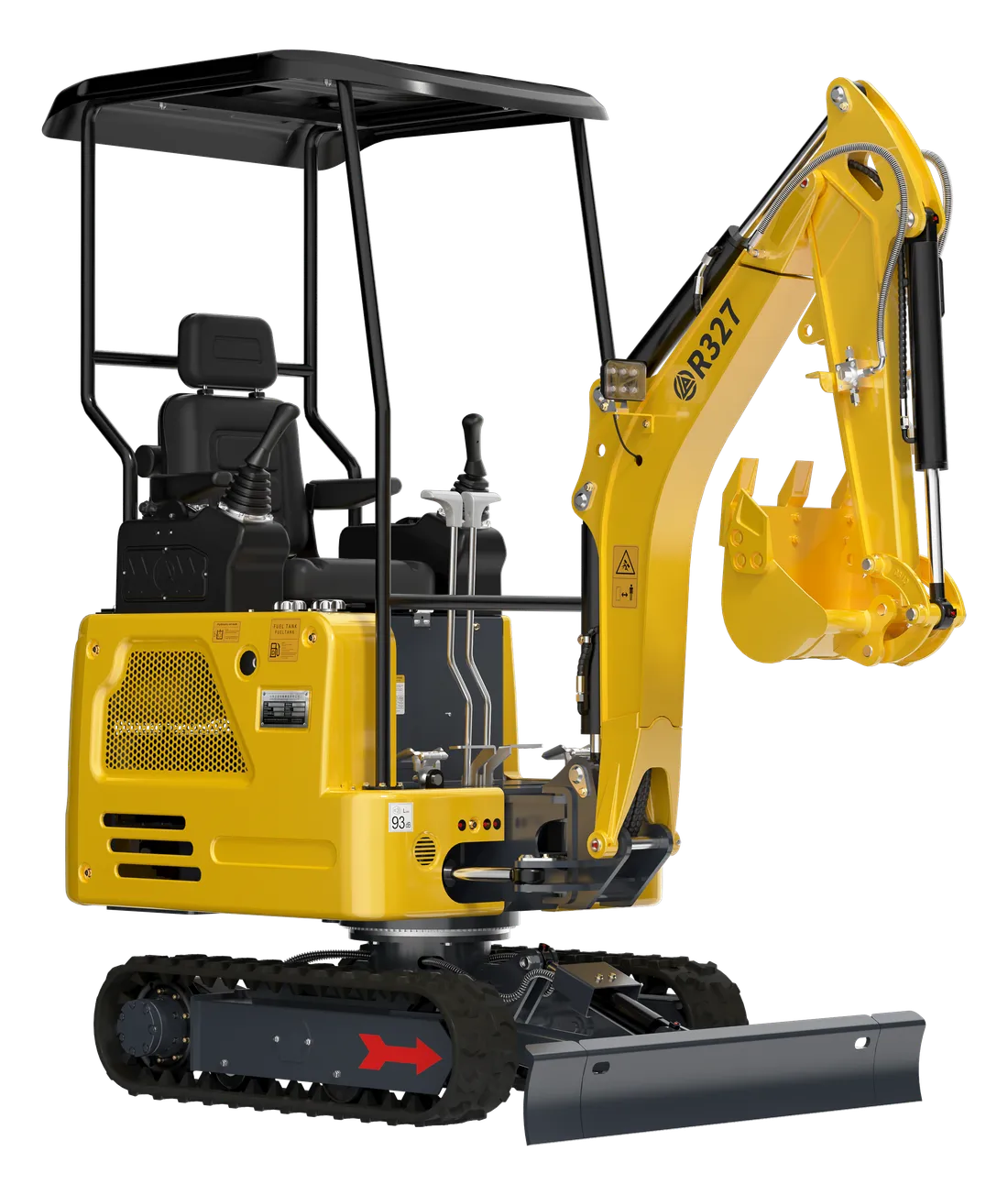
- R327 (1.7 t): The balance between access and power. 21 HP Kubota D722 engine, telescopic retractable tracks, 120° boom swing and articulated hydraulic thumb. 549.000 ₺, starting at 479.000 ₺ with the promotion (+ VAT). According to the spec sheet, its maximum digging depth is 1,580 mm and its digging radius 2,894 mm; it is slightly behind the R10 in depth but ahead on access.
- R350 (3.5 t): Deeper foundation and service trenches, hard ground and breaker work. 25 HP Kubota D1703 engine, enclosed cab with air conditioning, 22.5 kN bucket digging force, and according to the spec sheet 2,927 mm maximum digging depth and 5,007 mm digging radius. At 1,350 mm wide, its access through narrow passages is more limited and it needs a larger vehicle to transport. Ask for a quote for the current price.
If you are undecided, list the past six months’ jobs and ask of each one: “which model could have got onto this site, and which could have reached this depth?” The model that covers the most jobs is usually the right one. Compare the R350’s specifications and the other models with this in mind.
Hidden costs and risks
To keep the calculation realistic, don’t leave out these items:
- Operator: If you operate the machine yourself, the labour saving increases but the time you have for management shrinks. If you hire an operator, add the cost to the calculation. Confirm the current requirements for operator training and certification with your health and safety adviser.
- Transport: Every move between sites has a cost and takes time; a trailer and towing vehicle, or a transport service.
- Attachments: A breaker, an auger or extra buckets are a separate investment. Assess each attachment by the type of work it opens up and how many days a year it will be used; ask us for current attachment prices.
- Idle time: A machine waiting between two jobs keeps generating costs. If you are thinking of offering contract digging with an operator on idle days, do the calculation in our starting a business with a mini excavator guide.
- Underground services: Before digging, get information on electricity, gas and water lines from the relevant authorities; damaging a line can wipe out the whole profit on a job.
- Site security: If the machine stays on site overnight, the key must be taken and attachments kept in a locked place.
- Breakdowns and downtime: At EKSFORK, machines come with a warranty of 2 years or 2,000 operating hours; 382 spare parts are shipped from stock on the same day, and there are 14 authorised sales and service points in 12 provinces and a contracted service network in all 81 provinces. Even so, write scheduled servicing into your job calendar from the start.
If you will use the machine for only a few weeks a year, hiring may make more sense than buying; we calculate the break-even point in our rent or buy guide.
Quick checklist
- I have listed the past six months’ digging, breaking and backfilling jobs in person-days.
- I have worked out my crew’s hand productivity from my own records.
- I have calculated the daily machine cost with depreciation, fuel, maintenance, insurance and the operator.
- I have realistically estimated how many days a year the machine will work.
- I have assessed the time savings in terms of waiting crews and jobs brought forward.
- I have chosen the model based on my sites’ access conditions and the depth needed.
- My plan for transport, the operator and idle time is ready.
- I have added an underground services check before digging to my workflow.
You can explore the R327, which balances access and power, and message us on WhatsApp for a comparison based on your own job list and a current quote.