Taking down an old garden wall, breaking out a cracked concrete yard, clearing an old foundation next to a building that is being renovated or removing a set of concrete steps… Jobs like these are too small to call in a large demolition crew but too big to tackle with a sledgehammer. A mini excavator and hydraulic breaker working together fill exactly this gap.
Even so, demolition is a different job from digging. When you dig, the soil is under your control; in demolition, pieces can fall in unexpected directions, hidden pipes or cables can turn up inside a wall, and one part of a structure may be holding up another. That is why half the job is planning.
In this guide we cover which demolition jobs a mini excavator can handle, the site survey and preparation, the right order of work, breaker technique, dust and rubble management, and the effect this work has on the machine.
Mini excavators for small demolition: which jobs can they do?
A mini excavator’s place in demolition is on low structures that can be taken down in sections and are within the machine’s reach. The table below gives a general framework for the jobs you’ll come across most often:
| Job | Suitable? | Note |
|---|---|---|
| Breaking out concrete yards, pavements and ramps | ✅ Suitable | Start from an edge; the breaker and bucket work together |
| Garden walls, block or stone walls | ✅ Suitable | Plan the height and the direction pieces will fall |
| Old foundations, concrete blocks, sections of retaining wall | ✅ Suitable | Check the soil behind and any neighbouring structure |
| Concrete steps, planters, fence post footings | ✅ Suitable | Small pieces are moved with a grapple |
| Removing asphalt from small areas | ✅ Suitable | Lifting it with a ripper is often enough |
| Small single-storey building (store, shed) | It depends | Needs a structural assessment and a permit |
| Multi-storey or load-bearing structure | ❌ Not suitable | Requires specialists and an engineered demolition plan |
| Building with suspected asbestos | ❌ Specialist first | Removal must be carried out by firms qualified for this work |
The rule is simple: breaking a structure from below when it is taller than the machine can reach can bring it down uncontrollably onto the machine and the operator. Any job the arm can’t control calls for a different method and a different crew.
Survey and preparation before demolition
In demolition, the most expensive mistakes are made before the machine even starts work. Complete these steps before you begin:
- Have the services disconnected: Before demolition, the electricity, water and gas connections must be cut off by the relevant utilities or authorised tradespeople, and you should get confirmation that this has been done. Lines running inside a wall or under the concrete are the most dangerous surprises of all.
- Check for hazardous materials: In older buildings, asbestos may be present in materials such as roof and cladding sheets or pipe insulation. If in doubt, have a specialist assess it before demolition; removing these materials is subject to its own specific rules.
- Find out what it supports: Is the wall you are taking down supporting another structure, soil or a roof? The soil behind a retaining wall can slip once the wall is removed. If you are not sure, consult a civil engineer.
- Confirm the permits: In most places, demolishing a structure requires a permit; even for small jobs, check the current requirements with your municipality.
- Let the neighbours know: Breaker work is noisy and causes vibration. Telling them your working hours in advance heads off most complaints before they start.
- Plan for the rubble: Before you start, be clear about where the material will go and how it will be hauled away.
Matching the machine and attachments
In small demolition, it is rare to finish the job with a single attachment. On a typical job, the breaker breaks up the concrete, and the grapple or bucket separates the pieces and loads them.
- Hydraulic breaker: The main tool for breaking concrete, stone and hard ground. The breaker must suit the machine: one that is too heavy strains the machine’s stability and hydraulic system, while one that is too light won’t be up to the job. We cover choosing a breaker in detail in our hydraulic breaker guide.
- Hydraulic grapple: Used to pick up, sort and load broken concrete, stones and steel bars.
- Ripper: Useful for lifting thin concrete surfacing and asphalt from the edge, and for prising broken pieces loose.
- Digging bucket and standard bucket: For gathering rubble, clearing the ground underneath and loading.
- Quick coupler: If you will be switching often between breaker, grapple and bucket during the day, a quick coupler system saves a great deal of time.
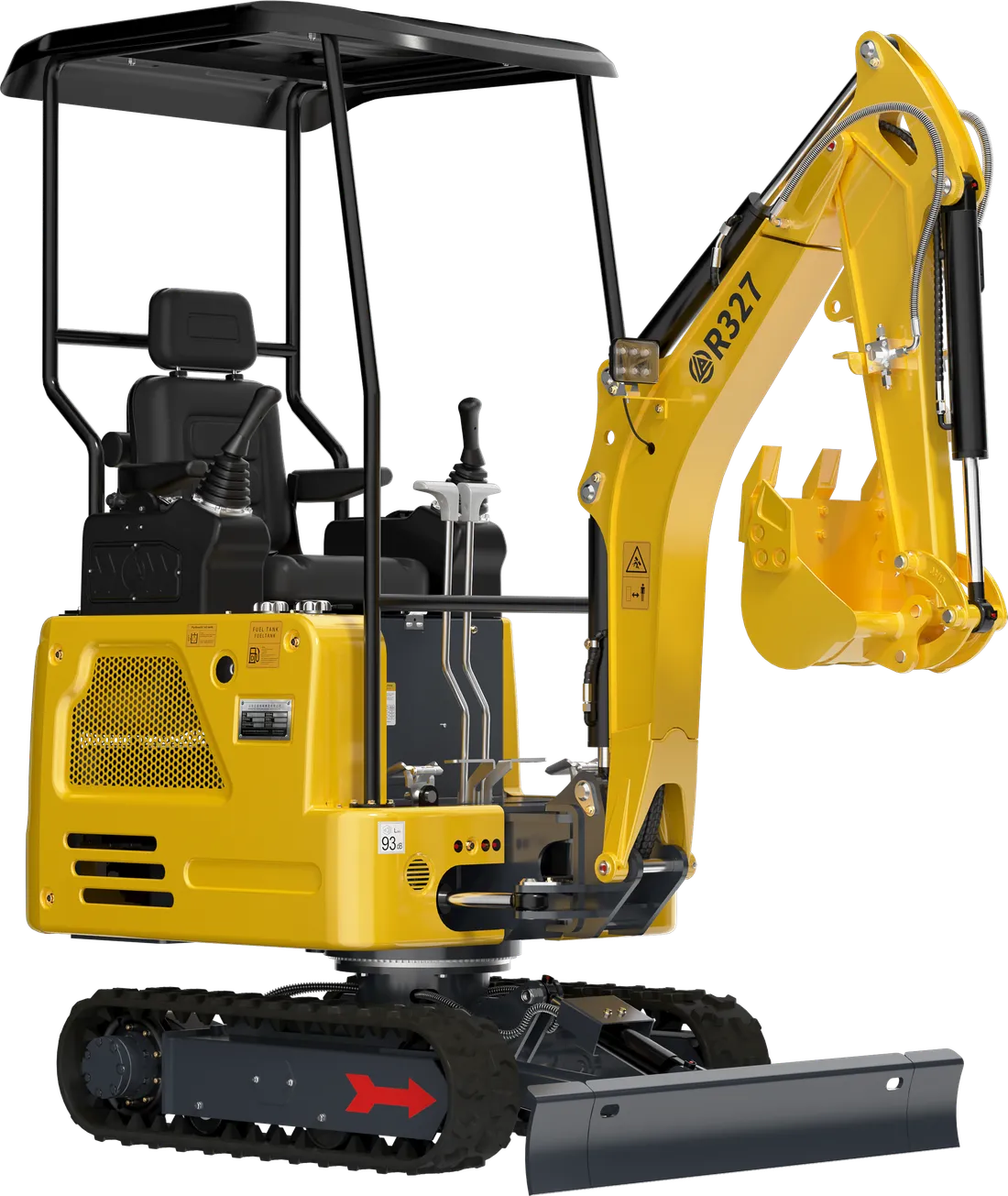
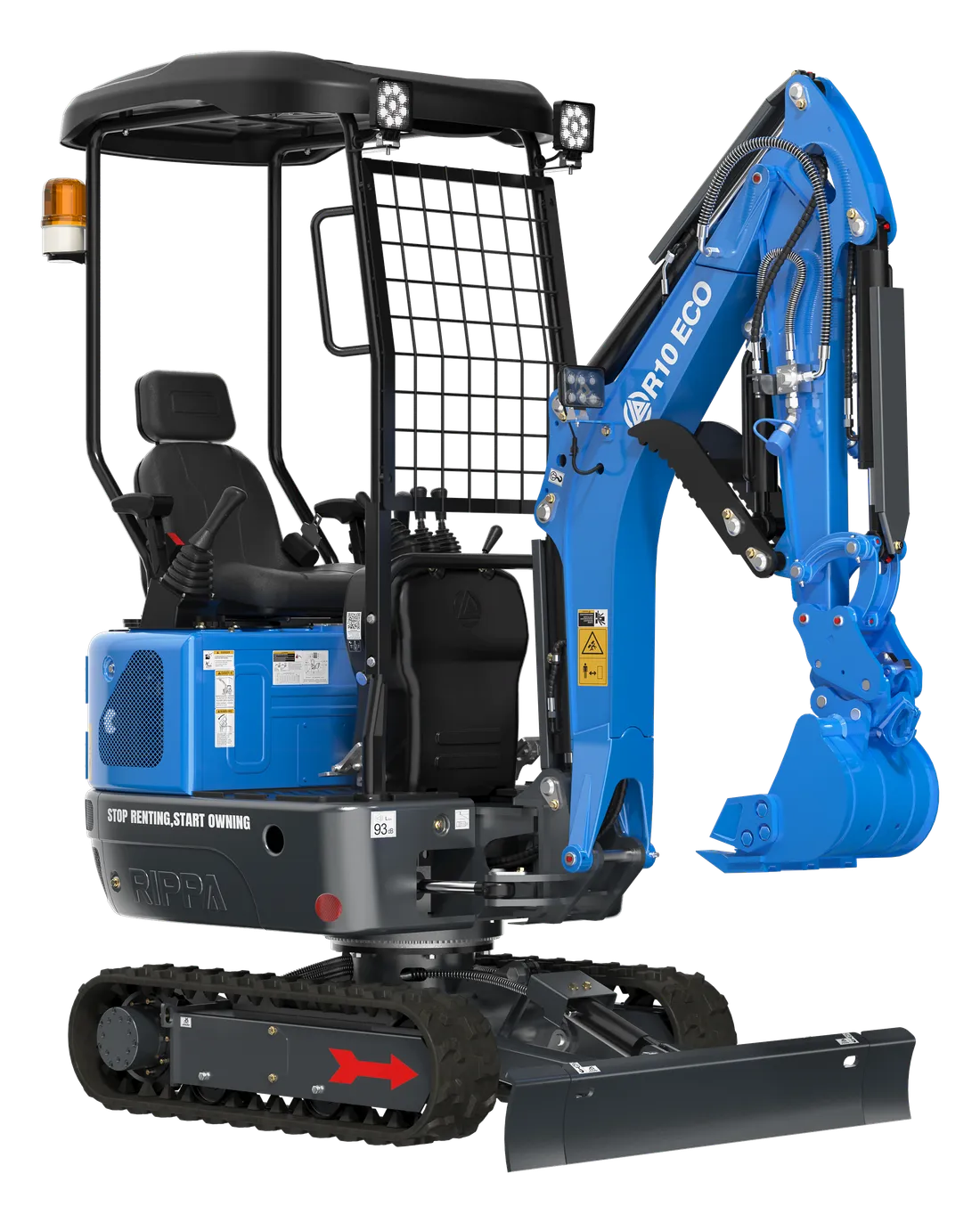
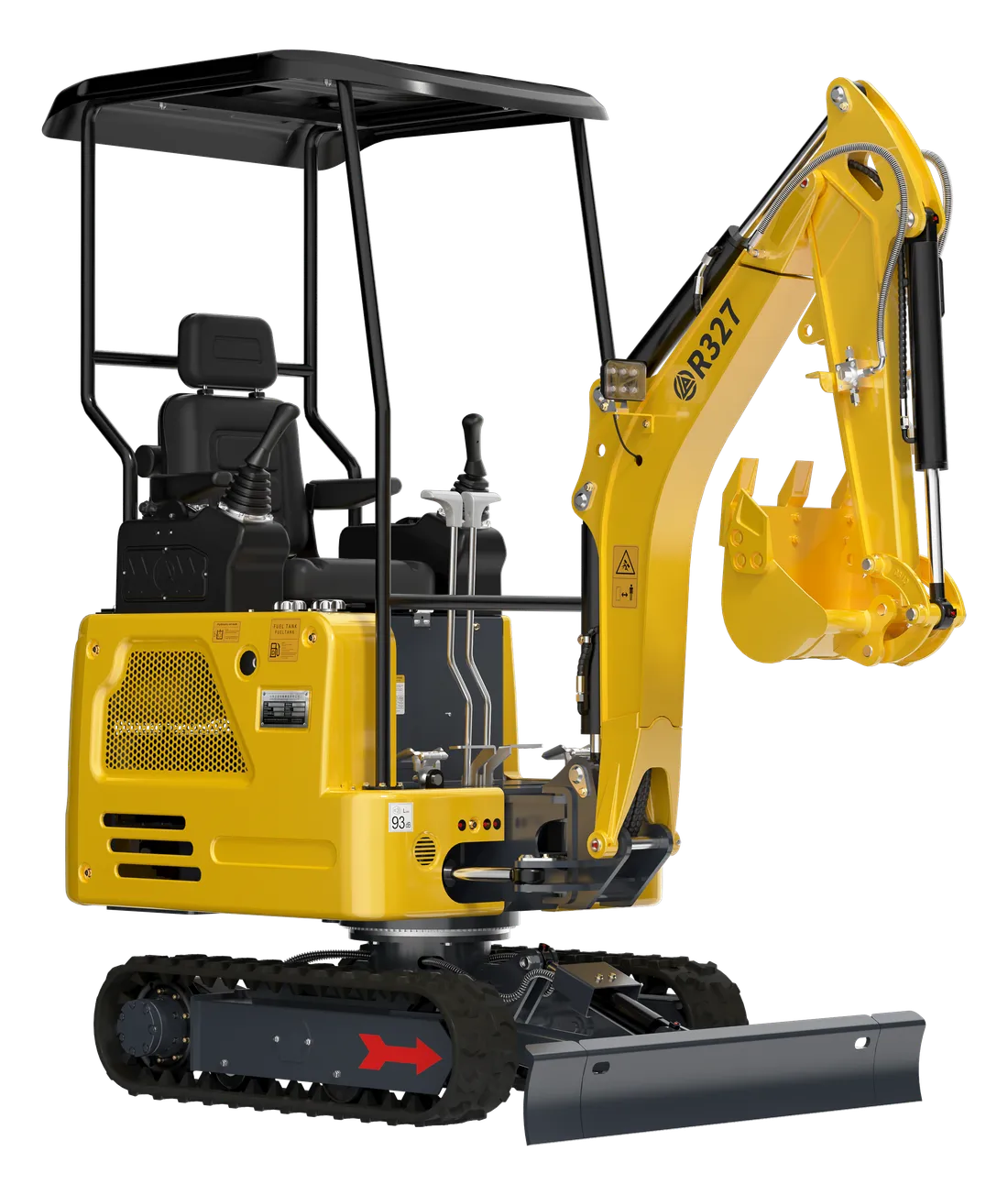
To use a breaker, the machine needs a suitable auxiliary hydraulic line; you can ask us whether your machine is breaker-ready. The machine class is also chosen to suit the scale of the job. The R10 and R327 stand out for work in narrow yards and gardens, while the R350, with its 3,500 kg operating weight and 22.5 kN bucket digging force, works steadily on thicker concrete and larger-volume jobs. Its air-conditioned enclosed cab noticeably improves the operator’s working conditions in this dusty, noisy work. You can see all the attachments on the mini excavator attachments page.
The right order of work: where do you start?
In demolition, the order of work determines both speed and safety. These general principles apply to most small jobs:
- Strip out what can be removed first: Remove doors, windows, railings, metal fittings, timber and cables by hand before the machine arrives. Mixed rubble is the hardest to haul and to dispose of.
- Work from the top down: On walls, start with the top courses; a wall broken from the bottom brings the mass above it down uncontrollably.
- Drop pieces away from the machine: Push sections of wall into the area being demolished, not towards the machine.
- On slabs, work in from the edge: Rather than trying to break a concrete slab from the middle, start at an edge. Concrete with a free edge breaks much more easily, and the pieces come apart more cleanly.
- Keep pieces to a manageable size: Break them small enough for the grapple to grip and to load safely onto a truck.
- Clear as you break: Gather up the rubble at intervals instead of letting it pile up; rubble heaped in front of the machine restricts both movement and visibility.
Example: planning the removal of a concrete yard
To plan the rubble and haulage, first work out the volume of concrete to be broken: concrete volume = area × average thickness. Measure the thickness at an edge or through a small hole you make; it may not be the same across the whole yard.
Example (illustrative figures): A 40 m² yard with an average thickness of 15 cm contains 40 × 0.15 = 6 m³ of concrete. Once broken, the concrete takes up more volume than it did in place, because gaps remain between the pieces, so allow a margin for this when planning the trucks. The work can be sequenced like this: divide the yard into strips, break the first strip starting from the free edge, separate and load the pieces with the grapple, then move on to the next strip. That way the machine always stands on clear ground, and broken pieces don’t pile up and block the way.
Breaker technique: protecting the machine and the chisel
The secret of working efficiently with a breaker is not force but angle and rhythm. The following rules both speed up the work and extend the life of the breaker and the machine:
- Work at right angles: Keep the breaker chisel as perpendicular to the surface as possible. Striking at an angle puts sideways stress on the chisel and bushings.
- Get the down-pressure right: Press the breaker onto the surface firmly enough, but not so hard that the front of the machine lifts off the ground.
- Don’t hammer the same spot for long: If the piece won’t break, shift the point slightly or start again closer to the edge. Hammering one spot for too long overheats and wears the chisel.
- Avoid blank firing: If the breaker runs without the chisel in full contact with the surface, the impact energy goes into the breaker’s own components. Release the trigger the moment the piece breaks.
- Don’t lever: Using the breaker as a crowbar will break or bend the chisel. Use the bucket or the ripper to move a piece out of place.
- Grease the chisel: Grease the breaker chisel at the interval given in the manual; breaker work needs grease much more often than normal digging.
Using the slew to sweep the breaker sideways, or using the breaker to lift loads, also causes serious damage. A breaker has only one job: breaking.
Dust, noise and flying debris: the safety zone
- Set up a safety zone: Broken pieces can fly. Tape off the work area, and make sure nobody is within the machine’s swing radius or near the breaker.
- Damp down the dust: A light spray of water from a hose on the breaking point noticeably reduces concrete dust. Concrete dust is harmful to health when inhaled.
- Personal protective equipment: Hard hat, safety glasses, ear defenders, dust mask, gloves and safety boots. When the operator gets out of the cab, they must wear the same equipment too.
- Watch out for nearby structures: Vibration can damage neighbouring walls and windows. Right next to a sensitive structure, consider cutting or removal by hand instead of a breaker.
- Noise hours: In residential areas there may be time restrictions on noisy work; follow your municipality’s rules.
We have gathered the general rules everyone on site should follow in our construction site safety guide.
Sorting and hauling rubble
Rubble is the hidden cost of demolition. Mixed rubble is the hardest to haul and the most problematic to dispose of, whereas sorted material can often be put to use.
- Concrete and stone: Clean pieces of concrete and stone can be reused in some fill and groundwork; ask the person responsible for the project what they can be used for.
- Steel: Reinforcing bars can be separated out with the grapple and set aside for scrap.
- Soil: Clean soil can stay on site; soil mixed with rubble needs to be dealt with separately.
- Timber, plastic and the rest: Collected separately and disposed of appropriately.
Where construction and demolition waste can be tipped depends on local rules; use the disposal sites designated by your municipality. We explain the finer points of loading pieces safely with a grapple in our hydraulic grapple guide.
How breaker work affects the machine, and maintenance
Let’s be honest — breaker work is one of the toughest jobs for a mini excavator. Vibration and impact put more load on the pins, bushings, hose connections and hydraulic oil than normal digging. Proper maintenance greatly reduces this effect:
- Grease more often: On days when you work with the breaker, don’t skip greasing the boom, arm and linkage pins; follow the intervals the manual gives for heavy-duty operating conditions.
- Check hoses and fittings every day: Vibration can loosen connections, and hoses can start rubbing against something.
- Watch for hydraulic oil overheating: Long spells of breaker work heat up the oil. If you see a temperature warning or feel the movements slowing down, take a break and make sure the oil cooler is clean.
- Check bolt tightness: The breaker mounting bolts and the machine’s critical connections can work loose with vibration.
We explain pin and bushing maintenance in detail in our pins, bushings and greasing guide.
Summary
- Small, low demolition jobs are mini excavator work; tall and load-bearing structures are not
- Don’t start until the services are disconnected, hazardous materials are checked and permits are confirmed
- Strip out by hand first, then break from the top down and from the edge inwards
- Keep the breaker perpendicular, avoid blank firing, never lever, grease often
- A safety zone, dust suppression and protective equipment are non-negotiable
- Sort the rubble as you break, and use only approved disposal sites
For thick concrete and larger demolition jobs, take a look at the R350’s specifications. Send us a photo and the dimensions of the structure to be demolished on WhatsApp, and we’ll work out the right machine, breaker and attachment combination together.