In land clearing, the job that takes the most time is often not digging but moving: large stones gathered from a field, the trunks of felled trees, steel and concrete pieces left over from a small demolition. A bucket can scoop these materials but can’t hold them. Round stones slide out of the bucket, long logs lose their balance, scrap hangs over the bucket edge. The result is three or four attempts for the same piece, or someone trying to help by hand — one of the most dangerous habits on any site.
A hydraulic grapple does these jobs by gripping like a hand. Used correctly, it both saves time and keeps people away from the load.
In this guide we explain how a grapple works, how it differs from a bucket with a thumb, how to think about the load the machine can carry safely, and the gripping techniques for stone, logs and scrap one by one.
What is a hydraulic grapple, and how is it different from a bucket?
A hydraulic grapple is an attachment fitted in place of the bucket, with two jaws that open and close by means of a hydraulic cylinder. The cylinder is fed from the machine’s auxiliary hydraulic line; the operator controls opening and closing with a button on the joystick or a pedal, depending on the machine.
The grapple’s real advantage is that it holds irregularly shaped objects by squeezing them from two sides. A bucket only carries a load from underneath; a grapple grips the load, guides it through the air and puts it down exactly where you want. Some grapples have a rotating head; these types need an additional hydraulic circuit for the rotation.
| Feature | Bucket | Bucket + hydraulic thumb | Hydraulic grapple |
|---|---|---|---|
| Holding irregular objects | ❌ They slide | Good | ✅ Very good |
| Digging ability | ✅ | ✅ | ❌ Not a digging tool |
| Precise placement | Poor | Good | ✅ Very good |
| Auxiliary hydraulic line | Not required | Needed for the thumb | Required |
| Best job | Digging and loose material | Digging + occasional carrying | Mainly carrying, sorting, stacking |
Let’s be honest: a grapple doesn’t dig. If your work is mostly digging and you move stones or roots in between, a bucket and thumb combination may be more practical; we explain this option in our hydraulic thumb guide. If most of your day is spent moving, sorting and stacking, a grapple shows its worth much faster.
How much can the machine carry? Thinking about capacity the right way
The most common misconception about grapples is that the limit is set by the load the grapple can hold. In fact, the real limit is the machine’s stability. A load that is carried safely when held close to the machine tries to tip the machine forwards or sideways when the arm is extended. The further the load is from the machine, the greater the tipping effect.
- Carry the load close to the machine and close to the ground; don’t extend the arm further than necessary.
- Stability varies with direction: with the dozer blade lowered to the ground, the machine is usually more stable towards the blade. To the side — especially with the upper structure slewed round — you reach the stability limit more quickly.
- On machines with telescopic tracks, working with the tracks extended increases side stability; the narrow position is for getting through narrow gateways. You will find the details in our telescopic tracks guide.
- The grapple’s own weight is added to the load with every lift.
- On soft, muddy or sloping ground, the safe limit drops noticeably.
Estimating a load’s weight by eye is often misleading; do a rough calculation. Example: a stone measuring 80 × 60 × 50 cm comes to about 0.24 m³. Although the unit weight varies with the type of stone, many natural stones weigh twice as much as the same volume of water or more — so a stone of this size can easily exceed half a tonne. For your own stone, measure the volume, find out the unit weight of the stone type and multiply.
If your machine’s manual has a load chart, that chart takes precedence over any estimate. If it doesn’t, or you’re not sure, send us the approximate weight of the load and the carrying distance and we will assess it together for your machine. Suspending a load from a sling or chain is a separate matter; if your machine isn’t equipped for it and the manual doesn’t allow it, don’t hang loads by chaining them to the grapple or a bucket tooth.
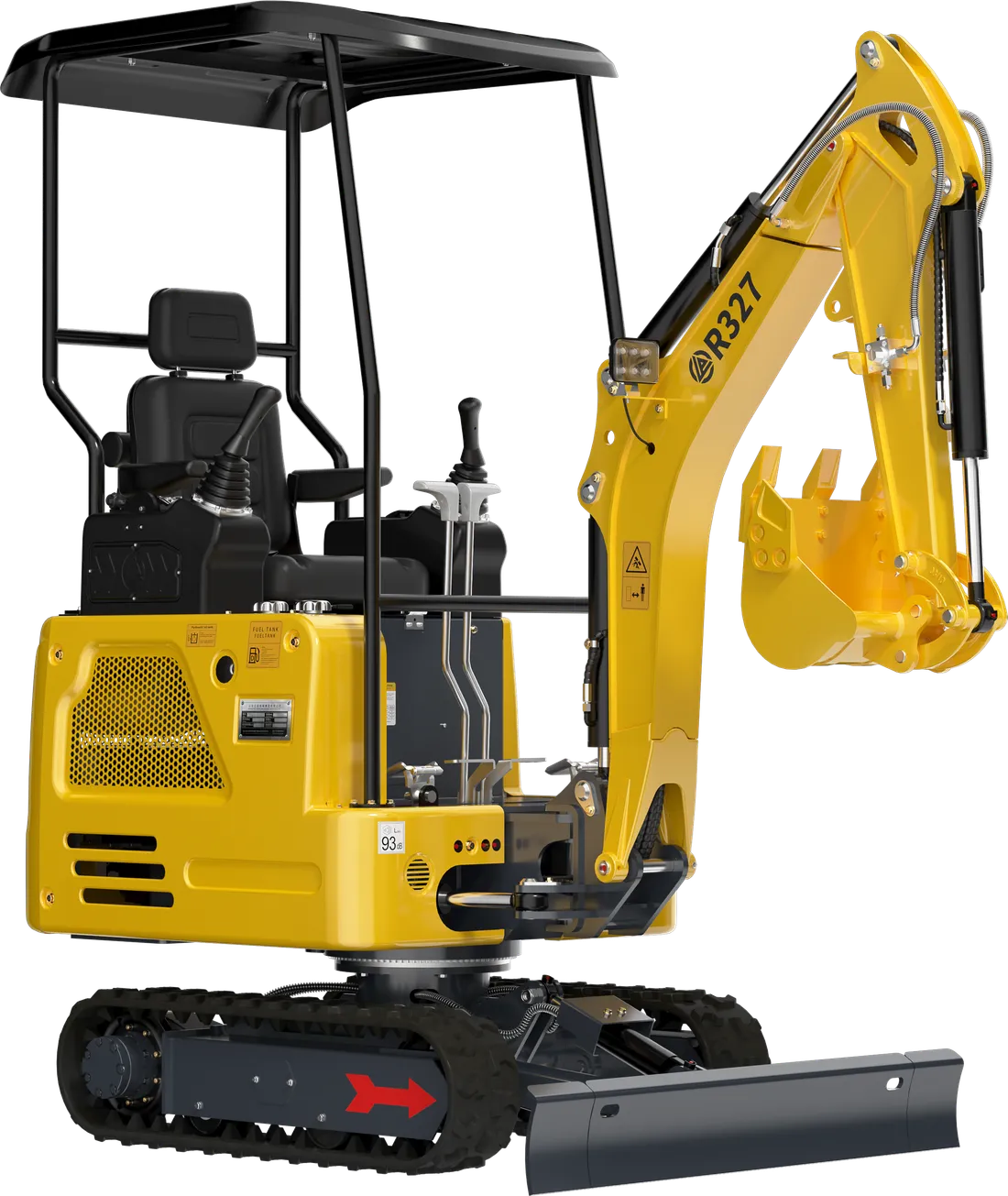
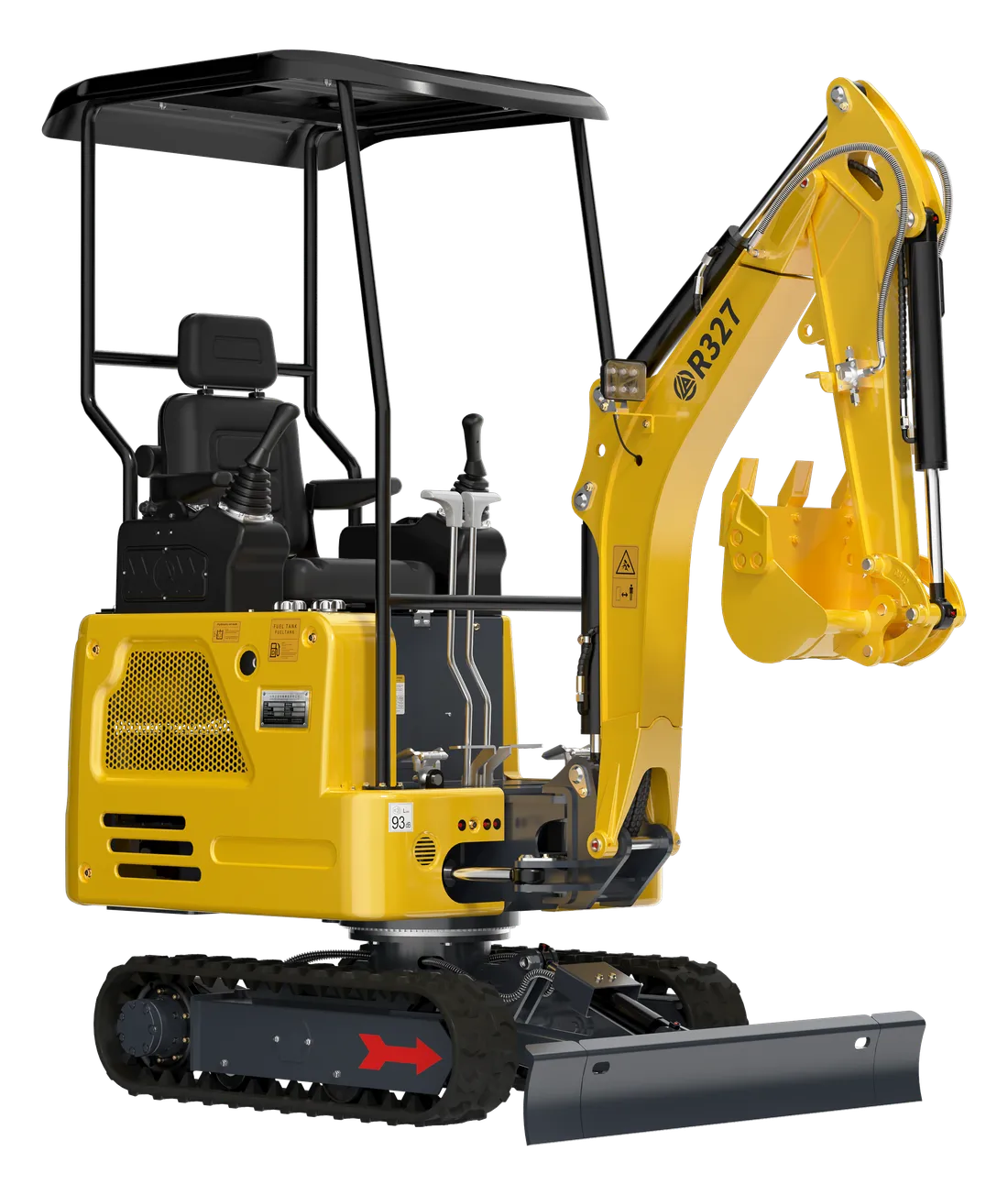
To sketch a rough framework by machine class: the R10, with an operating weight of 1,200 kg, suits garden-scale stones and short logs, while the 1.7-tonne class R327 (operating weight 1,700 kg) suits more frequent and heavier carrying. The R350, with its 3,500 kg operating weight and enclosed cab, is a more solid base for large rocks, long logs and heavy scrap sorting. The enclosed cab provides comfort against dust and weather; for jobs with a risk of flying fragments, assess separately, according to the risk of the job, whether extra protection is needed.
Moving and laying stone: technique
Stone is the load a grapple carries most often, but also the one that slips most easily. A few habits make the difference:
- Grip the stone with the deep part of the jaws, not their tips; the more contact surface, the less slipping.
- Hold long stones in the middle, close to their centre of gravity. With round stones, make sure the jaws wrap around the stone at more than one point.
- First lift the load a few centimetres and wait. If the stone turns or slips, put it down and grip it again.
- Keep the load low while carrying and slew slowly. Sudden braking and sudden slewing make the stone shift between the jaws.
- When laying stone, seat the stone in place first, then open the jaws. If a small adjustment is needed, correct it with short movements without letting go of the stone completely.
If you are building a stone wall or a retaining course, the precision of pilot controls really pays off here; use the levers with small, slow movements. If someone is guiding the placement, they should do so with signals, eye contact and from a safe distance; while the load is in the air, nobody should step under the stone or between the stone and the wall. If a final adjustment by hand is needed, the stone must first be fully seated, and the grapple opened and moved away.
Moving logs and roots
A log is challenging not only because of its weight but also because of its length. A long log behaves like a pendulum at the end of the grapple; in a sudden slew, its end can strike the machine, a tree or a person.
- Grip the log at its balance point. If one end hangs down noticeably when you lift it, you have missed the balance point; put it down and grip it again.
- When slewing, allow for the area swept by the ends of the log; nobody should be in that area.
- In narrow gateways and on sloping ground, it is safer to shorten a long log first rather than carry it.
- Shake the soil off extracted roots on site before carrying them: the weight carried goes down and no soil ends up at the stacking area or in the lorry. Shake them with short, controlled movements, not hard jolts.
- Stack logs on level ground with chocks to stop them rolling; don’t build the stack next to footpaths.
We explain the stump removal job itself — the sequence of digging, cutting and extraction — step by step in our stump removal guide. In that job, the grapple is what carries and stacks the extracted root; trying to tear the root out with the grapple puts needless strain on the pins and cylinder.
Sorting scrap and demolition waste
On small demolitions and in scrapyards, a grapple speeds up sorting material by type: metal on one pile, timber on another, concrete and stone on a third. Sorted waste is usually easier to move and recycle than mixed waste.
What really speeds up sorting is the site layout. Before you start, decide where the piles will go: pick spots the machine can reach with a short slew and that a lorry can easily pull up to. If the machine has to travel a few metres for every piece, that trip is repeated hundreds of times; setting the piles up in a semicircle around the machine is usually an efficient arrangement.
- Sharp-edged sheet metal and rebar can cut hoses; check the hose routing and protective sleeves every day.
- Don’t try to tear off pieces of reinforced concrete with the grapple; separate them with a breaker first. We cover small demolition jobs with a breaker in a separate guide.
- Never squeeze gas cylinders, drums, pressure vessels or containers with unknown contents with the grapple.
- When loading a lorry, don’t pass the load over the cab; lower it into the body before releasing it and spread it evenly.
- With long pieces of scrap, watch where the ends go as you slew; metal sheets can turn unexpectedly in the wind.
Rules for working safely with a grapple
When working with a grapple, most of the risks come not from the load itself but from the people around it and from hasty decisions. Go through this list before every job:
- Nobody is in the working and slewing area; tape the area off if necessary.
- Before working with a load near overhead power lines, get safe-distance information from the relevant authority.
- Don’t pass the load over people, vehicles or cabs.
- Don’t raise the load while travelling with it; on a slope, keep the load on the uphill side and don’t slew sideways with a load.
- Don’t use the grapple for pushing, pulling or levering; it is designed for holding and carrying.
- Don’t squeeze gas cylinders, drums or pressure vessels.
- People working on the ground should wear hard hats, gloves, steel-toecap boots and safety glasses.
- When taking a break or getting off the machine, put the load down, lower the grapple to the ground and engage the hydraulic safety lever.
Hydraulic connection and working habits
A grapple works off the machine’s auxiliary hydraulic line. Before connecting, wipe the coupling ends and release the pressure in the line as described in the manual, and fit the dust caps as soon as you disconnect. If you change attachments often, a quick coupler system shortens the process; the grapple’s hoses, however, are still connected separately.
Closing the jaws all the way and holding the control in that position for a long time heats the oil unnecessarily; release the control once you have gripped the load. The grapple’s speed and clamping force are limited by the machine’s hydraulic flow and pressure. Rather than forcing a grapple that is working more slowly than usual, check the oil level, the hoses and whether the couplings are fully seated.
With fragile loads, such as old bricks, roof tiles or thin stone slabs, limit the clamping force by using the control lightly. Closed harder than necessary, a grapple can break the material it is carrying and send fragments flying.
For an operator who is new to grapples, a short practice session makes a big difference. In an empty, level area, practise picking up and putting down a few different stones and a log: first right in front of the machine, then with a slew and at a slightly greater distance. In the first few days, aim not for speed but for gripping the load correctly in one go and putting it down without jolting it; speed comes naturally on top of this habit.
Maintenance: jaws, pins and hoses
A grapple is an attachment that works under impact and friction; think of its maintenance not like a bucket’s but like that of a piece of hydraulic equipment. The intervals in the manual take precedence; the table below is a typical starting framework:
| Check | Typical frequency | What to look for |
|---|---|---|
| Greasing pins and bushings | Every working day | Clean grease coming out, play in the pins |
| Hoses and couplings | Every working day | Chafe marks, leaks, crushing |
| Jaw tips and teeth | Weekly | Wear, bending, broken teeth |
| Cylinder rod | Weekly | Scratches, seal leaks, dried mud |
| Weld areas | After heavy work and monthly | Cracks, blistering paint |
Scratches on the cylinder rod quickly ruin the seal; if there is dried mud and sand on the rod, clean it off before starting work. If you feel play in the jaws, or the jaws don’t line up properly when closed, the pins and bushings should be checked for wear.
Summary
- A grapple grips irregular loads, while a bucket only carries them; for digging-heavy work, a bucket with a thumb may be more practical.
- The limit is set by the machine’s stability, not the grapple: carry the load close and low, and go by the load chart in the manual.
- Grip stone with the deep part of the jaws and logs at their balance point; protect the hoses when handling scrap.
- Pressure vessels, loads passed over people and use as a lever are strictly on the forbidden list.
- Greasing and hose checks should be part of every working day.
You can explore the grapple and our other attachments on the mini excavator attachments page, and send us your model and load details on WhatsApp to find the right grapple for your machine.