On a plot you have just bought, in a garden that has been neglected for years or when renewing an orchard, you always run into the same obstacle: the roots left behind by felled trees. As long as the stump stays in the ground, you can neither plough nor lay foundations; on top of that, it rots over time and makes the ground sink.
Digging out a single root with a pick and shovel can take a whole day. A mini excavator cuts the job down dramatically — but only with the right technique. Work the wrong way and you not only strain the machine, but also put yourself and those around you at risk.
In this guide we explain the step-by-step technique for removing stumps, what each attachment is for, the order in which to clear land and the most common mistakes.
When does a mini excavator make sense for stump removal?
Stump removal is one of the jobs where a mini excavator is at its most productive, because the work is really a combination of digging, cutting and lifting, and the machine does all three. In orchard renewal, grubbing up vineyards, clearing plots and garden landscaping, it takes away most of the effort you would otherwise spend with a pick. Because it can handle jobs such as stump removal and stone picking on its own, it also serves as a land-clearing machine on small and medium-sized plots.
Let’s be honest — not every stump is a job for a mini excavator. The root systems of very old, thick-trunked trees spread both wide and deep. Rather than forcing a stump like that with a small machine, it may be better to use a machine one class up or to grind the stump down in place (with a stump grinder). Ask yourself these questions when deciding:
- What species was the tree? Tap-rooted species go deep; fibrous-rooted ones stay close to the surface but spread over a wide area.
- What is the soil like? Roots come out more easily in moist soil; dried-out, stony soil makes the job noticeably harder.
- What is near the stump? If there is a building, a wall, a pipe or a cable nearby, the working area narrows and the method changes.
- How many stumps are there? Bringing in a machine for a single stump and removing dozens of stumps are two different calculations.
Before you start: site survey, permits and underground services
Stump removal disturbs the ground over a wide area. That is why, before you dig, knowing what is underground is essential. Get information on electricity, gas, water and sewer lines from the relevant utilities; on older land, unrecorded irrigation pipes and drainage lines may also turn up. Over the years, roots can wrap themselves around pipes, so pulling out the stump could tear out a pipe too.
Felling trees and removing stumps require a permit in some cases, especially in protected areas, on land close to forest boundaries and for publicly owned trees. Because the rules vary by region, check with your municipality and the relevant authorities in advance.
During the survey, also note where the machine will get onto the land, where the removed roots will be piled, any sloping sections and any soft ground. If you will be working on a slope, don’t start without reading our guide to mini excavator safety on slopes.
Choosing a stump removal machine and attachments
The bigger the stump, the more both digging force and machine weight matter; a heavier machine keeps its balance better while lifting the root. The table below is a starting point; for a firm recommendation, we’d like to see a photo of the stump.
| Situation | Machine class | Supporting attachment |
|---|---|---|
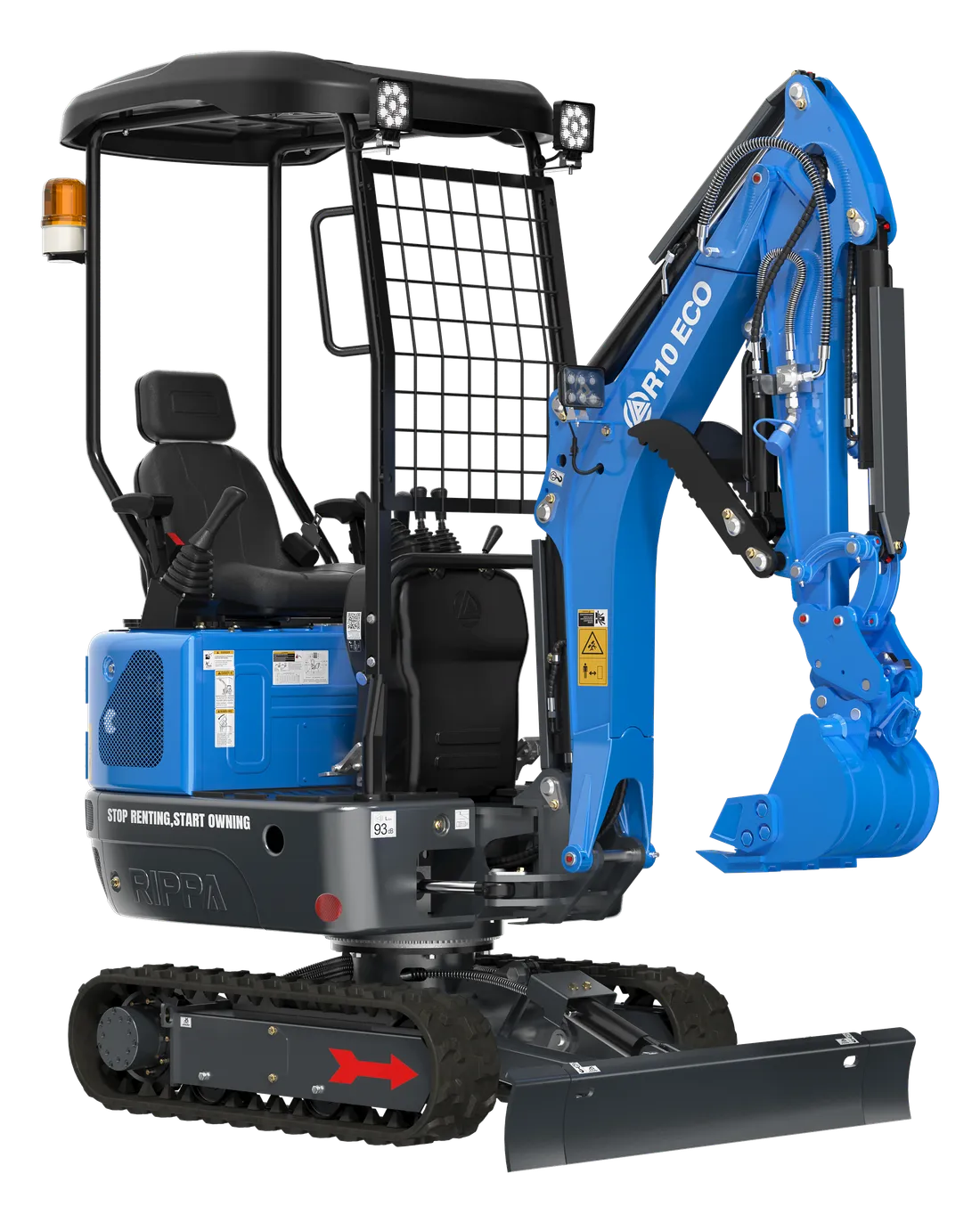
| Saplings, shrubs, vine stumps | R10 (1.2 t) | 40 cm bucket, hydraulic thumb |
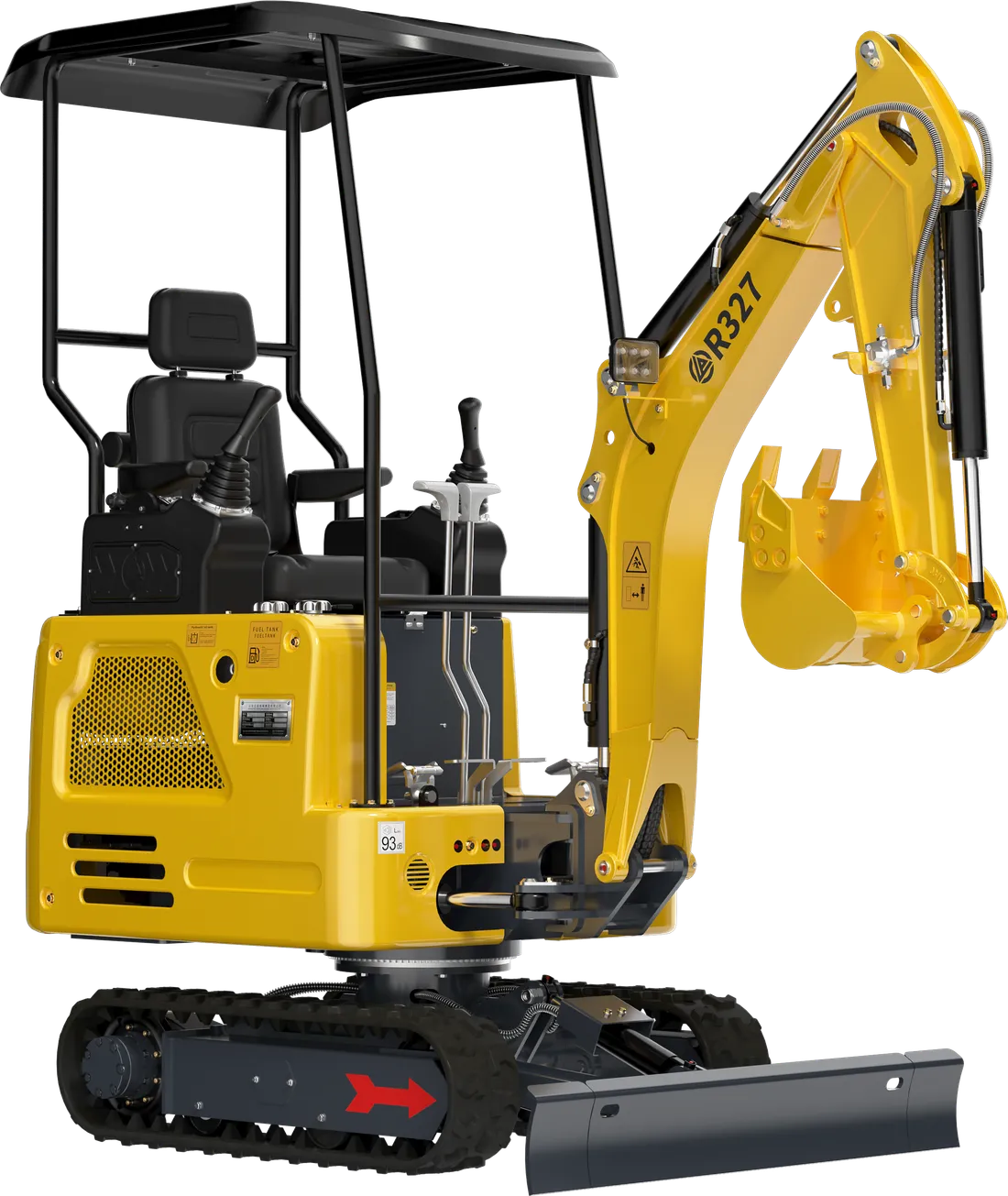
| Medium-sized fruit tree stump | R327 (1.7 t) | 60 cm digging bucket, ripper, hydraulic thumb |
| Thick-trunked stump with widespread roots | R350 (3.5 t) | Ripper, digging bucket, hydraulic grapple |
| Collecting root and branch debris | All three classes | 60 cm rake, hydraulic grapple |
| Separating soil from stones and root fragments | All three classes | 60 cm screening bucket |
The R10 and the R327 have the same bucket digging force (11 kN); what sets the R327 apart on medium-sized stumps is the stability it gets from being about 500 kg heavier than the R10 (1,700 kg operating weight) when lifting the root. On thick stumps, the real difference starts with the R350, with 22.5 kN of digging force and a 3,500 kg operating weight. In row-planted areas such as orchards, it also matters that the machine can get close to the stump. The R327’s telescopic tracks and 120° boom swing make it easier to approach a stump at an angle between rows of trees and at the foot of walls.
In brief, this is what each attachment does in this job:
- Ripper: With its single tooth, it cuts lateral roots and tears through hard ground. It is the first tool to reach for when roots are too much for the bucket; we cover it in detail in our ripper guide.
- Hydraulic thumb: Working with the bucket like a hand, it grips, rocks and carries the stump. The R10 and R327 have a hydraulic thumb; you’ll find tips on using it in our hydraulic thumb guide.
- Hydraulic grapple: Used to grip irregular pieces such as stumps, thick branches and large stones, and to stack them or load them onto a trailer.
- Digging bucket: Ideal for opening up the soil around the roots and cutting thin lateral roots with the bucket edge.
- Rake: After removal, it gathers up the root fragments and branches left on the surface without carrying off too much soil.
Step-by-step stump removal technique
The basic principle is this: don’t pull and tear the root out; free it first, then lift it. The sequence below lets you work without straining the machine or losing control:
- Don’t have the trunk cut flush with the ground. Leaving some of the trunk standing when the tree is felled lets you grip it with the bucket or thumb afterwards and use it as a lever. The cutting should be done with a chainsaw by someone who knows the job.
- Position the machine correctly. Stand on level ground, at a distance where the arm can work without overreaching. Lower the dozer blade to the ground; it provides stability during lifting.
- Open up the ground around the stump. Remove the soil around the trunk as if you were digging a trench. The aim is to expose the main lateral roots.
- Cut the lateral roots. Cut the thick roots you can see by pressing down on them with the bucket edge or the ripper. Once it has been cut free on every side, the root ball soon loosens.
- Undercut it. Push the ripper or the bucket teeth under the stump and try to cut or loosen the taproot beneath the root ball.
- Rock it loose. Push the stump one way, then the other. Loosening it with several small movements is both safer and faster than trying to lift it in one go.
- Lift and shake. Grip the stump between the bucket and the thumb, lift it and shake the soil off it back into the hole. That way the valuable topsoil stays where it belongs.
- Carry it to the stockpile area. Travel with the load kept close to the ground; never drive the machine with a load held high.
If the stump won’t loosen, a root is still holding it. Rather than straining the machine further, stop, open up the area a little more and find that root. If you feel the tracks lifting off the ground, the machine is at its limit: release the load immediately.
The right order of work for land clearing
On land with several stumps, scrub and stones, the order matters. Work in the wrong order and you go over the same area two or three times and churn up the soil unnecessarily. For most land, the sensible order is:
- Surface clearing: Scrub, rubble, old wire and posts are collected, and routes are opened up so the machine can move around safely.
- Tree felling: Trunks are cut leaving enough height for leverage, and branches are piled in a separate place.
- Stump removal: Start at one end of the land and work backwards; don’t drive back over ground that has already been cleared.
- Collection: Root fragments and branches on the surface are gathered into rows with the rake.
- Filling and levelling: Last of all, the stump holes are filled and the land is levelled.
To estimate how long the job will take, rely on measurement rather than guesswork. After removing the first few stumps, note the average time per stump and multiply it by the number of stumps; then add a separate allowance for collection, filling and levelling.
Example (illustrative figures): In a garden with 30 stumps, if the first three stumps took 20 minutes each on average, allow about 10 hours for removal. Collection and filling come on top of that. On your own land, the time depends on the soil type and the size of the stumps; base the calculation on the values you measure yourself.
We explain in detail how to use a grading bucket and a rake together at the levelling stage in our land levelling guide.
How do you fill stump holes?
The hole left behind once the stump is out is the most neglected part of the job. In a hole that has been filled carelessly, the soil sinks after a few rains and water collects at that spot.
- Clear out the remaining root fragments. Thick roots left in the hole rot over time and leave voids.
- Fill in layers. Don’t tip the soil in all at once and just smooth over the top; compact each layer by pressing it down with the bottom of the bucket.
- Save the topsoil for last. On land that will be sown or planted, the fertile topsoil should go on top.
- Leave a slight mound. On farmland, leaving the spot you have filled a little higher than its surroundings means less of a dip once it settles. On a site where something will be built, however, the person responsible for the project should decide how the fill is compacted.
On stony land, sifting the excavated soil with a screening bucket and reusing it reduces the need to bring in soil from elsewhere.
Working without straining the machine: common mistakes
Most breakdowns and accidents in stump removal come down to the same few mistakes:
- Pushing a standing tree with the boom. You can’t control where a toppling tree will fall; the trunk can come down on the machine or the operator. Tree felling is a separate job and is not done with a mini excavator.
- Hitting the stump with the bucket. The bucket and pins are not designed for impact; pin-to-bushing play increases rapidly.
- Lifting with the arm fully extended. The further away the load, the greater the tipping effect. Move the machine closer to the stump before lifting.
- Holding the load high when slewing. Especially on a slope, a heavy stump carried high can tip the machine over sideways.
- Not noticing branches caught on the hoses. Where branches are dense, the hydraulic hoses rub against or snag on them. Get down from the machine every so often and check the hoses.
- Having a helper work next to the machine. Someone trying to pull a root out by hand is in serious danger within the slewing area. While the machine is moving, nobody should stand within reach of the arm.
In this work, bucket teeth, pins and bushings wear faster than in normal digging. Don’t skip daily greasing; to replace worn teeth and pins in good time, take a look at our spare parts catalogue. 382 parts are shipped from stock on the same day.
What happens to the removed roots and branches?
At the end of land clearing, you are left with a considerable amount of wood, roots and branches. Plan what you will do with them before you start; otherwise the piles will sit in the middle of the land for months.
- Firewood: Thick trunks and stumps can be cut up and put to use. Leave a stump with soil on it to dry out first; once the soil has fallen off it is easier to cut, because soil quickly blunts a saw chain.
- Chipping for mulch: Thin branches can be turned into mulch with a wood chipper and used in the garden.
- Hauling away for disposal: Stumps and branches are loaded onto a trailer or truck with the hydraulic grapple. For safe handling with a grapple, see our hydraulic grapple guide.
Burning plant waste in the open is banned in many places or requires a permit, and it carries a fire risk. If you are thinking of burning, first find out the current rules from your local authority and the relevant bodies.
Quick checklist
- Underground services checked with the relevant utilities; any permit requirements confirmed
- Trunks cut leaving enough for leverage; machine positioned on level ground
- Ground opened up around the stump first, lateral roots cut, stump rocked loose
- Arm not overextended when lifting; load carried close to the ground
- Holes filled in layers; topsoil spread on top
- Plan ready for using or disposing of the roots and branches
- Greasing and hose check done at the end of the day
If you are looking for a well-balanced machine that can get into narrow rows for stump removal and land clearing, take a look at the R327’s specifications. Send us a photo of your stumps on WhatsApp and we’ll work out the right machine and attachment combination for your job together.