One of the most serious risks you can face when working with a mini excavator is tipping over. On level ground the machine is quite stable, but as the slope increases, the margin for error narrows quickly. In vineyards and gardens, on hillside plots, at the edge of an embankment or on trailer ramps, a moment’s inattention can tip the machine onto its side.
In this guide we explain in plain language why machines tip over, show you how to measure the slope on site and give practical rules for travelling, digging, slewing and ramp loading.
The slope limits and warnings in your machine’s operator’s manual always take precedence over this article. What we describe here is meant to help you stay safely within those limits.
Can a mini excavator tip over? Centre of gravity and support base
Every machine has a centre of gravity; on a mini excavator this point moves constantly with the position of the upper structure, boom and bucket. The machine stays upright as long as a vertical line dropped from the centre of gravity stays within the area where the tracks rest on the ground, in other words the support base. The moment this line moves outside the support base, the machine starts to tip over.
On a slope, three things happen at once:
- The centre of gravity shifts downhill. The point that sits in the middle on level ground moves closer to the edge of the downhill track on a slope.
- The load magnifies this shift. Reaching out downhill with a full bucket, or carrying it high, pushes the centre of gravity towards the edge of the support base.
- Slewing changes the balance instantly. As the upper structure slews, the counterweight and boom move; on a slope, a position that is safe facing one way can become dangerous facing the other.
Then there is the effect of sudden movements. Lowering a full bucket quickly and stopping it abruptly, cutting a hard slew short or suddenly letting go of the levers while travelling gives the machine a brief but strong jolt. That jolt, which you wouldn’t notice on level ground, can be enough to tip over a machine that is already close to its limit on a slope. That is why every movement on a slope should start slowly and finish slowly.
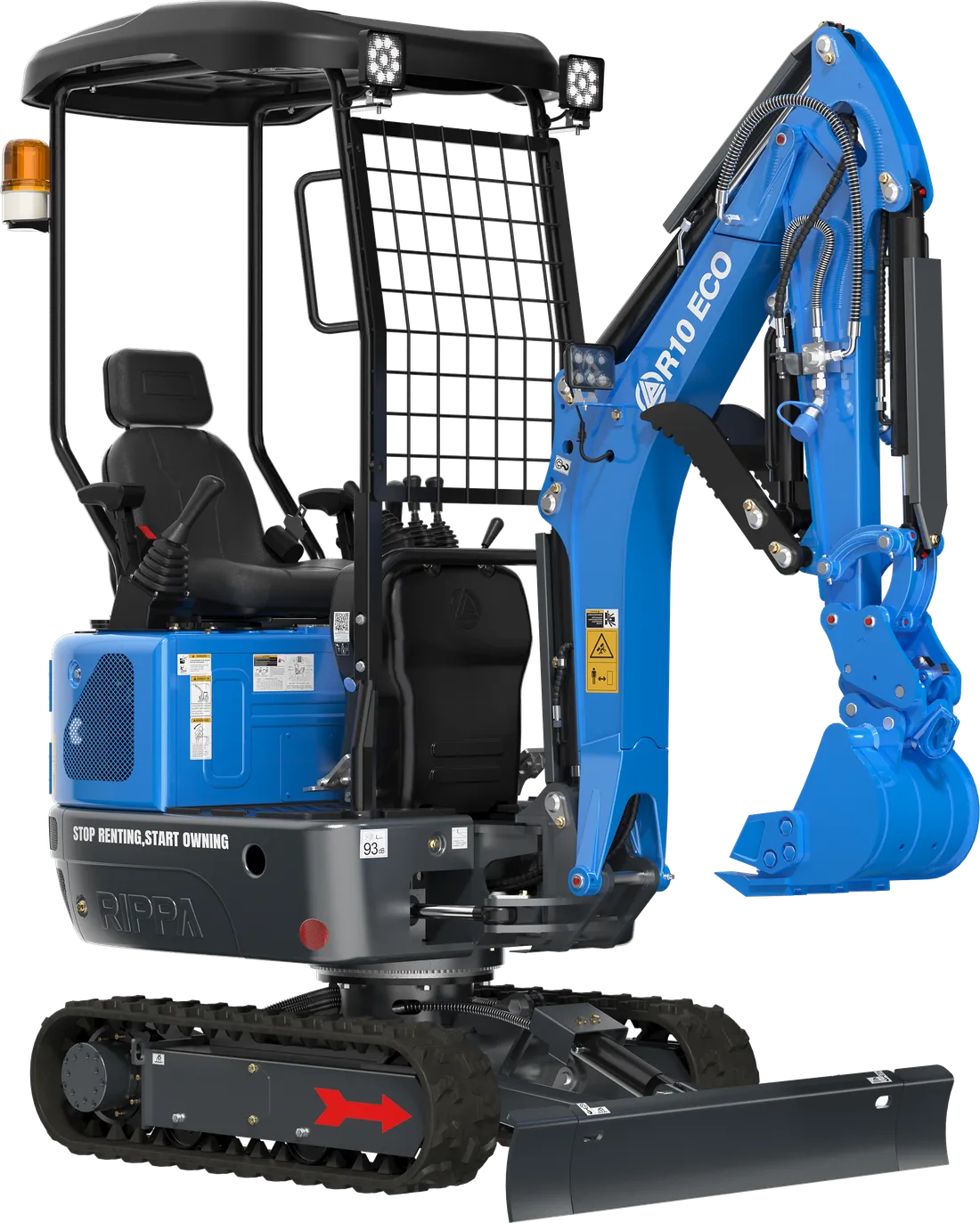
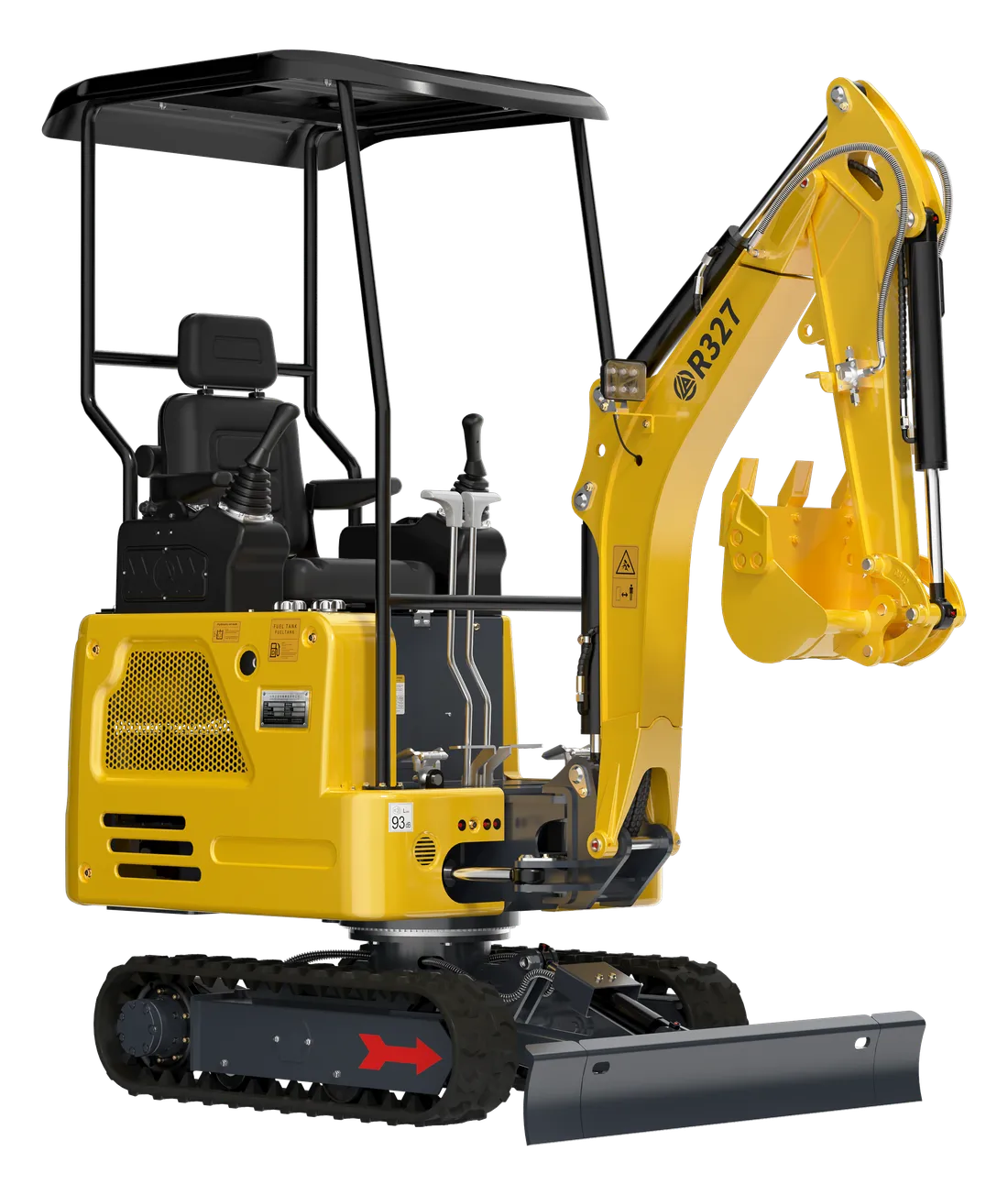
Mini excavators have a small support base, so they are more sensitive to slopes than large machines. One way to widen the support base is track spacing: telescopic, retractable tracks like those on the R327 increase lateral stability when they are extended after the machine has passed through a narrow gateway. We explain how and when to use them in our guide to telescopic tracks.
Don’t start work without measuring the slope
Judging a slope by eye is misleading: from the bottom of a hillside it looks gentler than it is, and from the top it looks steeper. To apply the slope limit from the manual on site, measure the slope. There are two practical methods:
- Phone inclinometer: Many smartphones or apps include an inclinometer. Place the phone on a straight board laid on the slope and take the reading.
- Straightedge and spirit level: Lay a 2-metre straightedge on the ground in the direction of the slope and lift its lower end until the spirit level shows level. Measure the height between the lower end and the ground in centimetres; half of this figure is the slope as a percentage. For example, if it is 30 cm, the slope is about 15%.
Manuals sometimes give the slope in degrees and sometimes as a percentage. The table below helps you compare the two units and the height you will measure with the straightedge:
| Degrees | Percentage (approx.) | Height difference over a 2 m straightedge |
|---|---|---|
| 5° | 8.7% | 17.5 cm |
| 10° | 17.6% | 35 cm |
| 15° | 26.8% | 54 cm |
| 20° | 36.4% | 73 cm |
| 25° | 46.6% | 93 cm |
| 30° | 57.7% | 115 cm |
This table is not a limit but a conversion tool. The slope your machine can work on safely is the value stated in its manual; if the ground is wet, loose or frozen, you need to stay below that value. Take a measurement at every spot where the machine will stand and travel, because slopes are rarely uniform.
Operating a mini excavator on sloping ground: rules for travelling
- Travel in the direction of the slope, that is, straight up or straight down. Crossing a slope sideways tilts the machine directly towards the side it would tip over. If you have to cross sideways, first cut a level path with the blade.
- Go slowly and avoid sudden movements. Low travel speed and low engine revs give you time to react if the machine starts to slide.
- Keep the bucket close to the ground and pointing in the direction of travel. This is a rule you will find in many manuals: if the machine starts to slide, you can press the bucket into the ground straight away for support. Set the position of the working equipment as shown in the diagram in your machine’s manual.
- Don’t turn on a slope. If you need to change direction, travel to a level spot first. Turning on the spot on a slope can make the tracks slip, or even throw a track.
- Don’t park on a slope. If you can’t avoid it, lower the bucket and blade to the ground and chock the tracks.
When going downhill, keep your speed low from the start. Push the travel levers gently; if the machine moves faster than you expect, slow down by easing the levers back to neutral rather than letting go of them all at once. Before you start the descent, make sure there is a flat, safe area at the end of the route.
Rules for digging and slewing on slopes
The safest way to dig on a slope is to prepare a level working platform for the machine before you start digging. A step cut into the hillside in stages and levelled with the blade both stabilises the machine and improves the quality of the dig.
- Position the machine in the direction of the slope. The front of the machine should face uphill or downhill; on a machine standing across the slope, every slew carries the load to the downhill side.
- Lower the blade to the ground. The blade provides extra support; many manuals state that working over the blade end, with the blade on the ground, is more stable.
- Don’t slew downhill with a full bucket. Where possible, tip the excavated soil on the uphill side and away from the edge of the dig. A full bucket reaching out downhill is the movement that increases the risk of tipping over the most.
- Keep the load low and close. The further out and the higher the bucket is, the more the centre of gravity shifts.
- Use the boom swing with care. The 120° boom swing on the R327 and R350 is a great help when working right next to walls; but on a slope, swinging the boom to the side also moves the load to the side.
- Keep away from the edge of the dig. The edge of the trench or slope you have cut can give way under the weight of the machine. We cover trench and slope safety in detail in our guide to digging channels and trenches.
Ground conditions: what makes a slope more dangerous
| Ground condition | Why is it risky? | Precaution |
|---|---|---|
| Wet grass and leaves | Track grip drops noticeably | Wait until it dries, or scrape the route clear with the blade |
| Clay after rain | Slippery and soft; the tracks sink and slide | Postpone work on the sloping sections |
| Loose gravel and fill | The ground can slip away under the tracks | Stay away from the edges of uncompacted fill |
| Frozen or thawing soil | The surface may be slippery and the layer beneath it soft | Keep off sloping sections during early-morning frost |
| Roots, rocks, stumps | Can lift one track and tilt the machine | Go around the obstacle, not over it |
| Hidden voids | Old wells, septic tanks or pipelines can collapse | Ask the owner about the site’s history and mark any suspect areas |
The same slope can be safe on a dry morning and dangerous on a rainy afternoon. When the ground changes, renew your measurement and your decision too. We cover the particular rules for working with a tracked tractor on slopes separately in our guide to muddy and sloping ground.
Planning the job on a sloping site
On sloping ground, risk is managed before the work starts, not after. The most dangerous scenario goes like this: the machine is unloaded on site, work begins and the route and order are decided “as things go”. Before you unload the machine from the trailer, make this plan:
- Walk the site. Mark soft spots, roots, rocks and old areas of fill with pegs or tape.
- Decide the way in and out. Settle which route the machine will take up and which route it will take down before work starts; if necessary, level that route with the blade first.
- Plan the order of work. Don’t choose a sequence that digs away and weakens the ground the machine will rely on while it works; build the platform first, then dig.
- Don’t work alone. On a sloping, isolated site, make sure there is someone nearby who can be reached by phone and who can see the machine.
- Take the weather and the time of day into account. Don’t pick an afternoon when rain is forecast, or the evening hours when the light is fading, for work on sloping sections.
Don’t forget the human factor either: fatigue, haste and an unfamiliar machine shrink the margin for error on a slope even further. Rather than trying to finish the last job of the day on a sloping section with “just one more bucket”, leaving it until the next morning is often the right decision.
Ramps and trailers: the slope people overlook
Loading the machine onto a trailer or lorry is often the steepest slope of the day. The rules on a ramp are the same as on a hillside, but the margin for error is even smaller:
- Check that the ramps are rated for the machine’s weight, have a non-slip surface and are firmly attached to the trailer.
- Line the machine up perfectly straight with the ramps; don’t correct your direction on the ramp. If the alignment goes wrong, come back down and start again.
- As the machine passes over the edge of the trailer bed, its weight suddenly shifts forward; take this moment very slowly and keep the bucket low.
- Load the machine with a helper giving you signals; the helper must not stand in the machine’s path or beside the ramps.
- Don’t load in the rain, with muddy tracks or on icy ramps.
You’ll find all the loading, securing and transport steps in our transport guide.
If the machine starts to slide or tip over
- Stop all movement. A panicked slew or boom movement makes things worse.
- Lower the bucket slowly to the ground. The bucket and blade are your nearest support for stopping a slide.
- Don’t jump off the machine. Operator’s manuals all give the same warning: stay in the seat with your seat belt fastened and hold on firmly to the controls and grab handles. Trying to jump from an overturning machine puts you at risk of being trapped underneath it.
- After the incident, have the machine checked for leaks and damage, and have the oil levels checked, before you start it again.
For these steps to work, the seat belt must be fastened at all times. Working without a seat belt, even for a short job, takes away the protection that the protective structure provides in a rollover. For first-time users, we have gathered the basic rules in our starter guide.
Quick checklist
- I know the slope limit given in the manual.
- I have measured the slope at the spots where the machine will stand and travel.
- I have checked the ground conditions (wetness, fill, frost, hidden voids).
- I have planned the travel route straight up and down the slope; no crossing sideways.
- I have prepared a level working platform for digging and lowered the blade to the ground.
- I won’t slew downhill with a full bucket; I’ll tip the soil on the uphill side.
- On a machine with telescopic tracks, I extended the tracks before starting work, as instructed in the manual.
- My seat belt is fastened; there is nobody in the slewing area.
You can take a look at the R327, whose telescopic tracks increase lateral stability on sloping and narrow ground, and send us your questions about the right model for your land on WhatsApp.