When choosing a mini excavator, two wishes constantly clash: the machine should be narrow so it can pass through a garden gate, a greenhouse entrance or the passage between two walls. But it should also be wide so it stands stable while working and inspires confidence when digging or loading to the side. On a machine with fixed tracks you have to give up one of these two wishes.
Telescopic, that is extendable and retractable, tracks are a piece of equipment developed to solve this dilemma. The machine passes through the tight space with its tracks retracted, and when it reaches the working point it extends them to gain a wider footprint.
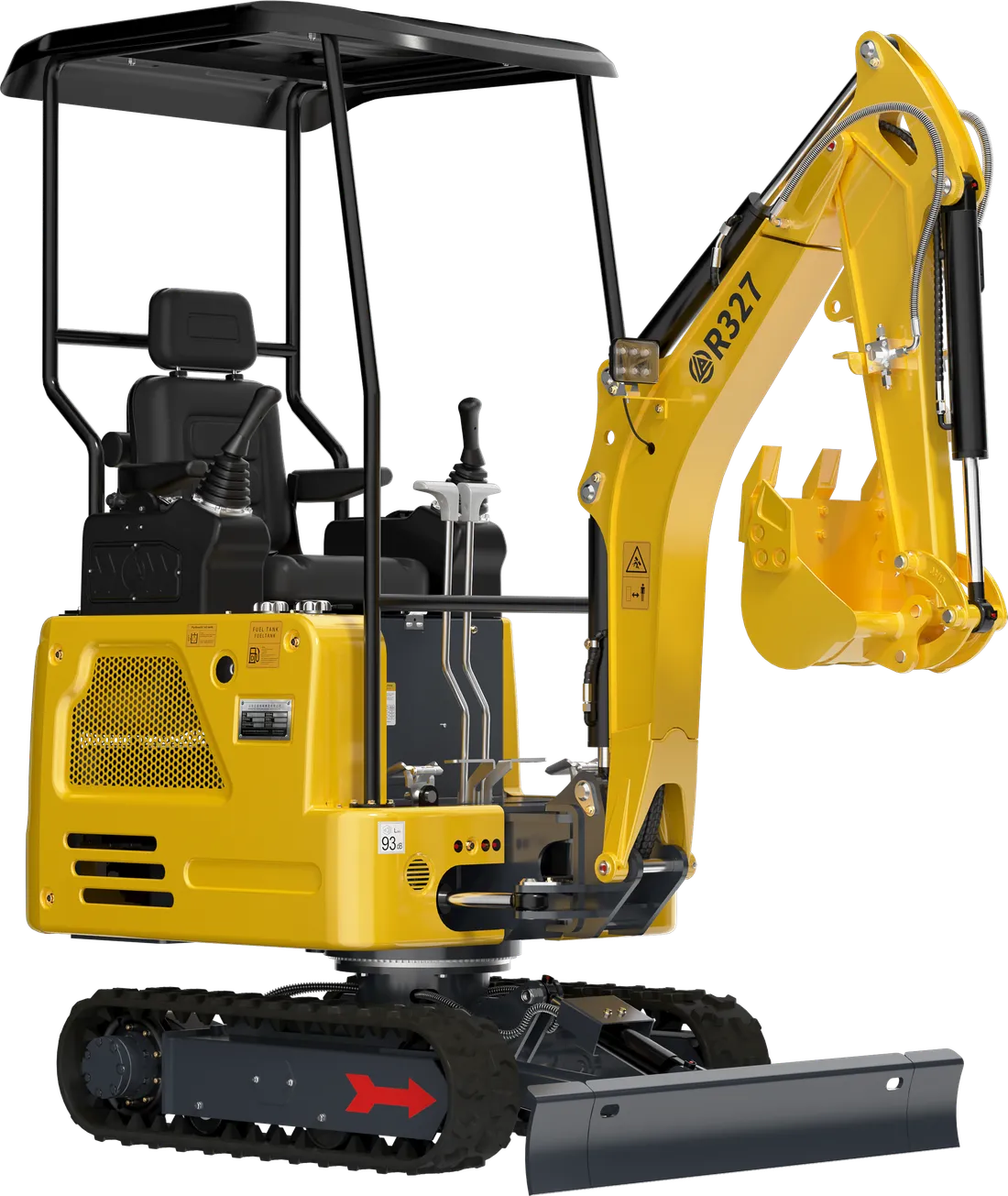
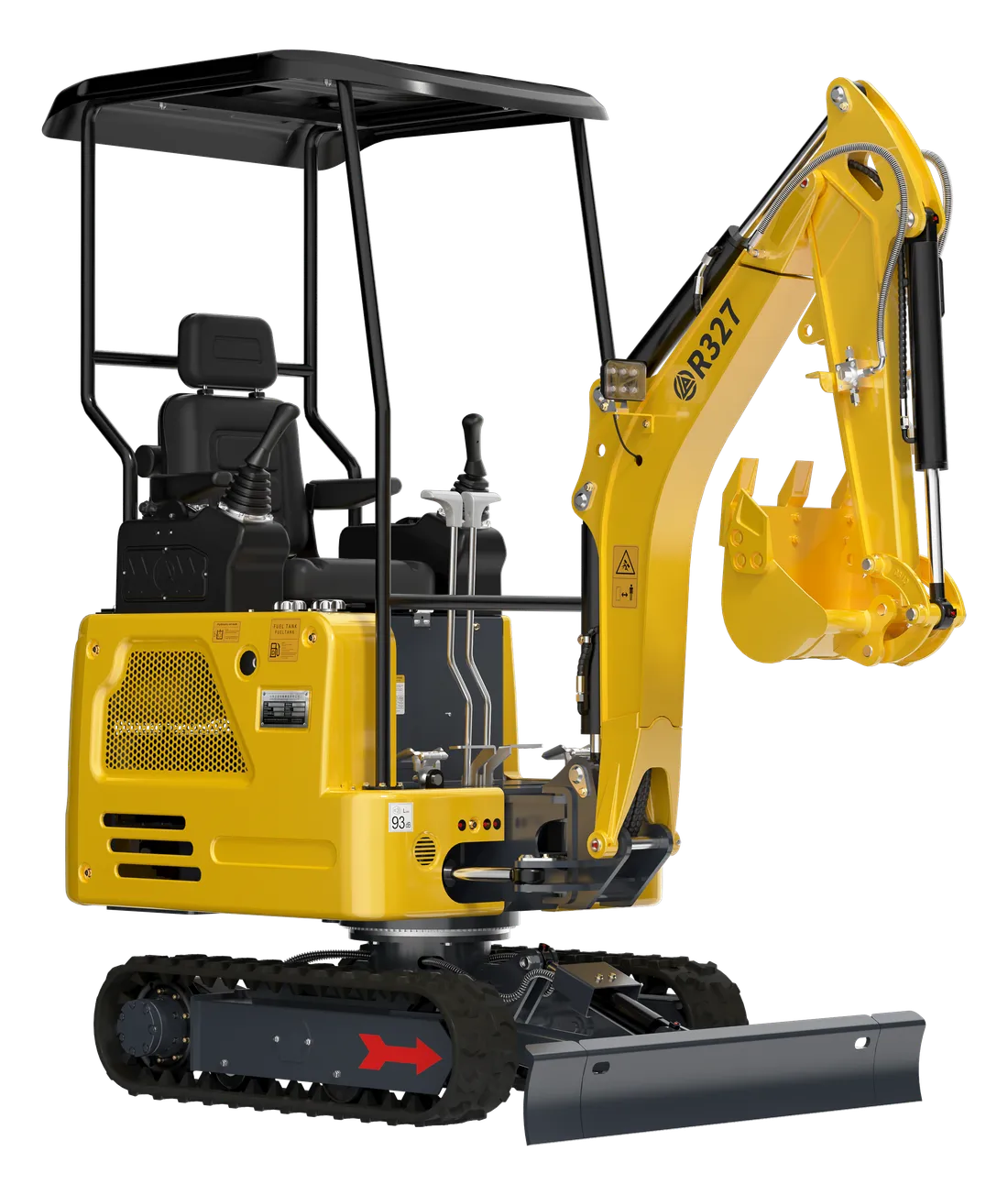
This volume explains how telescopic tracks work, when to use them extended and when retracted, and, just as importantly, what they don’t solve. We use the R327 with telescopic tracks as an example.
What are telescopic tracks?
A mini excavator’s undercarriage consists of a central main frame and two track frames on either side of it carrying the tracks. On machines with fixed tracks, these two frames are fixed to the main body; the distance between the two tracks, that is the track spread, never changes.
With telescopic tracks, on the other hand, the track frames are connected to the main frame by a sliding structure. Thanks to this structure, the tracks can be drawn in and pushed out. So the same machine has two different widths: narrow for passing through, wide for working.
The alternative is a fixed undercarriage with wide-set tracks from the start. Such a machine is stable while working, but can’t get into a narrow entrance at all. A fixed machine with narrow-set tracks, on the other hand, gets in everywhere, but its sideways stability while working is always limited by that narrow base. Telescopic tracks are the way to use both on the same machine instead of choosing between these two extremes.
Whether the adjustment is made with a hydraulic cylinder or a mechanical system, and in how many positions the tracks can be locked, varies with the design. At EKSFORK, the model whose technical specifications list telescopic extendable/retractable tracks is the R327. You can learn from the manual how the adjustment is made on the R327, and ask us to demonstrate it in practice during the basic operator training given at delivery. Note too that the R327’s dozer blade is adjustable; check in the manual how to adjust the blade to the track position.
Why more stable? The physics of it
A machine’s resistance to tipping depends on its centre of gravity staying within its support base. The support base is the area enclosed by the points where the machine presses on the ground; on a tracked machine, this area is set by the length of the two tracks and the spread between them.
Imagine holding a weight with your arm stretched out to the side. With your feet together you stagger; with your feet apart you carry the same weight much more easily. Telescopic tracks make the machine do exactly this: extending the tracks widens the machine’s sideways support base.
This difference is felt most when the upper structure turns to the side. When the machine digs forwards, the length of the tracks provides stability; but when you swing the bucket to the side to dump a load or reach out sideways, the track spread determines its resistance to tipping. With the tracks extended, these movements are made more safely and more calmly.
Example: Imagine you are digging sapling holes in a vineyard and loading the soil onto a trailer standing beside the machine. With each load the upper structure swings to the side and the full bucket is carried out beyond the side of the tracks. With the tracks retracted you need to make this movement slowly and cautiously; with the tracks extended, the same movement takes place over a wider base. The result is less unease and a steadier work rhythm.
When retracted, when extended?
The practical rule is simple: retracted when passing through, extended when working. But some situations need a little more care:
| Situation | Track position | Why? |
|---|---|---|
| Narrow gate, passage, greenhouse entrance | Retracted | Machine width is reduced to a minimum |
| Loading onto a trailer and transport | Transport position in the manual | On most machines this is retracted; transport width is reduced |
| Digging and loading to the side | Extended | Sideways stability increases |
| Working on rough and sloping ground | Extended | The machine is more resistant to leaning over sideways |
| Working between narrow rows | Retracted or a suitable intermediate position | To avoid damaging plants and rows |
| Sinking problems in soft ground | Makes no difference | Track spread doesn’t change ground pressure |
For intermediate positions, check your machine’s manual; some designs lock only in the two end positions.
Sometimes you have to work with the tracks retracted; for example, if the path between two rows doesn’t allow the tracks to be extended. In this case, work within the limits of the narrow base: don’t extend the arm further than necessary, keep the bucket close to the body, swing the upper structure slowly, avoid long sideways movements with a full bucket and lower the dozer blade to the ground. If possible, leave the soil in front of or behind the machine, not to the side.
We cover the other details of working in greenhouses and tight spaces in the greenhouses and tight spaces volume.
When extending and retracting the tracks
Changing the track spread changes the machine’s balance in an instant. That is why you should always make the adjustment in a controlled setting:
- Choose level, firm ground. Don’t make the adjustment on a slope, at the edge of a hole or on loose fill.
- Clear the surroundings. Nobody should be in the area the tracks will move into or near the machine; a foot or tool beside the track can get trapped.
- Empty the bucket and keep it close to the ground. Don’t change the track position with a load in the bucket or with the boom raised.
- Follow the method in the manual. Which control is used, and whether the machine stays stationary during the adjustment, vary with the design.
- Check the result visually. Make sure both tracks have reached their full position and sit symmetrically; if there is a lock or pin system, engage it.
Remember that once the tracks are extended, moving around in a tight space becomes harder. Reach the working point, extend the tracks, finish the job, and retract the tracks again before the exit route.
Let’s be honest: the limits of telescopic tracks
Telescopic tracks are valuable equipment, but they don’t solve every problem. Knowing their limits before buying saves you from false expectations:
- They don’t change ground pressure. Because the area of track in contact with the ground stays the same, the risk of sinking in soft ground doesn’t decrease.
- They don’t change front-to-back stability. The machine’s resistance to tipping forwards or backwards is still limited by the length of the tracks. The rules for working up and down a slope apply exactly as before.
- They don’t automatically increase lifting limits. If you will carry loads on the bucket, keep to the limits the manual allows for that position; having the tracks extended is no reason to exceed these limits.
- They need extra maintenance. The sliding structure is prone to trapping mud and stones; it needs regular cleaning and greasing.
- Manoeuvring is harder when they are extended. A wide base makes turning and moving around in a tight space harder.
Stability on slopes is a much wider subject than telescopic tracks; we have gathered all the rules in the mini excavator safety on sloping ground volume.
Maintenance: slides, greasing and checks
The telescopic track mechanism works in the same harsh environment as the rest of the undercarriage: mud, sand, stone and water. That is why you should make its maintenance part of the daily track check:
- At the end of work, especially after muddy jobs, clean the mud and stones out of the slide area; dried mud makes the mechanism harder to move.
- Grease the lubrication points specified in the manual at the specified intervals.
- If the adjustment is made by a hydraulic cylinder, check the cylinder and hoses for leaks, dents or chafing marks.
- Watch whether the tracks catch as they extend and retract and whether both sides move by the same amount; asymmetry can be a sign of a problem.
- Check track tension, the rollers and the drive sprocket as usual.
In winter this check becomes even more important. If wet mud left in the slides at the end of the day freezes overnight, the next morning the tracks will struggle to extend and retract, and the mechanism can be damaged by being forced. In cold weather, clean the mechanism when work is finished; in the morning, check for frozen mud before making any adjustment, and don’t keep forcing a strained movement with the controls.
For the tension adjustment and replacement timing of the tracks themselves, see the track maintenance volume. Parts such as the tensioning mechanism, rollers and drive sprocket are listed among the undercarriage spare parts.
Who are they really valuable for?
Telescopic tracks don’t benefit everyone to the same extent. They make a clear difference for these users:
- Those working in areas with narrow entrances: those who want to get the machine into gardens, courtyards, greenhouses and gaps between buildings and work safely once inside.
- Those who load to the side: those who often dump the soil they dig to the side or onto a trailer.
- Those working on rough ground: those who work on uneven ground in vineyards, orchards and along field edges.
- Those with mixed work: those who work both in narrow gardens and on open sites in the same week.
A decision shortcut: think one by one about the jobs you have done over the last year. Count how many of them had the machine struggling at the entrance or unable to get in at all, and in how many you felt uneasy when loading to the side or on rough ground. If these jobs take up a significant place in your calendar, telescopic tracks will directly save you time and give you confidence; if they hardly ever come up, you don’t need to set aside extra budget for this equipment.
If your jobs are always on open, wide sites and you have no problem with narrow passages, the return from this equipment will be more limited. When deciding, weigh up the models’ other differences together in the R10, R327 and R350 comparison.
Questions to ask when buying
- How wide is the machine in mm with the tracks retracted and extended?
- Is the adjustment hydraulic or mechanical; can it be made from the operator’s seat?
- Do the tracks lock only in the two end positions, or is there an intermediate position?
- How is the dozer blade adjusted to the track position?
- What are the mechanism’s lubrication points and maintenance intervals?
- Which position is recommended for transport? Make your transport plan together with our mini excavator transport guide.
- Is the mechanism covered by the warranty? At EKSFORK, machines come with a 2-year or 2,000-operating-hour warranty.
Summary
- By changing the machine’s track spread, telescopic tracks combine narrow access and a wide working base in the same machine.
- The rule is simple: retracted when passing through and in transport, extended when working; make the adjustment on level ground with the bucket empty.
- They increase sideways stability; they don’t change ground pressure, front-to-back stability or lifting limits.
- The sliding mechanism needs regular cleaning and greasing.
- They are among the most valuable pieces of equipment for users who move back and forth between tight spaces and open sites.
If you are looking for a mini excavator with telescopic tracks, take a look at the R327’s technical specifications; for the current campaign price (from 479.000 ₺ instead of 549.000 ₺, excluding VAT) and the track dimensions, write to us on WhatsApp.