Imagine you need to dig a trench right at the foot of a wall, fence or building. With a fixed-boom excavator you have two options: either you position the machine at right angles to the wall and slew the upper structure with every bucket, bringing the rear body close to the wall, or you keep the machine away from the wall and find that the bucket never reaches the line of the wall. Either way, the work slows down and the risk grows.
Boom swing is equipment developed to solve this problem. Because the boom itself can be swung right or left, you can shift the digging line into line with the wall while the machine stands parallel to it.
This volume explains how boom swing works, how it differs from slewing the upper structure, how to use it step by step next to a wall and, above all, which rules to follow to protect the wall, the foundation and the people around you.
What is boom swing?
An excavator’s boom is attached by a pivot to a mounting point at the front of the upper structure. On fixed-boom machines, the boom only moves up and down. On machines with boom swing, this mounting point is a swing bracket that can turn around a vertical axis, and a hydraulic cylinder swings the boom to the right or left around this axis.
As a result, the boom, arm and bucket shift to the side independently of the direction the upper structure is facing. The bucket keeps digging along a line parallel to the machine’s centre line but offset to the side by a certain distance.
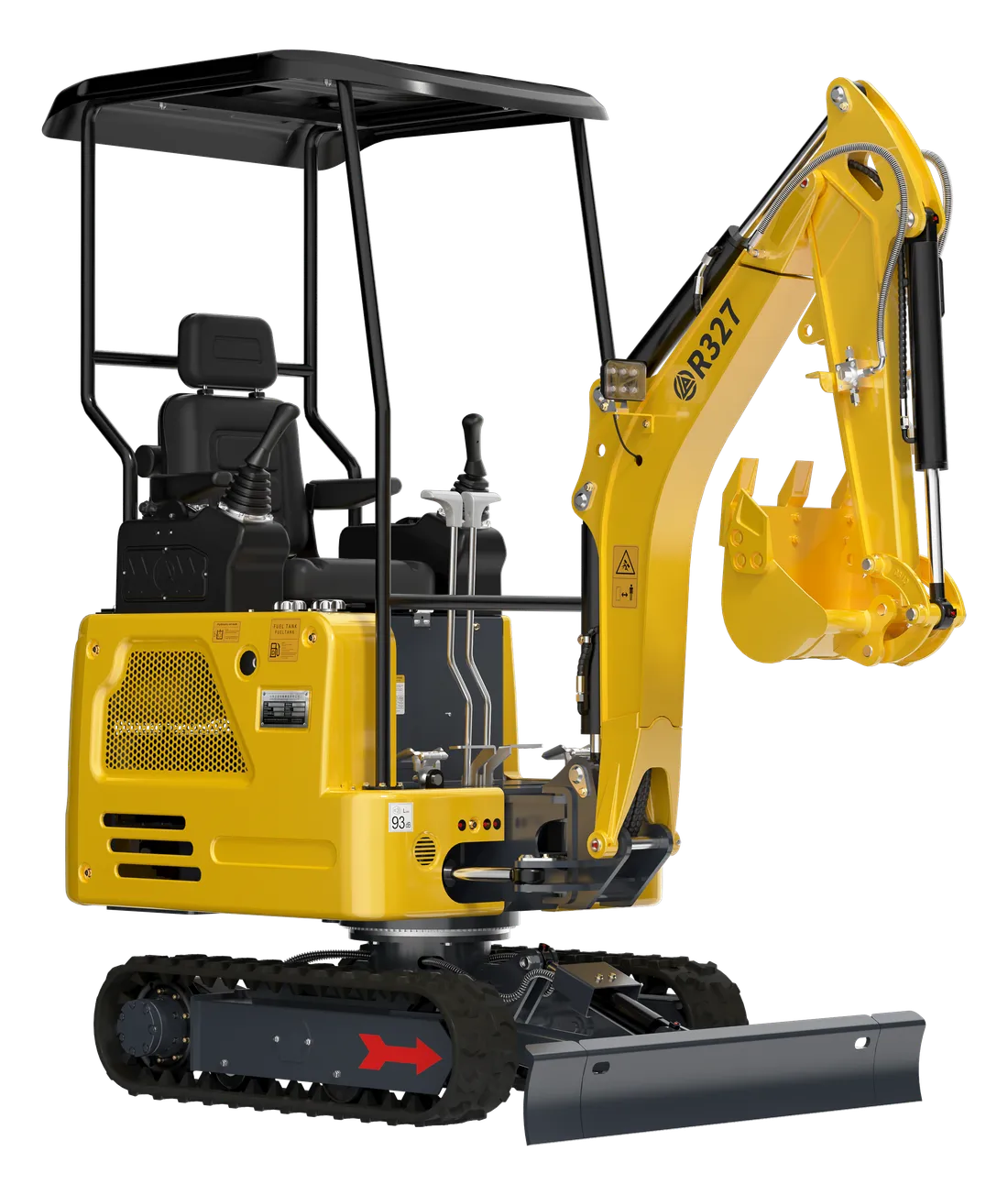
Among EKSFORK models, the R327 and R350 have 120° boom swing. How the swing is controlled varies from machine to machine; on most mini excavators this movement is made with a foot pedal or a button on the control lever. Check in the manual which control your machine uses and how the 120° range is split between right and left; be sure to try this movement in practice during the basic operator training at delivery.
How it differs from slewing the upper structure
This is what new operators confuse most often. Both movements take the bucket to the side, but their effects on the rest of the machine are very different:
| Upper-structure slew | Boom swing | |
|---|---|---|
| What turns? | The engine, cab, rear body and the whole front equipment | Only the boom, arm and bucket |
| Rear body | Describes an arc in the swing area | Stays where it is |
| Digging line | Along an arc from the machine’s centre | A line parallel to the machine’s centre line, offset to the side |
| Best suited to | Dumping soil to the side or rear | Digging next to walls, fences and obstacles |
| Risk next to a wall | The rear body hitting the wall | The bucket or boom rubbing against the wall |
In practice the two movements are used together: you swing the boom to the side to bring the digging line into line with the wall, and slew the upper structure away from the wall to empty the full bucket. Remember while doing this that the boom is swung to the side; a boom slewing with the upper structure describes a different arc from that of a machine with a straight boom.
Before starting work, take a measurement with your own machine: on level, clear ground, swing the boom fully towards the wall side, lower the bucket to the ground, and measure with a tape and note down how far the edge of the bucket sticks out beyond the outer edge of the track. This measurement shows directly how much distance you can leave between the track and the wall when positioning the machine next to a wall.
If you are using boom swing for the first time, don’t learn at the foot of a real wall. In an open area, stretch a straight string along the ground, position the machine parallel to it and try digging a shallow trench along the string by swinging the boom to the side. After a few attempts, lining up the bucket with the string becomes a habit; starting the real job with this habit protects both the wall and the machine.
Digging next to a wall: step by step
- Find out about the lines. The electricity, water, gas, sewer and telecom lines entering a building often run along the foot of the wall. Find out where the lines are from the relevant authorities and the building owner; expose the area around known lines by hand.
- Position the machine parallel to the wall. Keep the tracks parallel to the wall and at a safe distance from it. When setting this distance, also allow for how close the rear body will come to the wall when you slew the upper structure.
- Lower the dozer blade to the ground. The blade steadies the machine during digging and supports sideways stability.
- Swing the boom towards the wall. Lower the bucket and, with the help of a banksman, check that the digging line is in line with the wall; always leave a small margin between the bucket and the wall.
- Dig in layers. Take a similar depth on each pass; pull the bucket parallel to the wall, not towards it.
- Dump the soil on the opposite side. Slew the upper structure away from the wall and leave the soil away from it; don’t pile it at the foot of the wall.
- Work backwards. As you finish each section, pull the machine back on its tracks and continue, keeping the same line.
- Finish the last part by hand. Take out the centimetres closest to the foundation, the waterproofing or a line by hand, not with the machine.
Topics such as the behaviour of trench walls, where to put the spoil pile and checking the fall apply equally to digging next to a wall; we explain the details in the channel and trench digging volume.
Protecting the wall and the foundation
The most serious risk of digging next to a wall is less the machine itself than the effect of the excavation on the wall. Going below the foundation level right next to an existing wall can weaken the ground the foundation rests on and cause cracking or settlement in the wall.
- Find out the foundation level. If your digging depth will go below the existing foundation, consult a civil engineer before starting work; let them set the method and the digging sequence.
- Work in short sections. Instead of opening a long trench along the wall in one go and leaving it open for days, open short sections, do the work and close them.
- Mind the waterproofing. In excavations for repairing the waterproofing of a basement wall, bucket teeth easily tear the existing waterproofing layer. Always expose the last part close to the wall by hand.
- Protect the facade. Cover surfaces such as the facade, windows and pipes that the bucket or arm could rub against with temporary panels.
- Be cautious with a breaker. Working with a hydraulic breaker next to a wall transmits vibration directly to the structure; if it isn’t essential, choose another method.
If you are digging the foundation of a new structure next to a wall or a neighbouring building, we cover the planning and checkpoints separately in the foundation digging volume.
Uses beyond walls
Boom swing saves time not only next to walls but in many everyday jobs:
- Staying away from the trench edge: If you shift the trench away from the machine’s centre line by swinging the boom to the side, the tracks don’t press on the trench edge and stay on firm ground.
- Getting around obstacles: If a post, tree or manhole cover is on the line, you can shift the digging line beside the obstacle without repositioning the machine.
- Digging corners: It becomes easier to reach the corners where two walls meet without wedging the machine into the corner.
- Laying pipes: It becomes easier to align a pipe or material being lowered into the trench with the trench axis without changing the machine’s position.
- Dumping in tight spaces: Where you can’t fully slew the upper structure, the boom’s side angle gives you more places where you can leave the soil.
Stability and safety
When the boom is swung to the side, the bucket and its load move away from the machine’s centre line. This means the machine’s sideways stability decreases. Be particularly careful in these situations:
- Full bucket, long reach: Extending a full bucket far out while the boom is swung to the side increases the risk of tipping sideways. Keep the bucket close to the body.
- Sloping ground: On a slope, avoid swinging the boom to the downhill side and carrying a load; if possible, keep the load on the uphill side.
- Lifting loads: Don’t lift loads on the bucket while the boom is swung to the side; lifting is done only in the positions and within the limits the manual allows.
- Crushing risk: Nobody should stand between the machine and the wall. The most dangerous point in work next to walls is the banksman or a helper getting caught between the machine and the wall.
- Visibility: If your view on the wall side is limited, slow your movements down, and keep the banksman at a point where you can always see them but outside the machine’s reach.
Maintenance: pivot, pins and hoses
The boom swing mechanism works in one of the most heavily loaded areas of the front equipment: all the digging force passes through this pivot, and mud and dust collect here most of all. A few habits prevent play from developing and breakdowns:
- Grease the pins and bushes in the swing bracket pivot at the intervals specified in the manual; keep pumping until the old grease is pushed out and clean grease appears.
- Check the rod of the swing cylinder for scratches, impact marks or oil leaks.
- Check the hoses that flex as the boom swings for signs of chafing and crushing; keep the hose guards in place.
- With the bucket on the ground, move the boom gently left and right; if there is a clicking noise or visible play in the pivot, ask for a service check.
We explain why the greasing habit matters so much in the pins, bushes and greasing volume, and why and how hoses get damaged in the hydraulic hose volume. Cylinders, hoses and fittings are listed among the hydraulic system spare parts; give the model and serial number when you order.
Which model, for what?
The R327 combines boom swing with telescopic tracks: it can pass through a narrow entrance and position itself parallel to a wall, extend its tracks to increase stability and reach the foot of the wall by swinging the boom to the side. On garden walls, fence lines and work around buildings, this pairing saves a lot of time.
The R350 offers the same 120° boom swing with a 2,927 mm digging depth, 22.5 kN digging force and an enclosed cab. It is better suited to deep utility connections and foundation work around buildings; you can ask for the R350’s current price on the R350 page or on WhatsApp.
The R10’s spec sheet does not list boom swing; if you are considering the R10 for work next to walls, ask about this feature separately at the quotation stage. Working next to a wall without boom swing, you need to reposition the machine more often and pay more attention to the rear body’s swing area.
Quick checklist
- The positions of lines running along the foot of the wall have been found out and marked
- The level of the existing foundation is known; if the dig will go below it, an engineer’s opinion has been obtained
- The machine has been positioned parallel to the wall, allowing for the rear body’s swing area
- The blade is down, the boom is swung towards the wall, and there is a margin between the bucket and the wall
- Soil is being left on the opposite side from the wall and away from the edge
- Nobody is between the machine and the wall; the banksman is in view
- The last part close to the waterproofing, foundation and lines will be exposed by hand
- The swing bracket pivot has been greased and the hoses checked
If you are looking for a machine with boom swing and telescopic tracks for work next to walls and in tight spaces, take a look at the R327; send us your job’s dimensions on WhatsApp to get a model and attachment recommendation.