When researching mini excavators, you keep coming across the same line in specification lists: “Control system: pilot control.” It may look like a small equipment detail, but this line directly determines how the machine will feel in your hands, how tired you will be by the evening and how precisely you can work on fine jobs.
In this volume we explain how pilot controls work, where they differ from older-style mechanical controls, their weak points, and what you should test when taking delivery of a pilot-controlled machine.
You don’t need to be a hydraulics expert. Knowing roughly what happens inside the machine when you push the lever makes it easier both to choose the right machine and to notice a fault before it grows.
In short: what does pilot control mean?
On a pilot-controlled machine, the control lever (joystick) in your hand does not push directly on the main hydraulic valve that moves the boom and bucket. The lever opens a small valve right beneath it, and this valve sends a low-pressure oil signal to the main valve. The job of directing high-pressure oil to the cylinders is done by the main valve.
By analogy: with mechanical controls you push a heavy sliding door with your own arm; with pilot controls you touch a lever and hydraulics open the door. You only state the direction and speed of the movement. The “pilot” in the name points to this too: the low-pressure oil coming from the control is a guiding signal that shows the big valve the way.
How do mechanical controls work?
With mechanical (direct) controls, the lever is connected to the main valve spool by rods or steel cables. The further you pull the lever, the further the spool slides. The design is simple and easy to understand: you can follow the linkage by eye, and fix a loosened joint on site with a spanner.
The price of this simplicity is lever effort. Because it is your arm that moves the spool, your shoulder and wrist get tired over a long day. The joints develop play over time; a dead zone forms in the lever and fine adjustment becomes harder. Making combined movements smoothly, such as raising the boom while slewing and closing the bucket at the same time, also takes more experience.
What happens inside the machine when you push the lever?
On a pilot-controlled mini excavator, the chain behind a single movement is roughly as follows:
- You tilt the lever. The pilot valve beneath the lever opens in proportion to the lever’s angle of tilt.
- The pilot oil sets off. Thin pilot hoses carry low-pressure oil to the main control valve. On most machines this is not a separate oil; it is fed from the same hydraulic tank, only at a lower pressure.
- The main valve spool slides. As the incoming pilot pressure rises, the spool opens further. Tilting the lever slightly means a little oil; tilting it all the way means full flow.
- Power oil goes to the cylinder or motor. The boom rises, the arm opens, the bucket closes or the upper structure slews.
- When you release the lever, springs return the lever and spool to the centre position; the movement stops.
At the start of this chain there is also a safety (lock) lever. When the lock lever is in the locked position, the pilot oil’s path is cut off; even if you knock the controls, the machine won’t respond. That is why it matters that the lever is always locked when getting on and off. Learn in which position the lock lever locks on your machine by trying it together during the basic operator training at delivery.
Pilot controls versus mechanical controls
| Criterion | Mechanical controls | Pilot controls |
|---|---|---|
| Lever effort | Increases with load, tiring over a long day | ✅ Light, independent of load |
| Precise (proportional) control | Depends on play in the linkage | ✅ Proportional to lever angle, fine adjustment easy |
| Combined movements | Takes experience | ✅ Smoother |
| Response in cold weather | Heavy until the oil warms up | Delayed until the pilot lines warm up |
| Sensitivity to oil cleanliness | Lower | Higher; small valves are sensitive to dirt |
| Fault-finding on site | ✅ Linkages can be followed by eye | May need pressure measurement and service information |
| Safety lock | Varies by machine | ✅ The lock lever disables all controls |
| Use in the first hours | Heavy but “communicative” lever | Responds to a light touch; jerky in a heavy hand |
The conclusion from the table is clear: pilot controls come out ahead on productivity and comfort, while the advantage of mechanical controls is simplicity and ease of repair on site. On a machine that works more than a few hours a day, the time pilot controls save and the fatigue they reduce usually outweigh the rest.
A side benefit of the pilot system concerns the control pattern: on some machines a changeover valve allows the lever pattern (ISO or SAE) to be changed. Find out from the manual whether your machine has this option; we show the difference between the two patterns in a table in our first-use guide.
Where do you feel the difference on site?
The benefit of pilot controls shows most in these jobs:
- Levelling and fine scraping: Holding the bucket lip parallel to the ground and scraping off a few centimetres is much easier with millimetric lever movement.
- Digging near underground lines: Even if you have found out the routes of electricity, gas and water lines from the relevant authorities, the last layers are dug slowly and under control. Proportional control gives confidence here.
- Loading and piling: Raising the boom while slewing and getting the bucket ready to dump at the same time becomes a single, smooth movement; the cycle gets shorter.
- Working with attachments: It becomes easier to give slow, steady movement when drilling a vertical hole with an auger or holding a log with a hydraulic grab.
- Long shifts: The difference between your speed in the morning and in the evening shrinks; the risk of lapses in attention brought on by fatigue goes down.
A small but useful tip: the speed of a movement depends not only on the lever’s angle but also on engine speed, because the amount of oil the pump delivers changes with engine revs. On precise jobs such as digging around pipes or fine levelling, lowering the engine speed slightly gives you a slower, more controlled response to the same lever movement. On jobs that need speed, such as loading from a pile, you raise the revs again.
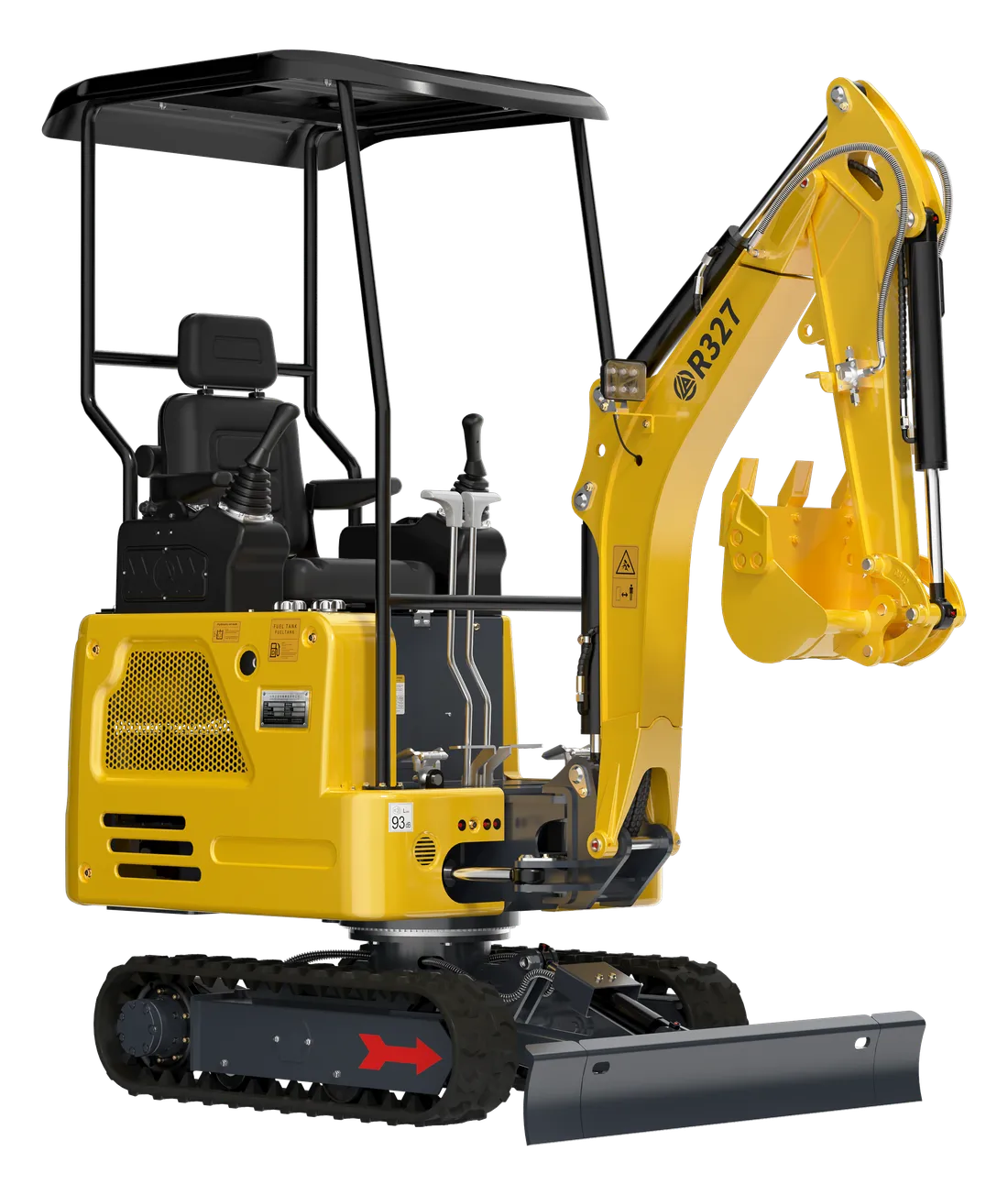
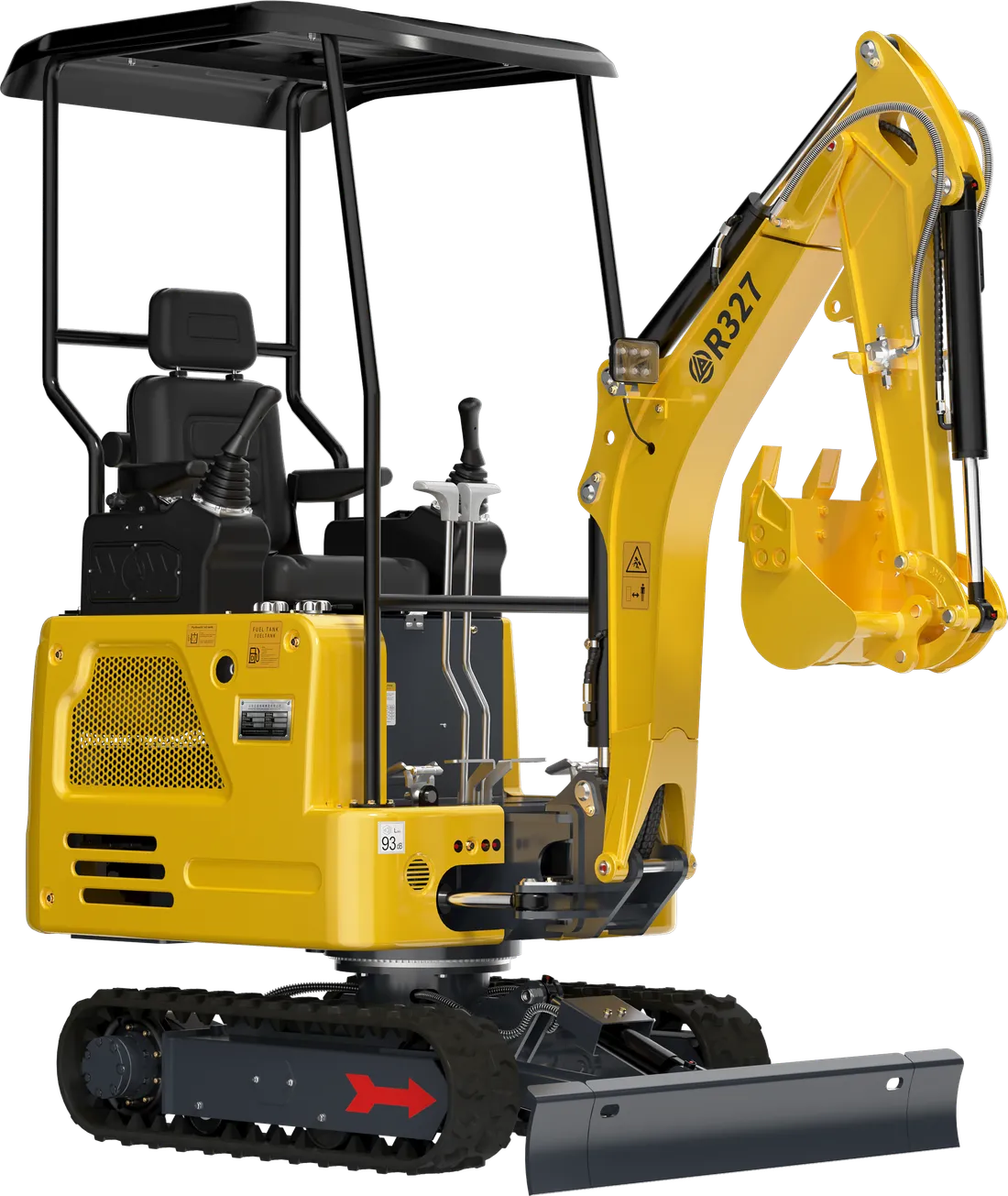
All three mini excavators at EKSFORK — the 1.2-tonne R10, the 1.7-tonne R327 and the 3.5-tonne R350 — have pilot-operated control systems. So even in the smallest class you don’t need to think about this comfort separately. On the R327 product page you can see, alongside pilot controls, features such as telescopic tracks and 120° boom swing.
Let’s be honest: the weak points of pilot controls
Pilot controls are not superior in every respect. There are four points you should know:
- Precision turns into jerkiness in a heavy hand. If someone used to mechanical controls pushes the lever with the same force, the machine moves suddenly and abruptly. This is a matter of habit that goes away with a few hours of practice.
- Delay in the cold. When the oil is cold, flow in the thin pilot lines slows down; in winter, movements feel heavy in the first minutes. The warm-up routine must not be skipped; we explain the details in the winter use volume.
- Sensitivity to dirt. Pilot valves are delicate parts with narrow passages. The effect of dirty oil or a filter not changed on time shows up here first. For the right oil and change interval, see our hydraulic oil guide.
- Limited repair on site. You can make do with a mechanical linkage using wire and a spanner; faults in the pilot circuit that need pressure measurement are a job for the service team.
Also know this: pilot pressure is provided by the running engine; when the engine stops, the controls lose their function too. Some machines have an accumulator that stores pressure so that a raised attachment can be lowered with the engine off; some don’t. Find out from the manual whether your machine has this facility, and never get off the machine with the bucket left in the air.
Five habits that give the pilot system a long life
- Change the hydraulic oil and filters at the interval in the manual; keep the funnel and container clean when adding oil.
- Don’t use the control levers as grab handles when getting on the machine; it strains the lever mechanism and, if the lock is off, can cause an accident.
- Don’t point a pressure washer at the control consoles; keep the gaiters at the base of the levers intact.
- In cold weather, don’t start heavy work before warming the oil by running the functions slowly and without load.
- When you feel stiffness, catching or a delay in one direction on a lever, make a note and consult the service team before it grows.
Common complaints and first checks
Some of the complaints blamed on pilot controls actually stem from how the machine is used or from another part. Before calling the service team, take a look at this table:
| Complaint | Check this first | When service is needed |
|---|---|---|
| None of the controls work | Is the lock lever in the locked position? Is the engine running, and is the engine speed sufficient? | If there is no response at all even with the lock off |
| Movements are heavy in the mornings, then improve | Was a warm-up done? Is the hydraulic oil level correct? | If it persists after the machine has warmed up |
| Movements are jerky and uneven | Are you using the lever gently? Oil level and visible leaks | If it continues with gentle use too |
| Movement doesn’t stop when the lever is released | Immediately lock the lock lever and stop the engine | Immediately, without restarting the machine |
| The boom or arm lowers by itself | Usually not the pilot circuit but a cylinder or valve leak | For a leak check |
| The gaiter at the base of the lever is torn | Dust and water ingress; renew the gaiter | If the lever catches or feels stiff |
Creeping down by itself (what mechanics call the cylinder “bypassing”) usually stems from cylinder seals or an internal valve leak; we cover its symptoms and solution in the seal replacement volume. Parts such as control levers, control valves and foot pedals are in our hydraulic system category; you can ask about them by giving your machine’s model and serial number.
Pilot control checklist when taking delivery
When taking delivery of a pilot-controlled machine, carry out these tests after the engine has warmed up, in an open and safe area:
- With the lock lever locked, move all the levers: there should be no movement at all.
- Release the lock; operate the boom, arm, bucket, slew and dozer blade one by one and slowly. Each movement should speed up in proportion to how far you tilt the lever.
- When you release the lever, the movement should stop immediately and the lever should return to the centre by itself.
- Close the bucket while raising the boom and slewing. The three movements should flow together smoothly; if one stops completely or jerks, make a note of it.
- On models with boom swing (R327 and R350), test this control in both directions too.
- Lift a full bucket slightly off the ground and hold it for a few minutes; there should be no visible creep down.
- Check that the gaiters at the base of the levers are intact and that the pilot hoses run without chafing or kinking.
- Find the control pattern label; confirm together during the training which lever makes which movement.
Summary
- With pilot controls, the lever operates not the main valve but a small pilot valve; the heavy work is done by hydraulics.
- The gain: a light lever, proportional and smooth movement, less fatigue over long shifts.
- The price: sensitivity to clean oil, the need to warm up in the cold and the need for service when there is a fault.
- The lock lever cuts off the pilot line; it must always be locked when getting on and off.
- Creeping down by itself is usually not a pilot fault but a cylinder or valve leak.
The R10, R327 and R350 all have pilot controls; you can compare our mini excavator models side by side, and send us your questions about controls, test runs and delivery on WhatsApp.