The mini excavator’s biggest advantage is that it can get into places big machines can’t: greenhouses, courtyards, the gap between two buildings or the back corner of a garden. The machine people look for on site as a “tight-access digger” is usually this one. But working in a tight space is not a scaled-down version of open-site work; it is a separate job with its own risks and its own technique.
In a tight space, what limits the machine is usually not its power but its surroundings: a post, a gutter, a heating pipe, a delicate row of plants or poor ventilation. This volume, with particular emphasis on work inside greenhouses, covers working in tight spaces under the headings of dimensions, movement, air, soil and hygiene.
Most of what we explain also applies to other tight spaces such as courtyards, gaps between buildings and enclosed stores. We have marked the parts specific to greenhouses separately.
Measure first: entrance, ceiling and internal paths
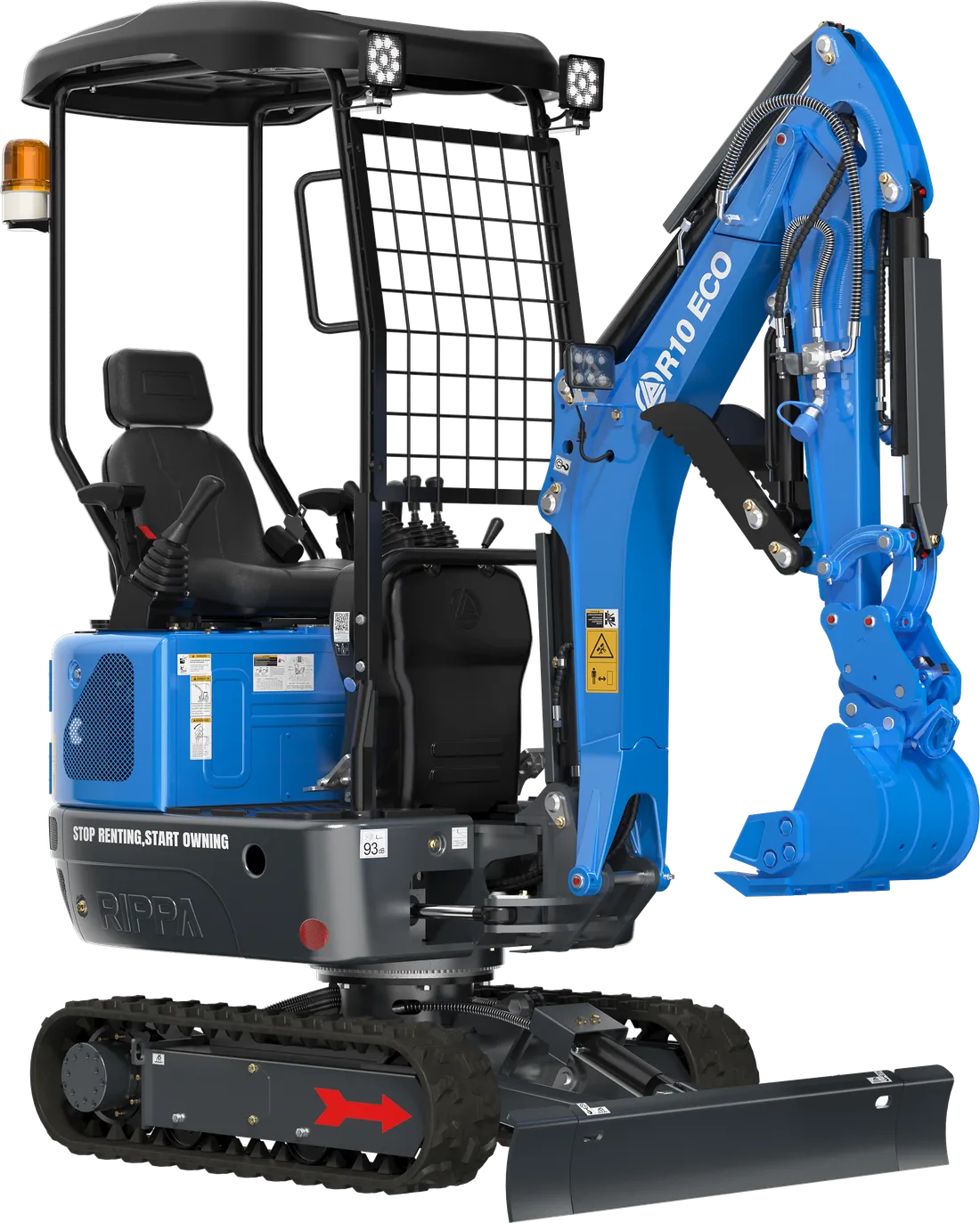
The first rule in tight-space work is not to assume the machine will fit. Walk around with a tape measure, take the measurements below and compare them with the machine’s technical values. As an example we have used the R10’s technical values:
| Measurement | Where is it taken? | Relevant R10 value |
|---|---|---|
| Entrance width | The narrowest point of the door or passage | Machine width 930 mm |
| Entrance height | Door head, gutter or beam | Machine height 2,200 mm |
| Working height | The lowest beam, pipe or cover at the working point | Max. digging height 2,550 mm |
| Swing clearance | From where the machine will stand to the nearest post or wall | Turning radius 1,190 mm |
| Internal path width | Between plant rows or benches | Machine width and track marks |
Example: If the clear width of the greenhouse door is 1,000 mm, the 930 mm wide R10 has only 35 mm to spare on each side as it passes through. This is a gap the machine fits through in theory but should not pass through in practice without a banksman. For passages like this, temporarily protect the door frame and posts with boards or a thick cover, and drive the machine through straight, slowly and in one go.
The trickiest row in the table is working height. The machine may pass easily through the entrance, but when you raise the boom inside, the bucket or arm goes well above the machine height at the entrance. If a greenhouse gutter, roof truss, heating pipe, irrigation line or shade screen is at this height, you need to limit boom movement while working.
A similar warning applies to swing clearance: check in the manual which part of the machine the turning radius value in the spec sheet covers, and always leave a safety margin between you and any post or wall.
Movement technique in tight spaces
In a tight space the operator’s worst enemies are haste and poor visibility. A few habits protect both the machine and its surroundings:
- Slow, one movement at a time: In a tight space, make movements one after another instead of using several controls at once. The fine control of pilot controls really pays off here.
- Use a banksman: Have a banksman wherever your view is blocked; work with hand signals agreed in advance and keep the banksman outside the machine’s swing area.
- Avoid full-circle swings: If possible, leave the soil you dig in front of the machine or beside it at a short angle; every full-circle swing means the rear of the body coming close to a post or wall.
- Keep the boom low: When moving, carry the bucket close to the ground with the boom tucked in; stability increases and the risk of hitting overhead elements decreases.
- Safe-height marker: If there is a low beam or pipe, hang a visible marker beneath it or ask the banksman to give a specific warning at this point.
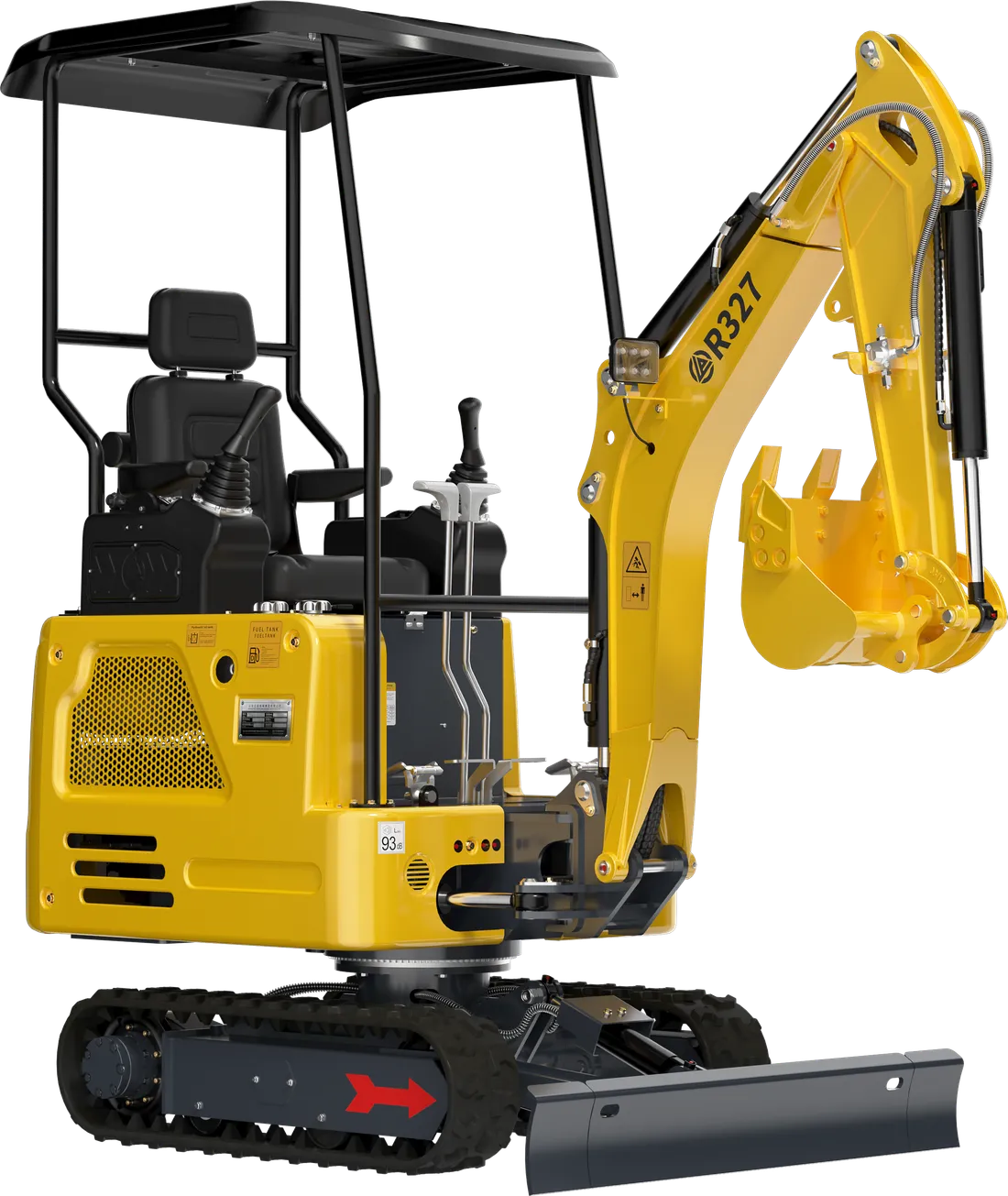
The machine’s equipment also makes a difference in tight spaces. The R327’s telescopic tracks let you pass through a narrow entrance with the tracks retracted and then extend them inside to work more stably; we explain how they are used in the telescopic tracks volume. 120° boom swing lets you shift the digging line parallel to a wall or the edge of a greenhouse without turning the upper structure; you can find the technique in the boom swing volume.
Exhaust and ventilation: the greenhouse’s invisible risk
Every time a diesel engine runs, it produces exhaust gas. On an open site this gas disperses quickly; in an enclosed or semi-enclosed greenhouse it can build up. Exhaust gas is a risk to the health of the people working, and plants can also be harmed by it.
- While the machine is in the greenhouse, open all doors and vents; if possible, create an air flow with openings on opposite sides.
- Don’t leave the machine idling inside the greenhouse. Stop the engine when taking a break, or take the machine outside.
- Split the working time into parts; on long jobs, take the machine outside in between and air the greenhouse.
- Nobody other than the team should be in the greenhouse; anyone who feels a headache, dizziness or nausea should go out into the open air immediately.
- Never run the engine in a fully enclosed space with inadequate ventilation.
These rules apply equally to other enclosed spaces such as stores, barns and basements.
Protecting the soil: compaction and tracks
Greenhouse soil is one of the operation’s most valuable assets. Driving a heavy machine back and forth over soil improved over years crushes the pores through which roots and water move. Sometimes this effect only becomes noticeable in how the next crop develops.
- Set a fixed machine route and drive the machine only along this route; don’t tread on the rest of the soil.
- Don’t work in wet soil. Soil compacts much more easily right after irrigation or in a rainy period.
- Lay thick panels on the route. Plywood or ground protection panels spread the machine’s weight over a wider area.
- Prefer a light machine. The R10’s machine weight is 900 kg; it puts less load on the soil than a heavy machine.
- Loosen the machine route after the job. Bring the crushed strip closer to its original state by deep hoeing or aerating it by hand.
Hygiene and plant health
A rarely discussed risk of working with a machine in a greenhouse is carrying in diseases and pests. Soil stuck to the tracks and bucket of a machine coming from another field or greenhouse can carry soil-borne disease agents, pests and weed seeds.
Before bringing the machine into the greenhouse, wash the tracks, bucket and attachments with a pressure washer and let them dry. If your operation has an entry disinfection procedure, include the machine in it too. Repeating the same cleaning after the job lets you arrive clean at the next site as well.
There is also the risk of hydraulic oil: oil dripping onto greenhouse soil affects both the soil and the crop. Before taking the machine inside, check the hoses and connections for leaks, and keep absorbent cloths or granules with you. If you see a leak, don’t take the machine into the greenhouse.
Typical greenhouse jobs and attachments
| Job | Attachments | Watch out |
|---|---|---|
| Drainage and main irrigation line | 20 or 30 cm bucket | Gather up existing drip lines beforehand |
| Soil renewal, moving soil | 40 cm bucket | Use the fixed machine route |
| Sapling and tree planting holes | Auger | Measure the row spacing beforehand |
| Clearing old roots and residues | Bucket and hydraulic thumb | Keep away from the structure’s posts |
| Surface levelling | Rake or grading bucket | Make the final passes while the soil is dry |
We explain the right bucket width for narrow trenches in detail in the bucket width guide, and the technique for planting holes in the auger hole-digging volume. If your main work in the greenhouse is tilling and moving soil, a small tractor may be a better tool than an excavator; we cover this choice in the choosing a tractor for nurseries and greenhouses volume.
Order of work in tight spaces: from the inside out
On an open site, a mistake in the order of work costs a little time; in a tight space it forces the machine to drive over finished work. That is why you should plan tight-space work by mapping out the machine’s entry, working and exit movements from the start.
- Start at the furthest point. In a greenhouse or a long courtyard, start at the point furthest from the entrance and work back towards the door. That way the machine doesn’t drive over the section you have finished.
- Decide in advance where the soil will go. In a tight space there is no room for piles. Either collect the excavated soil briefly on a tarpaulin inside, or take it straight out with a trailer or a wheelbarrow team waiting at the entrance.
- Bring materials in at the right time. Pipes, gravel or new soil should be delivered at a time and place that won’t block the machine’s exit route.
- Keep the exit route clear. The route by which the machine can get out at the end of the day or in an emergency must never be blocked with materials.
One more greenhouse-specific note: on sunny days the temperature inside a greenhouse rises much faster than outside. On a machine without a cab, the operator is directly exposed to this heat. Plan machine work for the cooler hours of the day, take frequent breaks and keep drinking water close by.
Mini excavators for greenhouses: which model suits tight spaces?
With its 930 mm width, 2,200 mm height and 900 kg machine weight, the R10 is the natural candidate for tight-space and greenhouse work. Because it is light, it puts less load on the soil and can be carried on a light trailer. Its limits are depth and hard ground; it cannot go below 1,650 mm.
The R327 is for those who want to get into a tight space and then work with more power and stability inside. Its telescopic tracks, 120° boom swing and Kubota D722 engine save time, especially on jobs along walls and greenhouse edges. The machine dimensions in the spec sheet are 2,200 × 930 × 2,200 mm, the maximum digging height is 2,481 mm and the turning radius 1,190 mm; confirm its width with the tracks retracted and extended with us, together with your greenhouse’s entrance dimensions. At 1,580 mm its digging depth is close to the R10’s; the R327’s difference lies not in depth but in access and stability. Because its operating weight is 1,700 kg (about 500 kg more than the R10), plan the machine route more carefully on soft greenhouse soil.
The R350, on the other hand, is too big for most greenhouses and tight spaces; its 3,500 kg operating weight increases both access difficulties and the load on the soil. It can be considered for large structures with wide entrances and firm ground.
Short checklist: before entering the greenhouse
- The entrance width, entrance height and the lowest element at the working point have been measured
- Swing clearance from posts and walls has been checked
- A fixed machine route has been set and panels laid on the route
- The soil is not too wet
- The tracks, bucket and attachments have been washed
- No leaks in the hoses and connections; absorbent material is ready
- All doors and vents are open
- A banksman and hand signals have been agreed; nobody other than the team is in the greenhouse
- Drip irrigation lines and delicate equipment have been removed from the route
If you are looking for a light machine designed for tight spaces, take a look at the R10 or the R327 with telescopic tracks; send us your greenhouse’s entrance and internal dimensions on WhatsApp and we can check together which model will fit.