Many people who only ever use their mini excavator with its standard bucket are tapping just a small part of what the machine can do. With the right attachment, the same machine breaks concrete, digs holes for fence posts, rips up hard ground, separates stones from soil and levels land. On the other hand, buying every attachment “just in case” wastes money and storage space.
At EKSFORK we offer 14 attachments for mini excavators. In this guide we explain what each one does, which jobs it makes a difference in, which one to buy first, how to check compatibility before you buy and how to maintain and store attachments.
What attachments are there for mini excavators? All 14 at a glance
Thinking of attachments in four groups makes the choice easier: buckets, hydraulic attachments, mechanical aids and system equipment.
| Attachments | Group | Main job | Auxiliary hydraulic line |
|---|---|---|---|
| 20 cm bucket | Bucket | Cable, irrigation and narrow pipe trenches | Not required |
| 30 cm bucket | Bucket | Drainage and small-diameter pipe trenches | Not required |
| 40 cm bucket | Bucket | General-purpose digging and trenching | Not required |
| 60 cm digging bucket | Bucket | Bulk digging, pits, loading | Not required |
| 60 cm screening bucket | Bucket | Separating stones and roots from soil | Depends on type |
| 100 cm grading bucket | Bucket | Levelling, slope trimming, loose material | Not required |
| Hydraulic breaker | Hydraulics | Breaking concrete, asphalt and rock | Required |
| Auger (earth drill) | Hydraulics | Holes for posts and saplings | Required |
| Hydraulic grapple | Hydraulics | Holding stone, logs and scrap | Required |
| Hydraulic thumb | Hydraulics | Gripping irregular material with the bucket | Required |
| Ripper | Mechanical | Breaking up hard, compacted ground | Not required |
| 60 cm rake | Mechanical | Sorting out stones, roots and rubble | Not required |
| Quick coupler (Quick Up) | System | Changing attachments in minutes | Depends on type |
| Cab | System | Protecting the operator from the weather | Not required |
Buckets: six different jobs, from digging to levelling
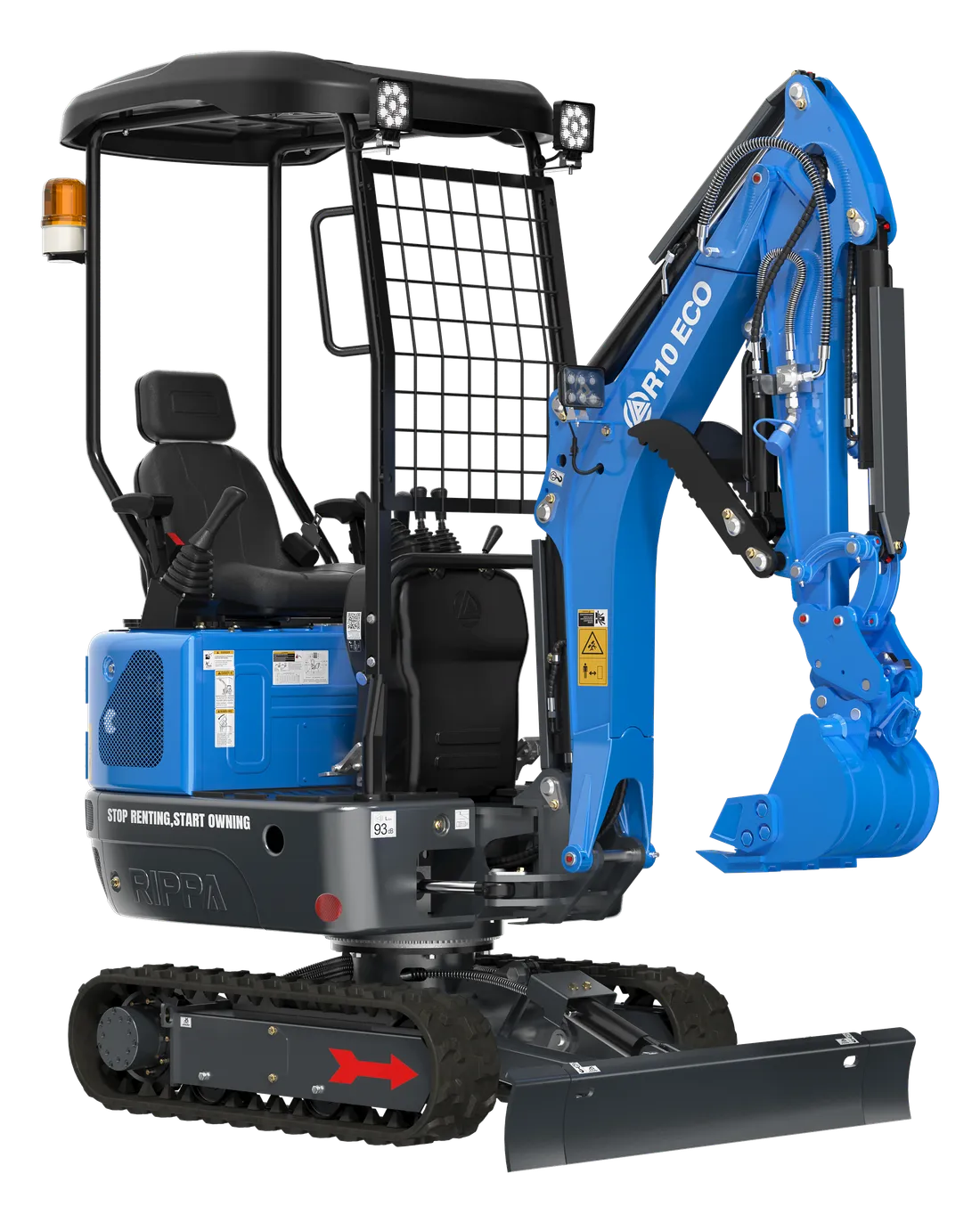
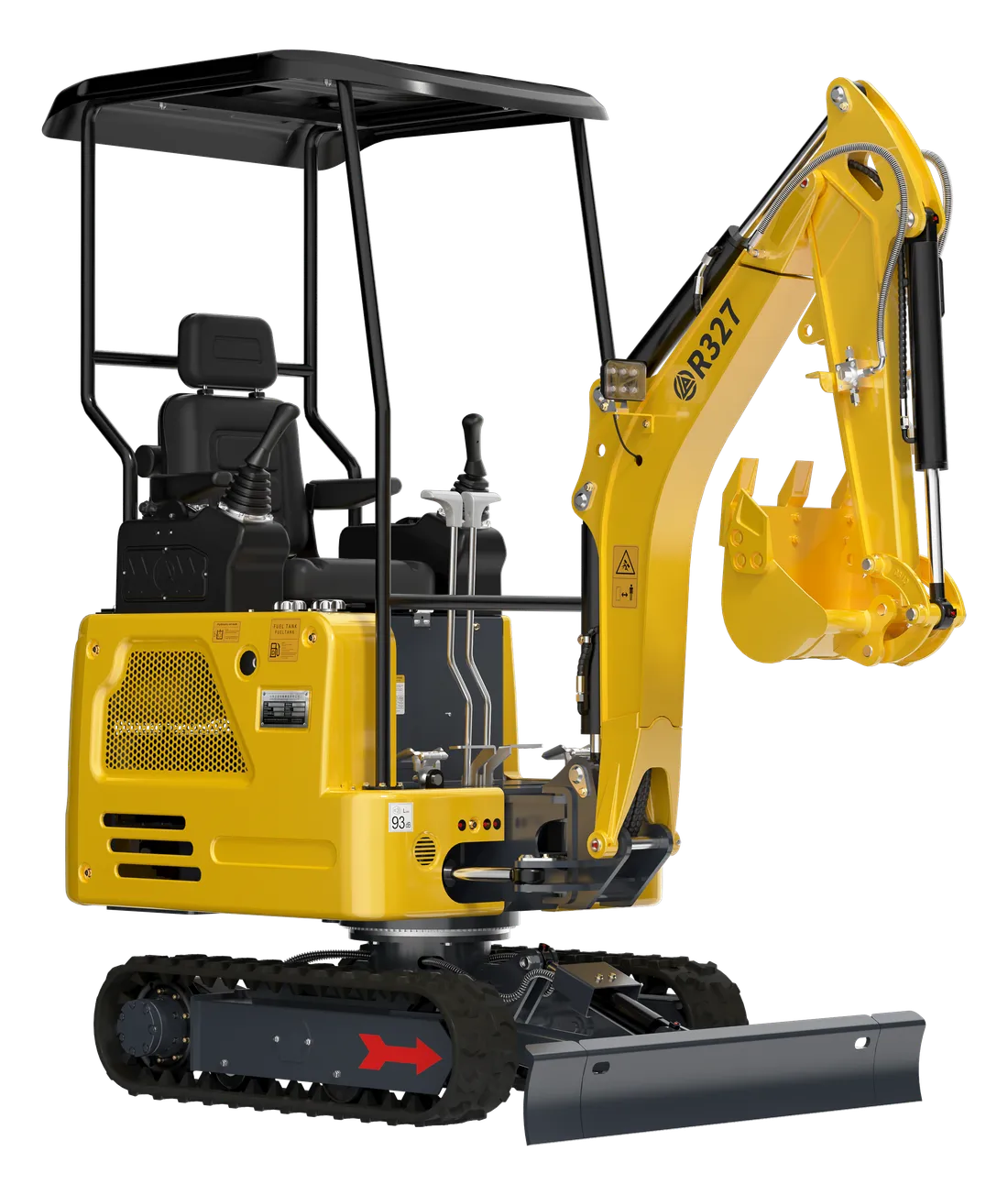
The bucket is the mini excavator’s most-used attachment, and its width defines the character of the job. The standard bucket width is 40 cm on the R10, 45 cm on the R327 and 50 cm on the R350; the extra buckets cover the jobs on either side of this standard.
- 20 and 30 cm buckets: These are narrow trenching buckets. For jobs such as electric cables, drip irrigation mains and drainage pipes, they make progress without digging out unnecessary soil, which also means less backfilling. The narrow cutting edge bites into hard ground more easily.
- 40 cm bucket: A balanced choice for general-purpose digging and medium-width trenches. On machines with a wider standard bucket, it serves as a second, “middle” bucket.
- 60 cm digging bucket: This one is about volume: digging pits, moving soil and loading. In soft and medium-hard ground it carries more material per cycle.
- 60 cm screening bucket: Its grid body lets fine soil fall through the gaps while keeping stones and roots in the bucket. It is meant for sorting rather than digging; screening soil and reusing it on site reduces the need to bring in soil from elsewhere.
- 100 cm grading bucket: With its wide, straight and usually toothless edge, it is used for levelling, slope trimming, ditch cleaning and loading loose material. It is not designed for digging hard ground.
With buckets, the type of edge matters as much as the width. A toothed edge penetrates the ground and cuts roots; a straight edge scrapes the surface and leaves the trench floor clean. If you mostly dig, choose a toothed bucket; if you mostly level and clean up, choose a straight-edged one. We explain which width to choose for which job, and how to work out trench width, in detail in our bucket width guide.
Hydraulic attachments: breaker, auger, grapple and thumb
The attachments in this group are powered by the machine’s hydraulic system. That is why choosing them takes more care than choosing a bucket: the machine needs a suitable auxiliary hydraulic line, the right flow and pressure, and a compatible hose connection. Before working with attachments that go into the ground, such as a breaker or an auger, always check with the relevant utilities where the electricity, gas and water lines run on site.
Hydraulic breaker
Used for breaking concrete slabs, old foundations, asphalt and rock. It is one of the attachments with the greatest potential to damage the machine when used wrongly; blank firing, using the tool as a lever and hammering the same spot for too long wear out both the breaker and the machine. We explain the rules for choosing and using one in our hydraulic breaker guide.
Auger (earth drill)
A spiral bit turned by a hydraulic motor, it digs neat, vertical holes for fence posts, saplings, signs and the foundations of light structures. It removes far less soil than a hole dug with a bucket, which cuts down on backfilling and concreting. Most augers need bi-directional hydraulic flow so they can be reversed when they get stuck. For practical details, see our guide to digging holes with an auger.
Hydraulic grapple and thumb
Both are for holding, but they go about it differently. A thumb is a movable finger mounted opposite the bucket; together with the bucket it grips irregular material such as logs, stones, chunks of concrete and branches, letting you both dig and hold without removing the bucket. A hydraulic thumb is already part of the R10 and R327 specifications. A grapple, on the other hand, is a gripper fitted in place of the bucket, with jaws that open and close hydraulically; it grips material more firmly and gives more control when sorting, stacking and loading.
Mechanical aids: ripper and rake
A ripper is a single-tooth tool for breaking up ground. It concentrates the digging force that a bucket spreads along its cutting edge onto a single point, loosening compacted soil, dried-out clay, fractured soft rock and root masses. Loosening with the ripper first and then scooping with the bucket is often faster than wrestling with hard ground using the bucket alone. We explain which ground it helps in, and which it doesn’t, in our ripper guide.
The 60 cm rake is used to sort out stones, roots and rubble in the final stages of land preparation. It doesn’t dig; it combs out the large pieces on the surface and leaves the soil in place. It saves time when preparing the surface before sowing grass or planting saplings. We explain how to use it together with a grading bucket step by step in our land levelling guide.
System equipment: quick coupler and cab
A quick coupler (Quick Up) doesn’t do a job on its own, but it determines how productive the other attachments are. It lets you change attachments without knocking out pins and, most of the time, without a second person. If you switch often between bucket, ripper and breaker during the day, it belongs on your list of first purchases. There are mechanical and hydraulic locking types; confirm which type suits your machine before you order. For details, see our guide to quick coupler systems.
A cab protects the operator of an open-canopy machine from rain, wind, cold and dust. If you will be working on site for most of the year, it isn’t a comfort feature but a productivity one; it stops work grinding to a halt in bad weather. The R350 already comes with an enclosed cab and air conditioning; for the other models, ask us about cab compatibility.
A first attachment set for each type of work
Choose attachments to match the work, not the machine. The sets below are starting examples; change the order to suit the mix of jobs you do.
- Gardens and landscaping: Standard bucket, 100 cm grading bucket and 60 cm rake. These three take care of moving soil, levelling and sorting; if you do a lot of posts and planting, add the auger.
- Farming, vineyards and orchards: Auger and 30 cm bucket. Holes for saplings and posts, plus drip irrigation and drainage lines.
- Infrastructure and utilities: 20 and 30 cm buckets with a quick coupler. In narrow trenches you change buckets often.
- Renovation and small demolition: Hydraulic breaker, quick coupler and 60 cm digging bucket. Break, swap, load.
- Clearing stony, root-filled land: Ripper, screening bucket, and a thumb or grapple.
- Municipal and village work: A grading bucket for cleaning channels and ditches, a hydraulic breaker for asphalt and concrete repairs, and an auger for putting up signs and posts.
Let’s be honest — you rarely need to buy the whole set on day one. An attachment you will only use a few days a year ties up capital while it sits in storage, and it goes unmaintained too. Spend the first season with the standard bucket and the attachment for the job you do most; note down how many times you turned a job down or did it by hand. That list will tell you what your second attachment should be.
Compatibility checklist before you buy
- Machine model and serial number: Connection dimensions can change between production periods of the same model.
- Connection dimensions: Do the pin diameter, pin spacing and mounting ear width match?
- Weight: Is the attachment’s weight right for the machine’s class? A heavy attachment hurts stability and working speed.
- Hydraulic line: Does the machine have an auxiliary line for hydraulic attachments, and is the flow one-way or two-way?
- Flow and pressure: Does the range the attachment needs match what the machine’s auxiliary line delivers?
- Hose and fitting type: Are the connectors compatible, or is an extra adaptor needed?
- Quick coupler compatibility: If the machine has a quick coupler, does the attachment suit that system?
- Transport: If you will move the machine together with its attachments, is the total weight within the capacity of the trailer and towing vehicle?
You don’t have to research all of this yourself; just send us your machine’s model and serial number.
Attachment maintenance and storage
Attachments need as much care as the machine itself, and they are often the part that gets neglected. A few simple habits extend an attachment’s life and protect the machine’s hydraulic system:
- Keep hydraulic connections clean: Wipe the couplings before connecting them and fit the dust caps after disconnecting. Dirt on a coupling goes straight into the hydraulic oil.
- Grease the pins: An attachment’s mounting pins need regular greasing, just like the machine’s pins.
- Replace wear parts early: When bucket teeth, the ripper tip and the auger’s cutting tips go blunt, the machine has to strain much harder.
- Store them properly: Put attachments on a pallet or blocks rather than in the mud, under cover if possible, and coil the hoses so they won’t be crushed.
After every attachment change, do a quick safety check. Are the pin retainers in place, and if you use a quick coupler, is the lock fully engaged? Before starting work, test the connection by pressing the attachment lightly against the ground and opening and closing the bucket. An attachment that comes loose from the end of the arm is a serious risk to both the machine and the people around it.
Summary
- The 14 attachments fall into four groups: buckets, hydraulic attachments, mechanical aids and system equipment.
- Breakers, augers, grapples and thumbs need an auxiliary hydraulic line; most buckets, the ripper and the rake are mechanical.
- In hard ground the ripper makes the difference, in stony soil the screening bucket, and on the final surface the grading bucket and rake.
- If you change attachments often, a quick coupler should be one of your first investments.
- Confirm the model, serial number and hydraulic compatibility before you buy.
Tell us your machine’s model and the work you will be doing, and we will share compatible attachments and current prices with you. Explore mini excavator attachments or ask us on WhatsApp.